Stadium · Spain · Still standing
Camp Nou
Camp Nou is the main football stadium of FC Barcelona, opened in 1957 and sited in the Les Corts district of Barcelona. It is an enormous oval bowl of continuous tiers of seating that has hosted World Cup matches, European finals and the club's museum, press areas and VIP facilities.
Its prime
1982
Today
Still standing
As it stood in 1982
What Camp Nou looked like in its prime.
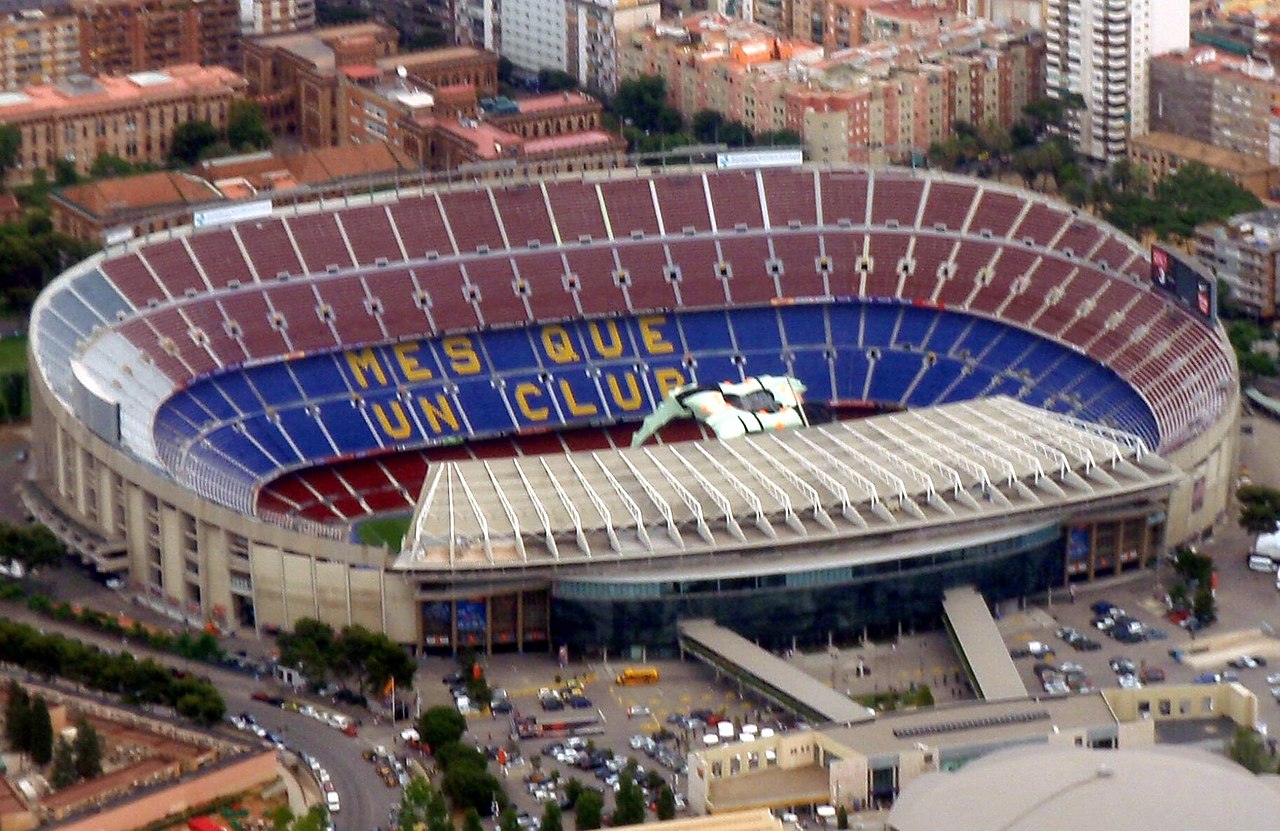
An enormous oval reinforced-concrete and glass bowl with three continuous tiers of seating encircling the rectangular grass pitch. The lower seats are blue with large yellow block letters reading 'MÉS QUE UN CLUB', while the middle and upper tiers are maroon. One main grandstand presents a broad glazed concourse and a white cantilevered roof supported by radial structural members; the exterior shows vertical concrete piers, entry ramps and surrounding mid-rise urban blocks.
Its story
The story of Camp Nou.
Miró-Sans and the 288-Million-Peseta Ground, from 1950
Camp de Les Corts had no room to expand, and on 14 November 1950 president Agustí Montal i Galobart won a members' assembly's agreement to buy land for a replacement, later exchanged with the city council for a site in Les Corts. The signing of László Kubala added impetus. Francesc Miró-Sans, made president on 14 November 1953, settled on that land, and the first stone was laid on 28 March 1954.
The architects were Francesc Mitjans (Miró-Sans's first cousin and neighbour), and Josep Soteras, working with Llorenç García-Barbón. The build was meant to take eight months against a budget of 67 million pesetas; unforeseen ground conditions dragged it out and the final bill reached 288 million. The club had counted on selling the Les Corts site to cover it, but the council took years to rezone the land, a period of economic hardship that ended only when Franco, then head of state and of government, authorised it.
From Estadio del Club de Fútbol Barcelona to Camp Nou, 1957–2001
The stadium opened on 24 September 1957, the feast of La Mercè, with a solemn mass presided over by the archbishop of Barcelona, Gregorio Modrego, Franco-regime and city dignitaries in the presidential tribune and some 90,000 people in the stands. Barcelona beat a Warsaw select side 4–2 in the opening friendly, Eulogio Martínez scoring the ground's first goal; the first competitive fixture, on 6 October 1957, ended 6–1 against Real Jaén.
The club had wanted the ground named after its founder, Joan Gamper, but the authorities of the day objected and it opened under the neutral Estadio del Club de Fútbol Barcelona. Press and supporters called it Camp Nou, 'new field', regardless, and a members' consultation in April 2001 chose that name, ratified by the assembly on 23 July 2001.
The Third Tier, the 1982 World Cup and Two European Finals, 1972–1999
In May 1972 the ground held its first European Cup Winners' Cup final, Rangers beating Dynamo Moscow 3–2. The 1982 expansion added boxes, VIP lounges, a press area and a third tier six metres shorter than the original design, taking the combined seated and standing capacity to 121,401; Barcelona's record crowd of 120,000 came on 5 March 1986, for a European Cup quarter-final against Juventus.
Camp Nou staged more 1982 World Cup matches than any of the sixteen other Spanish grounds used, opening the tournament on 13 June with Belgium beating the holders Argentina 1–0 before 95,000. Milan beat Steaua București 4–0 in the European Cup final of 24 May 1989, and two further tiers went in above the old roof-line for the 1992 Olympic football tournament, whose final Spain won 3–2 against Poland. A rebuild in 1993–94 lowered the pitch by 2.5 metres and replaced the terracing with individual seats. In the 1999 Champions League final Manchester United beat Bayern Munich with two injury-time goals, from Teddy Sheringham and Ole Gunnar Solskjær.
Papal Mass, Amnesty International and the Top 14 Final, 1982–2022
On 17 November 1982, on the occasion of being made an honorary citizen of Barcelona, Pope John Paul II celebrated mass at Camp Nou for a congregation of more than 121,500. On 10 September 1988 Amnesty International's Human Rights Now! concert brought Bruce Springsteen, Sting, Peter Gabriel and Tracy Chapman to the pitch. The French Top 14 rugby final was moved to the stadium on 24 June 2016 because the Stade de France was unavailable, being a venue for Euro 2016; the crowd of 99,124 set a record for a domestic rugby union match. Barcelona's women drew 91,553 and 91,648 in the 2022 Women's Champions League, the largest known attendances for women's football since the 1971 Women's World Cup final.
Club Property, Spotify's Name and the Limak Rebuild, 1984–2027
Camp Nou belongs to FC Barcelona and is protected as a cultural asset of Catalonia; the club museum opened on the site in 1984 and draws over 1.2 million visitors a year. Norman Foster's practice won a competition to restructure the stadium in September 2007, but the sale of the Mini Estadi training ground meant to fund it was postponed after the 2008 financial crisis, and the scheme was halted by Sandro Rosell's election as president in June 2010; in January 2014 the board opted to remodel to 105,000 rather than build anew.
Spotify bought the naming rights in 2022 and the ground was rebranded Spotify Camp Nou that July. Rebuilding began on 1 June 2023 with the Turkish group Limak Holding as main contractor, Barcelona playing meanwhile at the Estadi Olímpic Lluís Companys. The club returned on 22 November 2025, beating Athletic Bilbao 4–0 before 45,401 spectators with the third tier still closed, and on 10 March 2026 a first occupancy licence raised the permitted capacity to 62,652. Completion is now expected in 2027.
Step inside
9 places to explore in 1982.
The record describes 9 distinct spots at Camp Nou, including 7 interiors: pitch and player tunnel, lower tier: 'més que un club' section, middle tier: continuous oval stand and more. Create your own photoreal reconstruction and explore every one, more scenes means more photos, more angles and more of the immersive experience.
Build Your Own Castle
Recreate Camp Nou with AI to explore it.
Rebuilds stop at 1945, so the artist raises this site as it stood in 1945, not today's building, as a photoreal reconstruction that belongs to you alone. Pay with coins, no subscription needed.
Recreate Stadium to Explore →

Landmarks within reach of Camp Nou.


More landmarks of Spain


Explore the city


