Historic Cities · Spain
Seville through the ages
Seville is the capital and largest city of the Spanish autonomous community of Andalusia and the province of Seville. It is situated on the lower reaches of the River Guadalquivir, in the southwest of the Iberian Peninsula.

Seville in 1200
Almohad Seville
This is Seville at the height of Almohad rule: the city's great mosque now wears its new minaret and the river is guarded by a new watch-tower. The walk follows quays, gates, market lanes, the Alcázar gardens and the everyday quarters where potters, shipmen and cloth merchants move through orange-scented air.
Ishbiliyya in 1200 presents a compact medieval skyline: sun-baked mudbrick and fired-tile roofs, pale plastered walls punctured by high crenellated ramparts, the square brick-and-stone shaft of the mosque's new minaret rising above low residential roofs, and a stout river tower anchoring a guarded chain across the Guadalquivir. Streets are narrow and shadowed, courtyards bright with orange trees and glazed ceramic, and the riverfront is lined with boats and busy quays.
The route: 22 streets, squares and views
River Approach to Ishbiliyya → Torre del Oro → Ribera Quays → Puente de Barcas → Triana Potters' Quarter → Puerta de Triana → Triana Fishmarket → Riverside by the Bridge → Puerta de la Macarena → City Walls and Bastions → …
Step inside, 12 interiors
Torre del Oro Vaulted Room · Potters' Workshop · Kiln Firing Chamber · Main Prayer Hall · Sahn of Orange Trees · Covered Silk Lane · Silk Weaver's Workshop · Portico of the Orange Court · Private Chamber with Lattice · River Gate Guardroom · Hammam Steam Room · Alcázar Audience Hall
Planned from the Wikipedia record: Almohad Caliphate.
Seville in 1570
Golden Age Seville
Seville in 1570 is the commercial heart of the Spanish Empire, where the Casa de Contratación organises the Indies trade and treasure fleets ride at the Arenal. The walk follows the river quays, the cathedral with the Giralda's new belfry, the Alcázar and the tight artisan quarters where pícaros, sailors and muleteers move silver, cloth and maps through the city.
Low, dense rooflines of tile and plaster crowd around the vast bulk of the cathedral; the Giralda rises, topped by its new Renaissance belfry. Muddy riverbanks and wooden quays line the Guadalquivir, flanked by dour stone towers and timbered workshops. Whitewashed palaces and Moorish‑born courtyards sit beside narrow sunken lanes; at river level masts, canvas and the glint of merchant chests animate a skyline of spires and cranes.
The route: 22 streets, squares and views
Sanlúcar approach → Torre del Oro → El Arenal quays → Reales Atarazanas → Puente de Barcas → Puerta de Triana → Triana shipyards and potteries → Muelle de las Mulas → Lonja de Mercaderes → Casa de la Contratación → …
Step inside, 13 interiors
Arenal Ship Chandler's Yard · Great Carpenters' Hall · Santa Ana Church Nave · Potters' Kiln Workshop · Mule Warehouse and Loading Shed · Lonja Great Hall (under construction) · Casa de Contratación Map Room · Ledger and Archive Chamber · High Nave of the Cathedral · Cathedral Treasure Chamber · Ambassadors' Hall · Nave of San Salvador · Central Patio of Casa de Pilatos
Planned from the Wikipedia record: History of Seville.
Seville in 1929
Exposition Seville
Sevilla in 1929 is a city hosting the Ibero‑American Exposition, when newly built pavilions and the crescent of the Plaza de España announce Spain’s regional and overseas ties. This walk visits the exposition buildings in María Luisa Park, the newly polished Hotel Alfonso XIII and the bright ceramic work of Triana, passing flamenco cafés cantantes, busy shopping streets and the riverfront life along the Guadalquivir.
The 1929 skyline of Sevilla is low and punctured by the Giralda, pavilion towers and the Plaza de España’s semicircular brick and glazed‑ceramic façade. Exposition buildings fuse neo‑Mudéjar and regional Renaissance motifs: red brick, ornate plasterwork, cobalt and ochre azulejos, glazed ceramic benches and colonnades. The Guadalquivir brings reflected light; palm‑lined avenues and the dark foliage of María Luisa Park frame sunlit squares. Automobiles mix with horse carts; ceramic smoke and kiln heat rise across Triana’s riverfront.
The route: 25 streets, squares and views
Arenal Riverfront → Puerta de la Macarena → Torre del Oro → Avenida de la Palmera → Hotel Alfonso XIII Exterior → Plaza de España Crescent → Plaza de América → Pabellón Mudéjar → Peruvian Pavilion Grounds → Paseo de las Delicias → …
Step inside, 12 interiors
Arabesque Marble Lobby · Ceramic Colonnade and Alcoves · Hall of the Discovery of America · Mudéjar Art Salon · Peruvian Archaeology Hall · Argentine Pavilion Theatre · Covered Commercial Arcade · Cathedral Nave and Choir · Salón de Embajadores · Colonial Documents Reading Room · Café Cantante Flamenco Room · Triana Pottery Workshop and Kiln
Planned from the Wikipedia record: Ibero-American Exposition of 1929.
Its story
The story of Seville.
From Tartessian Ispal to Umayyad Išbīliya
The original core of the city, around the present Cuesta del Rosario, dates to the 8th century BC, when the site was an island in the Guadalquivir; excavations in 1999 found human remains under the north wall of the Real Alcázar from the 8th or 7th century BC. The Tartessians, who controlled the Guadalquivir valley, called the town Spal or Ispal and traded heavily with the Phoenician colonies on the coast, and Carthage had brought about the collapse of Tartessos by 530 BC. Under Rome, Hispalis was a Hispano-Roman town of craftsmen and a regional commercial hub, district capital of one of the four legal convents of the province of Baetica, while nearby Italica (founded for Scipio Africanus's veterans after his victory at Ilipa in 206 BC) remained residential and wholly Roman, and produced the emperors Trajan and Hadrian. Julius Caesar granted Hispalis colony status, and the poet Ausonius ranked it tenth among the cities of the Roman Empire.
In the 5th century the city was taken in turn by the Vandals under Gunderic in 426, the Suebi king Rechila in 441, and finally the Visigoths, under whom it was known as Spali and housed the royal residence for a time. Its bishop Leander converted Hermenegild, son of King Leuvigild, from Arianism to Catholicism; Hermenegild proclaimed himself king in the city, rebelled with Hispano-Roman noble support, and was executed in 585. Leander's brother Isidore, also bishop of the city, compiled the Etymologies, twenty encyclopaedic books that carried Greco-Roman learning through medieval Europe.
The city fell to the Muslim conquest in 712, taken by the forces of Musa bin Nusayr and his son Abd al-Aziz; by one account Musa took it in the late summer and it had to be retaken in July 713 after the Visigothic population who had fled to Beja returned. It was the seat of the governor of al-Andalus until 716, when the capital moved to Córdoba, and Hispalis became Išbīliya, which passed through the Mozarabic Ixbilia and Sivilia to the modern Sevilla. In the autumn of 844 a Viking flotilla of about eighty ships, having already attacked Asturias, Galicia and Lisbon, came up the Guadalquivir and took the city by storm, seizing hostages for ransom. While the raiders waited on an island in the river, the emir Abd ar-Rahman II assembled a force, and a pitched battle at Tablada on 11 November cost them a thousand casualties and some thirty ships; the survivors left, surrendering their plunder and the hostages.
The Abbadid Taifa and the Surrender of 1248
After the caliphate broke up, a powerful taifa emerged here from 1023 under the Abbadid dynasty, absorbing smaller neighbours and becoming an important scholarly and literary centre. Its weakness was military: a Christian raid in 1063 under Ferdinand I of Castile met little resistance, and within a few years al-Mutamid was buying peace with an annual tribute, making the city a tributary of Castile for the first time. The Almoravids took it after a siege in 1091 and the Almohads on 17 January 1147; in 1163 it became the seat of the Andalusi half of the Almohad empire, a twin capital with Marrakesh, and the Giralda minaret of the great mosque was built between 1184 and 1198. By the end of the 12th century the walled enclosure may have held 80,000 people.
Ferdinand III of Castile and León laid siege in 1247 and kept an army in the vicinity for fifteen months. The decisive stroke came in May 1248, when Ramón Bonifaz sailed up the river and severed the Triana bridge, cutting off supply from the farms of the Aljarafe. The city surrendered on 23 November 1248, and the terms of capitulation provided for the eviction of the population; contemporary accounts indicate that a mass movement of people out of the city did take place. It was resettled by the Castilian aristocracy, and as capital of the Kingdom of Seville it held a vote in the Castilian Cortes and often housed the itinerant court. Ferdinand died in the Alcázar in 1252 and was buried in the former mosque under an epitaph in Latin, Castilian, Arabic and Hebrew.
The Massacre of 1391 and the First Auto de Fe
The fourteenth century went badly: the Black Death arrived in 1348, an earthquake in 1356 killed people and badly damaged buildings including the great mosque, and the wider economic crisis compounded both. The pressure broke in the anti-Jewish revolt of 1391, incited by the sermons of Ferran Martínez, Archdeacon of Écija; the rising began here and spread across Castile and Aragon. Four thousand Jews were killed in the city, many more were forcibly converted, the Jewish quarter's houses were burned and its land and shops taken by the church, and its synagogues were seized and reconsecrated as churches. One of the largest Jewish communities in the Iberian peninsula effectively ceased to exist, and the conversos who succeeded it inherited the same role of scapegoat.
During a stay of the Catholic Monarchs in the city in 1477, Alonso de Ojeda, prior of the Dominicans and an adviser to Queen Isabella, pressed for action against the conversos; the Holy Office of the Inquisition was established in 1478 and its first tribunal sat here, charged with ensuring that nominal Christians were not practising Judaism in secret. The first auto de fe took place on 6 February 1481, when six people were burned alive and Ojeda preached the sermon. Under the Alhambra Decree all Jews in Spain were compelled to convert or leave, and the Muslim minority followed in 1502, forced into conversion as Moriscos.
The Monopoly on the Indies, from 1503
The port lay some eighty kilometres up the Guadalquivir, but the city was the largest demographic, economic and financial centre of Christian Andalusia, and its inland position offered military security and tax control. It became the port of entry and exit for all trade with the Indies by royal monopoly in 1503, when the Catholic Monarchs founded the Casa de Contratación here. Every voyage of exploration and trade had to be approved through it; the Casa levied the quinto real, a twenty per cent tax on precious metals entering Spain, and worked with the merchants' guild founded in 1543, the Consulado de Mercaderes, which held its own monopoly and kept colonial prices high. Only ships leaving from and returning to this inland port could trade with Spanish America, so merchants from across Europe had to come here to buy New World goods.
The city grew past 100,000 inhabitants, the largest and most urbanised in Spain at the time. The Casa employed the cartographers and navigators who produced and guarded the Padrón Real, the secret master chart from which the maps aboard Spanish ships were copied. About three per cent of the sixteenth-century population were Black people; competition for work was intense, they were frequently scapegoated, and they were ridiculed as buffoons in the plays of the day.
Plague, Silt and the Loss of the Trade to Cádiz
The seventeenth century brought a deep economic decline, worsened locally by the plague of 1649, which may have killed some 60,000 people out of a population of about 130,000; the population did not recover until the early nineteenth century. The Counter-Reformation filled the city with religious houses (by 1671 there were 45 monasteries and 28 convents), and in that setting the Holy Week processions took their shape, following the mandates issued at the Synod of 1604 which fixed the official route to the cathedral.
As the Guadalquivir silted up the trade left. Silting in the 1620s made the harbours harder to use and broke the monopoly in favour of Cádiz, which had funded the Bourbon claimant during the War of the Spanish Succession and was rewarded with the monopoly port. In 1717 the Bourbon administration moved the Casa de Contratación there, and Charles IV abolished it in 1790. The Archive of the Indies was established under Charles III in the old merchants' exchange to hold the documents of the overseas empire, and construction of the Royal Tobacco Factory began in 1728. Yellow fever, carried into Cádiz in July 1800 by a corvette from Havana, spread through the city within four months and killed a third of its people.
French Occupation, Railways and the Exposition of 1929
The Central Junta fled the city on 23 January 1810 as Marshal Victor's French army advanced, and the government that replaced it absconded five days later. The French vanguard was fired on when it appeared on 29 January, but the municipal corporation negotiated a surrender to avoid bloodshed, and Victor occupied the city on 1 February accompanied by Joseph Bonaparte. The French stayed until Anglo-Spanish counterattacks forced them out on 27 August 1812; Marshal Soult looted a great many works of art in the interval.
The province of Seville was created in 1833. The Ecclesiastical Confiscations of 1835–37 put church property up for national sale, intended to create a broad class of proprietors but in the event enriching a few of the nobility and bourgeoisie; the Liverpool merchant Charles Pickman bought the abandoned Carthusian monastery on the Isla de La Cartuja in 1840 and turned it into a tile and porcelain factory, which went on producing until 1982. From the second half of the century the city expanded east and south on the back of railway building and the demolition of part of its ancient walls, and the Plaza de Armas station opened in 1901. The Ibero-American Exposition, prepared from 1910, ran from 9 May 1929 to 21 June 1930, and before it opened the government put up new hotels and widened medieval streets for motor traffic.
Queipo de Llano's City, and the Andalusian Capital After It
In the municipal elections of 12 April 1931 the Republican Socialists took 57 per cent of the vote here against 39 per cent for the Monarchist coalition; Alfonso XIII went into exile and the Second Republic was proclaimed. The military had been planning a coup since February 1936, and on 18 July General Gonzalo Queipo de Llano seized control of the 2nd División Orgánica. Unions and leftist parties raised militias in the poor neighbourhoods of Triana and La Macarena, and Radio Seville called on the peasants to come in for arms, but Queipo defeated them with superior weaponry and harsh repression and took the radio station to broadcast Nationalist propaganda. Holding the city gave Franco ground to fly the Army of Africa into Andalusia. Repression between 18 July 1936 and January 1937 caused 3,028 deaths, among them the mayor, Horacio Hermoso Araujo, the former Republican mayor José González Fernández de Labandera and the president of the provincial council, José Manuel de los Santos Puelles. Around 8,000 civilians were shot by the Nationalists in the city over the course of the war.
Under Franco the city stayed economically and culturally isolated, its mayors appointed by the Minister of the Interior. On 13 March 1941 the gunpowder in the Santa Bárbara magazine at Cerro del Águila exploded, destroying ten blocks and damaging many more; the depot belonged not to the military but to the Sociedad Española de Explosivos. The shipyard opened in 1953 and employed more than 2,000 workers by the 1970s. In November 1961 the Tamarguillo overflowed and the city was declared a disaster zone. Underground trade unionism began in the 1960s through the Comisiones Obreras in factories such as Hytasa and the shipyards, and several of its leaders were imprisoned after the Process 1001 of November 1973.
Spain's first democratic municipal elections after Franco were held on 3 April 1979, and a coalition elected Luis Uruñuela as mayor. The Palace of San Telmo has housed the presidency of the Junta de Andalucía since 1989. The Universal Exposition of 1992 ran for six months on the Isla de La Cartuja and rebuilt the city's infrastructure with it, from the SE-30 ring road to the AVE high-speed line to Madrid. ETA killed the deputy mayor Alberto Jiménez-Becerril and his wife, the court attorney Ascensión García Ortiz, at their home on 30 January 1998, and the military doctor Colonel Antonio Muñoz Cariñanos in his office in October 2000. The shipyard closed in late 2011. The Alcázar, the cathedral and the General Archive of the Indies are UNESCO World Heritage Sites, and as of 2024 the foreign-born population stood at 72,990, or 10.6 per cent of the total.
From the archive
Seville on paper: the old town as it was mapped.
A period plan or bird's-eye view of the old town, drawn between 1500 and 1850, the streets this page's reconstructions walk. Public domain, with its source named.
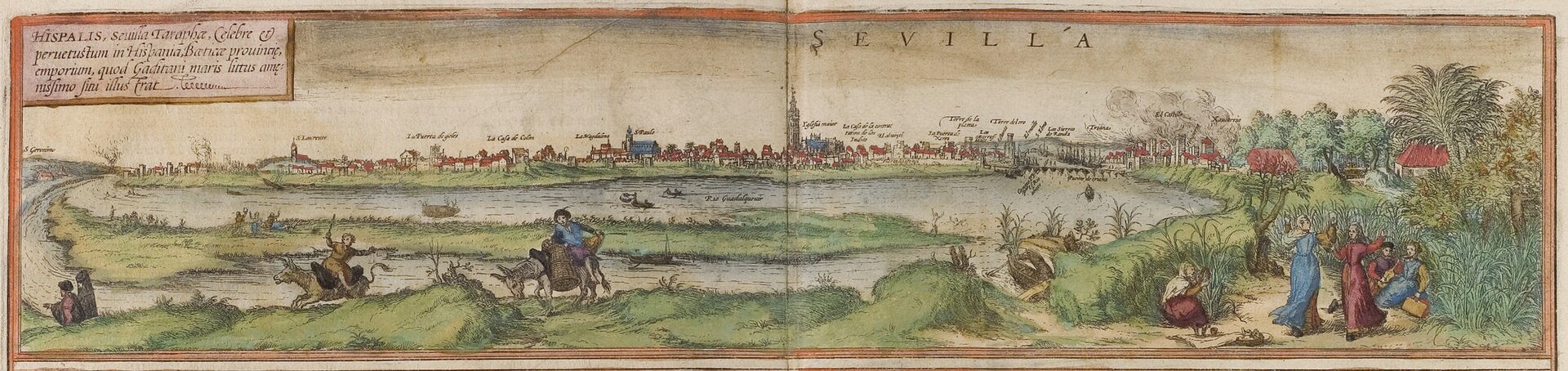
Prospect of Seville (Sevilla), from Braun & Hogenberg's Civitates Orbis Terrarum
Riverside panorama showing the Guadalquivir, Seville’s cathedral tower (Giralda), bridges and the continuous riverside urban skyline.
1572 · Georg Braun; Frans Hogenberg · Wikimedia Commons
Public domain (plate dated 1572)
In this city
Landmarks of Seville, see each in its prime


Castles of Seville


More cities to explore
 SpainRondaExplore it in 1840
 SpainCórdobaExplore it in AD 975 · 1300 · 1600
 SpainBarcelonaExplore it in 1350 · 1888 · 1915
 SpainMadridExplore it in 1630 · 1800 · 1925
Castles of Europe · Landmarks of Europe · create your own reconstruction.