Historic Cities · Spain
Ronda through the ages
Ronda is a municipality of Spain belonging to the province of Málaga, within the autonomous community of Andalusia.

Ronda in 1840
Town Above the Gorge
This is Ronda in the age of the Romantic travellers, a white town dented by a great limestone chasm and newly famed for its dramatic bridge and its old bullring. The walk moves from mule tracks on the plateau, through market streets and cliffside promenades, to the parapets that sketchers and travellers crowd to draw the Tajo and its bridges.
A compact whitewashed centre perched on a Miocene plateau, split by the hundred‑metre El Tajo gorge and threaded by narrow winding streets. Stone (local limestone and dressed ashlar of the late 18th‑century bridge and bullring) dominates bridges, façades and defensive gates; timber balconies and dark shuttered windows mark domestic fronts. Olive and almond terraces and scrubby pines surround the town, mule trains climb the dusty tracks, and travellers with sketchbooks gather at cliff‑edge viewpoints.
The route: 16 streets, squares and views
Camino de la Vega → Puerta de Almocábar → El Mercadillo → Barrio de San Francisco → Plaza del Socorro → Barrio Bajo (San Miguel) → Plaza de Toros → Puente Viejo → Baños Árabes → Puente Romano (Puente Árabe) → …
Step inside, 8 interiors
Gate Guardroom · Posada Courtyard · Arcaded Ring · Vaulted Bath Hall · Water‑Mine Stair · Mill Wheelroom · Mudéjar Courtyard · Audience Chamber
Planned from the Wikipedia record: Ronda.
Its story
The story of Ronda.
Arunda on the Plateau: Rome, the Suebi and the Visigoths
Ronda sits on the Ronda Depression, a Miocene plateau between roughly 600 and 800 metres above sea level, on land fertile enough for the Mediterranean triad of wheat, olive and vine. The site is split by a deep gorge, el Tajo, carrying the Guadalevín river. That combination made the place easy to defend and put it in a position to command the passes and roads down into Lower Andalusia, and it is why a town grew here rather than on the easier ground around it.
The city is traditionally identified with ancient Arunda, which Pliny names alongside nearby Acinipo, and it was populated under the Iberians and the Romans. Accounts of its beginnings do not agree: one tradition has Arunda growing out of existing Iberian settlement, another dates the town proper to the Second Punic War and the campaign of Scipio Africanus against the Carthaginians in Hispania, when the castle of Laurus was built and population gathered around it. In the High Imperial period Arunda was one of the main urban centres of the depression, along with Acinipo and Lacilbula.
In the fifth century the city was taken by the Suebi under Rechila. It was recovered in the following century by the Eastern Roman Empire, under whose rule Acinipo was abandoned for good, and the Visigothic king Liuvigild later captured it for his realm.
Hisn al-Rundah and the Taifa of the Banu Ifran, 713–1485
Ronda remained part of the Visigothic kingdom until 713, when it fell to Umayyad troops, who called it Hisn al-Rundah, the Castle of Rundah, and made it the capital of the province of Takurunna. It was the home town of Abbas ibn Firnas (810–887), an inventor, engineer, alleged aviator, chemist, physician, poet and musician.
After the caliphate of Córdoba broke up, Ronda became the capital of a small kingdom under the Berber Banu Ifran, the taifa of Ronda, and it was in this period that the city acquired most of its Islamic architectural heritage. In 1065 it was conquered by the taifa of Seville under Abbad II al-Mu'tadid. Two writers born in the town carried its name: the poet Abu al-Baqa ar-Rundi (1204–1285) and the Sufi scholar Ibn Abbad al-Rundi (1333–1390). The Arab baths below the town, beside the Puerta del Puente, were built at the end of the thirteenth century, where visitors were expected to purify themselves before entering the city; the Palacio de Mondragón is dated to 1314 and attributed to the ruler Abomelik.
By the late Middle Ages Ronda had settled into the role of a regional administrative centre within the Nasrid Kingdom of Granada. It was taken by force by the Crown of Castile in 1485.
Castilian Settlement and the Morisco Revolt, 1485–1570s
On its conquest Ronda was granted a fuero copying Seville's. Castile pursued a policy of settling Christians in the towns while leaving Muslim majorities in the countryside, which produced a balance of roughly 70 per cent mudéjares to 30 per cent Christian settlers across the Serranía de Ronda. Property changed hands with the conquest: the house that became the palace of the Marqués de Salvatierra was gifted to the family of Don Vasco Martín de Salvatierra by the Catholic Monarchs when they redistributed the spoils. A new quarter, the Mercadillo, was founded outside the old medina in the wake of the conquest.
In the early sixteenth century a series of edicts required mudéjares of the Crown of Castile either to leave or to convert. Among converts, the practice of taqiyya was common, and cultural and religious continuity was prevalent in the district until the Alpujarras revolt. In 1570 the decision was taken to resettle the so-called moriscos de paces, those uninvolved in the uprising, away from the Kingdom of Granada. That, together with the actions of the municipal Christian militias led by Antonio de Luna, which involved theft and enslaving, radicalised a morisco community in the Serranía that had until then been largely peaceful. Moriscos took to guerrilla warfare and banditry, using their better knowledge of the country.
The Maestranza, the Bridges and the Romeros, 1520–1839
During the War of the Communities of Castile in 1520–21 Ronda, like most Andalusian towns, stayed loyal to Charles I and sent deputies to the anti-comunero league at La Rambla, pledging 100 infantry should the province have to face the rebels in the field; friction between the town council and the corregidor was settled by the Marqués de Mondéjar. In 1572 the Real Maestranza de Caballería de Ronda was founded to train men for defence and for the kingdom's wars.
The bulk of the town as it survives took shape across the sixteenth and seventeenth centuries. The old medina became known as La Ciudad, the Espíritu Santo quarter the barrio Alto and San Miguel the barrio Bajo, while the newer San Francisco and Mercadillo quarters grew quickly and filled with inns, churches and monasteries. The eighteenth century brought the largest works: the Puente Nuevo across the Tajo, begun in 1751 and not finished until 1793, and the bullring of 1784, both by the architect José Martín de Aldehuela. The bullring belongs to the Real Maestranza.
Ronda's Romero family shaped the bullfighting that went with it. Francisco Romero was born in 1698; his son Juan and his grandson Pedro, who died in 1839, followed him. The family is credited with innovations including the use of the cape, or muleta, and a sword designed specifically for the kill, and Pedro in particular is held to have turned bullfighting into its modern form.
The French War and the Bandits It Left Behind
The Napoleonic invasion and the Peninsular War that followed hit Ronda and its sierra hard. The French demolished the Castillo del Laurel, the town's alcazaba, as they withdrew; mills and crops were ruined and the district left in a precarious state. The town was subject to heavy taxes and daily requisitions of food, industrial and livestock output fell to less than half and a third respectively, and a third of the market gardens went to ruin because so many rondeños had gone into the mountains to fight. The population fell from 15,600 to 5,000 in three years.
The banditry the Serranía became known for grew directly out of that. Guerrilla bands formed to fight the invaders, and when the war left them without means of subsistence they turned to robbery on the roads and to smuggling goods from Gibraltar. Romantic travellers made the most of it: Washington Irving, Prosper Mérimée, Richard Ford and Gustave Doré all took Ronda as a subject, mixing what had happened with what they invented.
The Railway, the Phylloxera and the Assembly of Ronda
Through the nineteenth century Ronda's economy stayed mainly agricultural, the town serving as the meeting point for the villages of the Serranía. The Bobadilla–Algeciras line reached it in 1890, and the single-track railway between Ronda and Algeciras was built between 1890 and 1892 by the Algeciras Gibraltar Railway Company, the work of the engineer James Morrison in partnership with the financier Alexander Henderson, later 1st Baron Faringdon; it allowed British military officers to get away from the summer heat of Gibraltar. Ronda station opened in 1892. Vine growing, long established here on the evidence of local place names, was all but wiped out at the end of the nineteenth century by phylloxera, and only revived much later, with production rising markedly from 2004.
In 1918 the Assembly of Ronda met in the Casino, the Círculo de Artistas on the Plaza del Socorro, and fixed the design of the Andalusian flag, coat of arms and anthem; it was there that Blas Infante showed the flag and arms for the first time. Around the same period the Caja de Ahorros de Ronda began to consolidate, and it drove the local economy until 1990, when it disappeared into Unicaja through merger.
1936, the Executions, and the Town Since
The military coup of July 1936 failed in Ronda and the town stayed loyal to the Republic. The carabineros opposed the plotters while the Guardia Civil stood aside, and after an exchange of fire between the rebel Falangist officers and a population that made common cause with the carabineros, the rebels were arrested on the mayor's orders. The capture of Ubrique, the discovery of blacklists naming hundreds of militants to be killed once the rebels took the town, and the uncovering of a plot by which the prisoners would help Falangist troops in an assault, together set off a series of executions. Estimates put the number shot at 317, most of them bankers, aristocrats and others aligned with the rebels, among them the philosophy teacher Joaquín Amigo, a friend of García Lorca. The figure is hard to establish, given both the controversy and the propaganda of the dictatorship that followed. The scene in chapter 10 of Hemingway's For Whom the Bell Tolls, in which Nationalist sympathisers in a fictional village are thrown from a cliff, is considered to be modelled on what happened in Ronda.
After the war the town went through a demographic crisis caused by the devastation of the district, the collapse of its economy, political repression and emigration; population recovery began in the late 1940s. Ronda is today a municipality of Málaga Province, head of its own judicial district, which covers the town and 22 other municipalities, and capital of the comarca of the Serranía de Ronda. Serrato and Montecorto, formerly hamlets of Ronda and autonomous local entities from 1999 and 2002, became independent municipalities in 2014. The registered population was 33,671 in 2025. The economy now rests largely on cultural and rural tourism, with agri-food and furniture industries alongside it, and the municipality forms part of the Sierra de las Nieves National Park.
From the archive
Ronda on paper: the old town as it was mapped.
A period plan or bird's-eye view of the old town, drawn between 1500 and 1850, the streets this page's reconstructions walk. Public domain, with its source named.
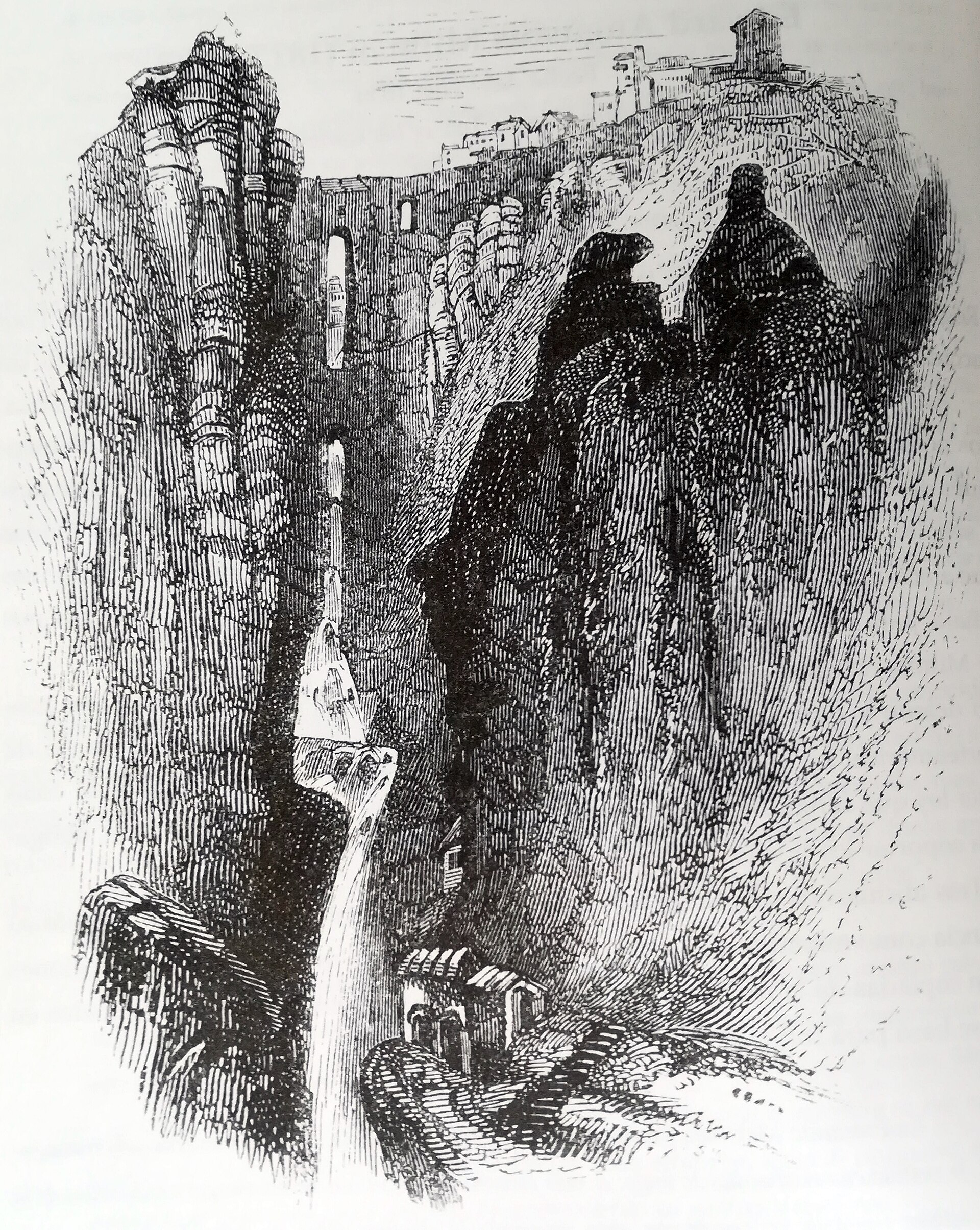
The Puente Nuevo and the Tajo of Ronda
The bridge fills the gorge in stacked tiers, the town's houses crowding the cliff edge above and the mills of the Guadalevín in the shadow at the bottom of the cut.
1847 · The Wayside Cross: A Tale of the Carlist War · Wikimedia Commons
Public domain (plate dated 1847)

More cities to explore
 SpainSevilleExplore it in 1200 · 1570 · 1929
 SpainCórdobaExplore it in AD 975 · 1300 · 1600
 SpainBarcelonaExplore it in 1350 · 1888 · 1915
 SpainMadridExplore it in 1630 · 1800 · 1925
Castles of Europe · Landmarks of Europe · create your own reconstruction.