Historic Cities · Spain
Córdoba through the ages
Córdoba, or sometimes Cordova, is a city in Andalusia, Spain, and the capital of the province of Córdoba. With a population of 324,902 as of 2024, it is the 12th-largest city in Spain and the 3rd-largest in Andalusia.

Córdoba in AD 975
Caliphal Córdoba
This is Córdoba at the height of the Umayyad caliphate under Al-Hakam II, a centre of learning, craft and riverside commerce whose palaces and a newly adorned mosque mark its power. The walk moves from the Guadalquivir's banks through the city's markets, workshops and gates to the river, the caliphal Alcázar and the terraces of Madinat al-Zahra on the western hill.
Stone city walls and timber-framed houses cluster along the wide sweep of the Guadalquivir, punctuated by the long span of the Roman bridge and creaking wooden waterwheels. The Great Mosque presents a broad, sunlit courtyard and a forest of columns behind plain outer walls; caliphal palaces and Madinat al-Zahra shine with marble, carved stucco and colored tile. Narrow lanes and shaded arcades host crowded markets, mule trains, potters' kilns and book-sellers' doorways, all under hard Andalusian light.
The route: 22 streets, squares and views
Guadalquivir Approach → Roman Bridge → Albolafia Waterwheel → Bridge Gate → City Walls → Caliphal Alcázar → Great Mosque Courtyard → Medina Main Street → Jewish Quarter → Royal Silk Market → …
Step inside, 12 interiors
Millworks Beneath the Wheel · Caliphal Audience Hall · Hypostyle Prayer Hall · Mihrab Chamber · Silk Weavers' Hall · Leather Sheds · Potters' Kiln Workshop · Caliphal Library · Scribes' Copying Room · Warm Bath Hall · Pavilion Courtyard · Golden Salon
Planned from the Wikipedia record: Umayyad state of Córdoba.
Córdoba in 1300
Mudéjar Córdoba
Córdoba in 1300 is a recently-Castilian, Mudéjar city reshaped after the Christian conquest of 1236: the great mosque stands as a Christian cathedral while neighbourhoods still hold Andalusi craftsmen, markets and narrow courtyards. The walk moves from the Guadalquivir and Roman bridge into the dense medina, past fortress walls and parish churches, through potters' and tanners' quarters and up to a broad vantage over the walled city.
The skyline is a tangle of low, whitewashed houses and clay-tile roofs threaded by narrow shaded streets and courtyards. Stone and brick walls, ochre Roman masonry and the red-and-white voussoirs of the mosque's arcades punctuate the city, while a squat bell-tower rises near the mosque. The Guadalquivir and the Roman bridge anchor the south; gates, defensive towers and clustered parish church belfries mark a compact medieval city whose streets still smell of leather, smoke and wet clay.
The route: 21 streets, squares and views
Fields of the Guadalquivir → Roman Bridge (Puente Romano) → Torre de la Calahorra → Puerta del Puente → South Ribera Quay → Alcázar (exterior) → Alcázar Gardens (Terraces) → Puerta de Almodóvar → Judería Entrance → Calleja de las Flores → …
Step inside, 14 interiors
Bridge Chapel · Calahorra Guard Chamber · Alcázar Bathhouse · Audience Hall · Royal Chapel · Hypostyle Prayer Hall · Inn at the Potro · Cordwainer's Workshop · Covered Market Hall · Potter's Workshop · Tanner's Workhall · Parish Nave · San Lorenzo Nave · Gatehouse Guardroom
Planned from the Wikipedia record: Córdoba, Spain.
Córdoba in 1600
Golden Age Córdoba
Córdoba in 1600 is the post‑Golden Age city of whitewashed houses, narrow guild streets and the great former mosque now wearing a new cathedral within it. Walkers will see the Mezquita’s crucero rising above the forest of horseshoe arches, the first geometry of Plaza de la Corredera, lanes of silversmiths and countless private patios with wells and orange trees.
Low terracotta roofs and whitewashed façades crowd a compact medieval plan, pierced by chimneys and filigreed iron balconies. The Mezquita‑Catedral’s red‑and‑white arches and column forest dominate the skyline, with a Baroque crucero and bell tower projecting from the mosque roof: stone and brick, carved capitals and glazed tile. Narrow, shaded lanes open into sunlit patios of citrus and wells; the Guadalquivir and the Roman Bridge edge the city with mills and riverside gardens.
The route: 20 streets, squares and views
Madinat al‑Zahra Ruins → Ribera del Guadalquivir → Puente Romano → Puerta del Puente → Alcázar Exterior Bastions → Posada del Potro Yard → Plaza de la Corredera → Calle de la Feria → La Judería → Calleja de las Flores → …
Step inside, 12 interiors
Palatial Audience Hall Ruins · Riverside Merchant Warehouse · Bridge Gate Guardroom · Alcázar Great Hall · Posada del Potro Inner Yard · Tavern Overlooking the Square · Weaver's House Workshop · Whitewashed House Patio · Patio of the Orange Trees · Crucero Baroque Vault · Silversmith's Workshop · Warm Room of the Baths
Planned from the Wikipedia record: Córdoba, Spain.
Its story
The story of Córdoba.
Corduba, Capital of Baetica
There were settlements on the hill of Los Quemados from the third millennium BC and pre-urban communities along the Guadalquivir from the eighth century BC, but Córdoba as a town was a Roman foundation. In 169 BC, some historians argue 152 BC, the consul Marcus Claudius Marcellus established a new settlement alongside the existing one, placed to control the passage between Turdetania and the Meseta, and populated it with patrician families brought from Italy and belonging to the Turdetanian nobility. It grew on the mining of the Sierra Morena, sheep farming on the campiña and the export of olive oil. Between 143 and 141 BC it was besieged by Viriatus, and a forum existed by 113 BC.
Its position made it the base of Roman operations in Hispania Ulterior, and it played a considerable part in the Roman civil wars of the first century BC. In the war between Caesar and Pompey the town was divided, though Pompey's party appears to have been the larger, and after the battle of Munda on 17 March 45 BC it became the refuge of the defeated Pompeians. Caesar's troops took it that August after a siege of four months and put some 22,000 of Pompey's supporters to the sword. The city was then razed and refounded with Roman citizens brought from Italy as Colonia Patricia Corduba, its free inhabitants made Roman citizens.
Augustus resettled it with veteran soldiers and extended the republican perimeter to the bank of the Guadalquivir, and under the provincial division of 27 BC Corduba became the capital of Baetica, reaching perhaps 50,000 inhabitants. It was the main centre of Roman intellectual life in Hispania Ulterior: the orator Seneca the Elder, the philosopher Seneca the Younger and the poet Lucan all came from the city. Through the earlier fourth century Hosius of Corduba was the dominant figure of the Latin Church. Corduba held an important place in the Byzantine province of Hispania between 552 and 572, and the Visigoths took it in the late sixth century.
Qurṭuba: Emirate and Caliphate, 711–1002
The city was captured by the Muslims in 711 or 712. Unlike other Iberian towns no capitulation was signed; the place was taken by storm and put under direct Arab rule. In 716 it replaced Seville as the provincial capital, subordinate to the caliphate at Damascus, and was known in Arabic as Qurṭuba. The centre of the Roman and Visigothic city became the walled medina, and as many as 21 suburbs grew up around it. In 747 the Battle of Saqunda was fought in the surroundings, setting Arab Yemenites against northern Qays. After the Abbasids overthrew the Umayyad caliphate in 750, the surviving Umayyad Abd ar-Rahman crossed to the peninsula, defeated the sitting governor Yusuf al-Fihri outside the city in May 756 and proclaimed himself emir. In 785–786 he ordered the building of the Great Mosque, finished the following year and enlarged by his successors.
Abd ar-Rahman III came to power as emir in 912 after a period of weak central rule and campaigned systematically to re-impose Córdoba's authority across al-Andalus. In 929 he declared himself caliph, a title that challenged both the Abbasids in Baghdad and the Fatimids in North Africa. Two palatine cities were raised outside the walls that century: Madīnat al-Zahrā to the west, built by Abd ar-Rahman III, and Medina Alzahira to the east, built later by al-Mansur. Population estimates vary wildly (75,000 to 160,000 for the ninth century, and anything from 100,000 to a million for the year 1000), but by the tenth century the city had grown to be the second-largest in Europe.
The city manufactured leather, metalwork, glazed tiles and textiles, and its countryside produced fruit, vegetables, herbs and spices along with cotton, flax and silk. It held more than 80 libraries and institutions of learning, and its knowledge of medicine, mathematics, astronomy and botany far exceeded the rest of Europe at the time. That record was not unbroken. The revolt of 818 in the southern suburb was repressed so ruthlessly that the suburb was destroyed; the vizier al-Mansur, de facto ruler of al-Andalus from 976 to 1002, burned most of the philosophy books in the library of Caliph al-Hakam II to appease the Maliki jurists, and most of the remainder were sold off or perished in the civil strife that followed. Córdoba had substantial Christian and Jewish communities, among them the statesman and physician Hasdai ibn Shaprut, but they dwindled over time under repression by the Muslim authorities.
The Fitna and the Taifa, 1009–1233
On 15 February 1009, with Hisham II as caliph and Abd al-Rahman Sanchuelo as hajib and effective ruler, a revolution in Córdoba proclaimed a rival caliph and began the long civil conflict in al-Andalus known as the Fitna. Berbers entered and sacked the city in May 1013. Hisham III was driven out on 30 November 1031 and an oligarchic republic replaced the caliphate. Under the Banu Yahwar, Cordoban power reached barely beyond the walls while independent polities took the rest of the former caliphate; one estimate puts the eleventh-century population at 65,000.
In 1070 forces from the Abbadid taifa of Seville entered the city to help defend it against al-Mamun of Toledo, then seized control themselves and drove the last taifa ruler, Abd al-Malik, into exile. Al-Mamun did not give up: using a Sevillian renegade who murdered the Abbadid governor, he entered the city in triumph on 15 February 1075 and died there barely five months later, apparently poisoned. The Almoravids took Córdoba by force in March 1091, and in 1121 the population revolted against the abuses of their governor. Between 1158 and 1160 the Wolf King, Ibn Mardanīsh, allied with Alfonso VIII of Castile, besieged the city and ravaged its surroundings without taking it.
The Almohad caliph Abdallah al-Adil appointed al-Bayyasi governor in 1224, after which the city broke from caliphal rule; al-Bayyasi asked Ferdinand III of Castile for help and Córdoba revolted against him. In 1229 it submitted to Ibn Hud, disavowed him in 1233 and went over to Muhammad Ibn al-Aḥmar of Arjona, soon to be emir of Granada.
Ferdinand III and the Fuero of 1241
Ferdinand III entered Córdoba on 29 June 1236 after a siege of several months; Arab accounts date the fall to 23 Shawwal 633, a day later than the Christian tradition. The mosque was converted into a Catholic cathedral dedicated to the Virgin Mary. The church bells that al-Mansur had looted from Santiago de Compostela and had carried to Córdoba by Christian prisoners of war in the late tenth century were returned.
In 1241 Ferdinand granted the city a fuero, drawn from the Liber Iudiciorum and the customs of Toledo but formulated in an original way, and ordered that its council should have a seal of its own. The city was divided into 14 colaciones and filled with new church buildings. The Kingdom of Córdoba was unusual within the Crown of Castile in having almost no royal-demesne council towns beyond the capital itself, and the military orders held comparatively little there. The land belonging to the council of Córdoba peaked at about 12,000 square kilometres by the end of the thirteenth century, falling to some 9,000 by the end of the Middle Ages as new lordships were carved out of it.
The frontier stayed close. The countryside was raided during the Marinid expedition of 1277–78, and in 1282, during the disputed succession to Alfonso X, an army of his supporters with Marinid forces besieged the city for 21 days while prince Sancho was inside; the council had joined a brotherhood formed that year with other councils of the upper Guadalquivir in defence of Sancho's claim. In 1368, during the Castilian civil war, the city held for the Trastámara side and was attacked by supporters of Peter I with Granadan backing. The synagogue in the old Jewish quarter was built in 1315.
Cloth, Stagnation and the Railway, 1530–1866
Córdoba had a golden age between 1530 and 1580, living on the trade in agricultural produce and the making up of cloth brought from Los Pedroches, and reaching a population of about 50,000 by 1571. Stagnation and then decline followed, and by the eighteenth century the city was down to 20,000 inhabitants. Neither population nor economy began to grow again until the early twentieth century.
The railway reached the city in the second half of the nineteenth century, with the Seville–Córdoba line opening on 2 June 1859. Connections followed to Jerez and Cádiz in 1861 and, by way of the link to Manzanares, to Madrid in 1866; lines to Málaga and Belmez came later.
The Coup of 18 July 1936 and the Repression
On 18 July 1936 the military governor of the province, Colonel Ciriaco Cascajo, launched the Nationalist coup in Córdoba, bombing the civil government building and arresting the civil governor, Rodríguez de León. Following the orders of General Queipo de Llano he declared a state of war. The political and social representatives who had gathered in the civil government headquarters resisted until Nationalist rifle fire and the presence of artillery broke their morale; as the defenders began to flee the building, Rodríguez de León surrendered and was arrested.
In the weeks that followed, Queipo de Llano and Major Bruno Ibañez carried out a repression in which 2,000 people were executed. The Francoist repression in the province during the war and the years immediately after it, from 1936 to 1951, is estimated to have caused around 9,579 killings.
Four UNESCO Inscriptions, 1984 to 2018
The Mosque-Cathedral was declared a UNESCO World Heritage Site in 1984, and in 1994 the inscription was extended to the whole historic centre, one of the largest in Europe at 246.73 hectares. The Festival de los Patios was recognised as Intangible Cultural Heritage in December 2012, and the palatine city of Madīnat al-Zahrā outside the built-up area was inscribed in July 2018, giving Córdoba four separate UNESCO inscriptions, more than anywhere else in the world.
The city is the capital of Córdoba province and, with 324,902 inhabitants in 2024, the twelfth-largest in Spain and the third-largest in Andalusia. Foreign-born residents numbered 19,432 in that year, six per cent of the total.
From the archive
Córdoba on paper: the old town as it was mapped.
A period plan or bird's-eye view of the old town, drawn between 1500 and 1850, the streets this page's reconstructions walk. Public domain, with its source named.
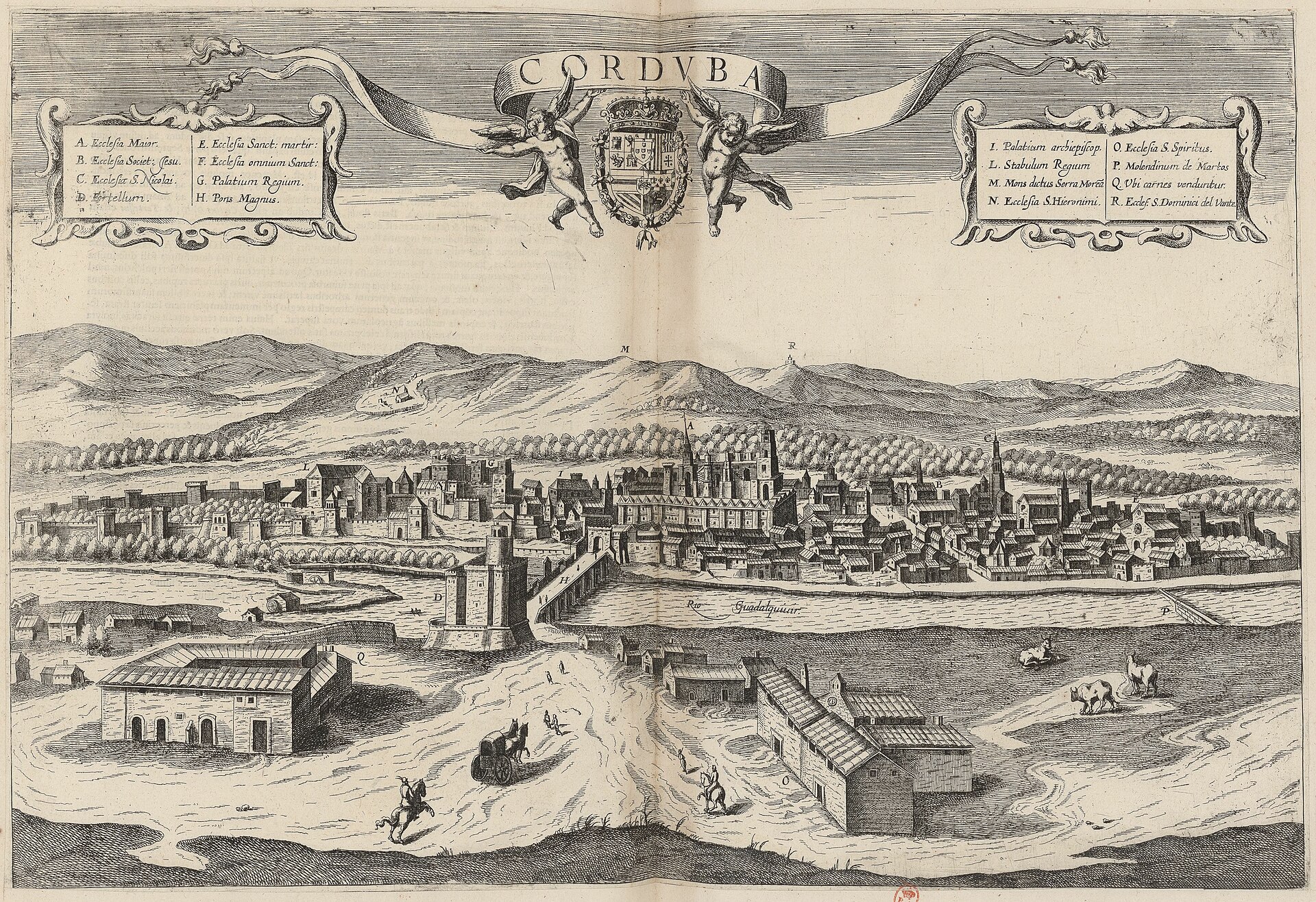
Bird's-eye view of Cordvba (Córdoba), from Braun & Hogenberg's Civitates Orbis Terrarum
Shows Córdoba's walled old town, the Guadalquivir with its medieval bridge, city gates, clustered streets and the prominent cathedral–mezquita.
1635 · Wikimedia Commons
Public domain (plate dated 1635)

Castles of Córdoba

More cities to explore
 SpainSevilleExplore it in 1200 · 1570 · 1929
 SpainGranadaExplore it in 1480 · 1620 · 1830
 SpainBarcelonaExplore it in 1350 · 1888 · 1915
 SpainMadridExplore it in 1630 · 1800 · 1925
Castles of Europe · Landmarks of Europe · create your own reconstruction.