Historic Cities · Spain
Granada through the ages
Granada is the capital city of the province of Granada, in the autonomous community of Andalusia, Spain. Granada is located at the foot of the Sierra Nevada mountains, at the confluence of four rivers, the Darro, the Genil, the Monachil and the Beiro.

Granada in 1480
Nasrid Granada
This is Ġarnāṭa at the late Nasrid court: a shrinking independent emirate whose capital still concentrates courtly refinement and urban working life beneath the Alhambra. The walk moves from the Vega approach through the medina's markets, madrasa and silk exchange, along the Darro and up the Sabika to the palace terraces and irrigated gardens fed by Sierra Nevada snowmelt.
A compact skyline dominated by the reddish mass of the al-Qal'a al-Hamra on Sabika hill, crenellated towers, and the watch-tower silhouette of the Torre de la Vela; below it a tangle of whitewashed houses climbing the Albaicín, narrow streets carved into the slope, and the dark green ribbons of irrigated gardens and acequias. Streets are paved in stone or packed earth, river bridges low and arched, and the pale Sierra Nevada hangs nearby, its meltwaters brightening channels and fountains throughout the city.
The route: 22 streets, squares and views
Vega of Granada → Puerta de Elvira → Calle Elvira → Plaza Bib-Rambla → Alcaicería (Silk Exchange) → Madraza of Yusuf I → Corral del Carbón → Great Mosque (al-Jamīʿa) → Puente del Aljibillo → Carrera del Darro → …
Step inside, 15 interiors
Gate Guard Chamber · Silk Exchange Hall · Madrasa Study Hall · Merchant Courtyard · Great Mosque Prayer Hall · Bridge Arch Room · Riverside Hammam Hall · Mill Wheel Room · Casa del Chapiz Hall · Dar al-Horra Chamber · Acequia Control Chamber · Water Stair · Hall of the Acequia · Court of the Lions · Comares Hall
Planned from the Wikipedia record: Emirate of Granada.
Granada in 1620
Morisco Granada
Granada in 1620 is a city remade after the Christian conquest and the recent expulsions of the Moriscos, where a new Renaissance cathedral rises on the old mosque's site and Charles V's round palace sits within the Alhambra. Visitors will see Nasrid walls and gardens, whitewashed Albaicín lanes, emptied workshops in places, and the Alhambra's towers against the Sierra Nevada.
The skyline is a layering of Nasrid fortresses, Renaissance stone, clustered white houses and tall cypress groves, set against the snowy flanks of the Sierra Nevada. Streets are narrow, often paved with worn stone; many façades are stuccoed and whitewashed, while palaces and churches use warm Renaissance ashlar. The Darro runs under houses with bowing wooden balconies, and formal gardens and orange trees punctuate the higher slopes.
The route: 24 streets, squares and views
Vega approach to Granada → Puerta de Elvira → Calle Elvira → Corral del Carbón → Plaza de Bib-Rambla → Alcaicería → Arco de las Pesas → Cathedral of Granada → Capilla Real → Carrera del Darro → …
Step inside, 13 interiors
Caravanserai Great Hall · Meat Market Hall · Silken Bazaar Hall · White Rotunda · Royal Funerary Chapel · Riverside Merchant's Hall · Hammam Hot Room · Scholars' Courtyard · Bridge Cistern Chamber · Walled Garden Loggia · Circular Renaissance Courtyard · Hall of Ambassadors · Vigil Chamber
Planned from the Wikipedia record: Granada.
Granada in 1830
Romantic Granada
Granada in 1830 sits beneath the half‑ruined terraces and towers of the Alhambra, recently reawakened in European taste by visitors such as Washington Irving. This walk moves from the Vega plain into the medieval streets, along the Darro river, up into the Albaicín and the Sacromonte caves, where travellers sketch crumbling stucco, gypsy life gathers, and moonlight dramatizes ruined courts.
The city presents a serried roofscape of red clay tiles and whitewashed houses climbing a steep ridge, with the ochre stone of the Alhambra and its cedar groves crowning the hill. Narrow, shadowed alleys open onto small sunlit plazas; the Darro runs in a stone channel under little bridges. Outside the walls, the Vega plain is green with orchards; in the hills, Sacromonte caves and abbey ruins punctuate ochre slopes beneath a sharp southern light or cool moonlight.
The route: 25 streets, squares and views
La Vega → Puerta de Elvira → Calle Elvira → Plaza Bib‑Rambla → Alcaicería → Plaza Nueva → Granada Cathedral → Royal Chapel → Realejo Quarter → Corral del Carbón → …
Step inside, 12 interiors
Coppersmith's Workshop · Alcaiceria Weaver's Stall · Inn Parlor at Plaza Nueva · Cathedral Nave under Light · Merchant Caravanserai Hall · Bañuelo Warm Bath Chamber · Generalife Summer Hall · Torre de la Vela Chamber · Irving's Alhambra Apartment · Fallen-Tiled Court · Sacromonte Cave Dwelling · Abadia Vaulted Crypt
Planned from the Wikipedia record: Tales of the Alhambra.
Its story
The story of Granada.
From Ilturir to Ġarnāṭa: the City that Moved Uphill
The oldest ruins in the area belong to an oppidum called Ilturir, founded by the Iberian Bastetani around 650 BC and later known as Iliberri. Iliberis became a Roman colony in 44 BC and a municipium named Florentia Iliberritana in 27 BC. Whether the present city stands in direct continuity with the Roman town has long been debated, though digs on the Albaicín hill have uncovered a substantial Roman settlement there. Very little is known of the place between the end of Roman rule and the eleventh century. The Christian Synod of Elvira met somewhere in this region around AD 300 (Elvira derives from Iliberri), but no archaeological or documentary evidence fixes where.
After the Umayyad conquest that began in 711, the principal town of the district was Madīnat Ilbīra, on the southern slopes of the Sierra de Elvira, settled after 743 by soldiers from Syria who had backed Abd al-Rahman I. Ġarnāṭa was then only a smaller settlement and fortress on the south side of the Darro, on or near the site of the Albaicín; its population was mainly Jewish, and it was known as Gharnāṭat al-Yahūd, Gharnāṭa of the Jews. When the Caliphate of Córdoba collapsed after 1009 and the Fitna began, the Zirid leader Zawi ben Ziri (whom Arab chroniclers such as al-Idrisi treat as the city's founder) made himself an independent kingdom here. Ilbīra sat on a low plain and was hard to defend, so he moved his residence to the higher ground of Ġarnāṭa; Ilbīra was razed during the Fitna and never rebuilt on its old site. Within a short time the former Jewish town had become one of the major cities of al-Andalus; until the eleventh century it had a mixed population of Christians, Muslims and Jews.
Samuel ha-Nagid and the Massacre of 1066
Under the Zirid kings Habbus ibn Maksan and Badis, the most powerful figure in Granada was a Jewish administrator known in Hebrew as Samuel ha-Nagid and in Arabic as Isma'il ibn Nagrilla, an educated member of the old Cordoban elite who had fled that city when the Fitna broke out. Habbus appointed him his secretary in 1020 and gave him charge of much of the administration, including tax collection; under Badis he also took command of the army, the Muslim king being by then largely a symbolic figure. Daniel Eisenberg describes Granada between 1027 and 1066 as a powerful Jewish state at the peak of Sephardi civilisation, in which Jews did not hold the dhimmi status usual under Islamic rule and Samuel was king in all but name; he notes that Samuel's fortifying of the city is said to be what later allowed it to survive as the last Islamic state in the peninsula. Moses Ibn Ezra was from Granada and hosted Judah ha-Levi there for several years, and Ibn Gabirol's patrons were Samuel and his son Joseph.
Joseph succeeded to his father's position but lacked his diplomacy, and the 1066 Granada massacre followed. It ended the golden age of Jewish culture in Spain.
Zirid Walls, Almoravid Capital, Almohad Decline
The Zirids built their citadel and palace, the al-Qaṣaba al-Qadīma or Old Citadel, on the hill the Albaicín now occupies, linked to two smaller forts on the Sabika hill, where the Alhambra would later stand, and on Mauror to the south. Through the eleventh century the city spread across the Albaicín, the Sabika, the Mauror and part of the plain below, and was walled to enclose roughly 75 hectares.
From the late eleventh century al-Andalus was ruled by two successive Berber empires from North Africa: the Almoravids took Granada in 1090 and the Almohads in 1166. Granada served as an administrative capital of Almoravid rule in al-Andalus, and the artistic and archaeological remains suggest the city thrived under the Almoravids and declined under the Almohads. The Alcázar Genil, built in 1218–1219, survives from Almohad Granada.
Tribute, Silk and Refugees: the Nasrid Emirate after 1228
When Idris al-Ma'mun, the last effective Almohad ruler in the peninsula, left Iberia in 1228, local leaders emerged across a collapsing al-Andalus while Castile and Aragon pressed south; Córdoba fell in 1236, Seville in 1248. Ibn al-Ahmar, Muhammad I, founded in Granada the Nasrid dynasty, the last and longest-reigning Muslim dynasty in Iberia. He aligned himself repeatedly with Ferdinand III and in 1246 agreed to become his vassal, making the emirate a tributary of Castile, a relationship broken often by war, and complicated by Nasrid emirs sheltering Castilian noblemen and Castilian kings sheltering rival Nasrids. Marinid intervention from North Africa on the emirate's behalf ended after the battle of Río Salado in 1340.
The emirate's population was swollen by Muslim refugees from the territories Castile and Aragon had taken, leaving a small, densely populated and more uniformly Muslim and Arabic-speaking state. The city grew new quarters accordingly: the Albaicín is named for refugees from Baeza and the Antequeruela for those who came from Antequera after 1410. A new line of walls went up to the north in the thirteenth and fourteenth centuries, entered from the west through Bāb Ilbīrah, the Puerta de Elvira, with a large Muslim cemetery outside it. The Great Mosque stood where the cathedral now does, beside the commercial district called the qaysariyya, the Alcaicería. The Madrasa al-Yusufiyya, founded in 1349, was the only major madrasa built in al-Andalus; the caravanserai al-Funduq al-Jadida, now the Corral del Carbón, dates from the early fourteenth century, and the Maristan hospital was built in 1365–1367 and demolished in 1843.
Because the tribute owed to Castile was heavy, the economy specialised in high-value goods. The kingdom's ports traded intensely with the Genoese, and also with Catalans, Venetians, Florentines and Portuguese, while inland routes connected Granada to Muslim and Arab trading centres, particularly for gold out of the Maghreb and sub-Saharan Africa; the city exported silk and dried fruit grown in its own vega. Ibn al-Ahmar had moved the royal residence from the old Zirid citadel across to the Sabika hill, beginning the Alhambra, which functioned as a self-contained palace-city with its own mosque, hammams, fortress and quarters for workers and servants; the Comares Palace and the Palace of the Lions belong to the reigns of Yusuf I and his son Muhammad V. Ibn Khaldun and Ibn al-Khatib both served at the Nasrid court. Ibn Battuta, who visited in 1350, described a powerful and self-sufficient kingdom perpetually skirmishing with Castile, and called Granada the metropolis of Andalusia and the bride of its cities.
Surrender, the Alhambra Decree and Forced Baptism, 1492–1501
On 2 January 1492, at the close of the Granada War, Emir Muhammad XI (Boabdil to the Spanish) surrendered the emirate to Ferdinand II of Aragon and Isabella I of Castile. The Treaty of Granada, agreed at the end of 1491, expressly allowed the Muslim inhabitants, the mudéjares, to go on practising their faith and customs, as Castilian conquests had generally permitted since Toledo in the eleventh century. The treaty pressed the city's Jewish inhabitants, then 110 households, to convert or leave within three years; that clause was overtaken within months by the Alhambra Decree of 31 March 1492, which required all Jews in Spain to convert or be expelled within four months. Those who converted were known as conversos. As this and other guarantees of the surrender were eroded through the 1490s, many of the city's wealthier Muslims and its old ruling class emigrated to North Africa, though these early departures numbered only a few thousand; the rest could not afford to go.
By 1499 Cardinal Francisco Jiménez de Cisneros, impatient with the slow conversion work of Granada's first archbishop, Hernando de Talavera, began a programme of forced baptisms in direct violation of the treaty. It provoked the Rebellion of the Alpujarras, which lasted into 1500 in Granada and until 1501 in the mountains south-east of the city. In response the Crown of Castile rescinded the Treaty of Granada altogether and ordered the city's Muslims to convert or emigrate. More of the remaining Muslim elite left for North Africa; the majority converted, becoming the moriscos, in order to stay. Both converted populations were subject to persecution, execution or exile, and both contained groups who kept their original religion in secret; conversos accused of crypto-Judaism were called marranos.
A Castilian City: from the Charter of 1500 to the Morisco Expulsions
Granada's town council was not fully constituted until the Constitutive Charter of 23 September 1500, almost nine years after the conquest. It became a crucible for Old Christian and converted morisco elites, with sharp factionalism from 1508 onwards, and it was joined by a set of new institutions: the Cathedral Cabildo, the Captaincy-General, the Royal Chapel and the Royal Chancellery. For the rest of the sixteenth century roughly 40 per cent of the ruling oligarchy were conversos of Jewish descent and about 31 per cent hidalgos. Immigrants arrived from across Castile drawn by the prospects of a newly conquered city, and the balance of the population shifted fast: at the surrender in 1492 Granada held 50,000 people and only a handful of Christians, mostly captives, but the first royal census in 1561 counted over 30,000 Christian incomers against about 15,000 moriscos. The first churches were installed in converted mosques; most of the remaining mosques were converted during and after the mass conversions of 1500, and from the 1520s the mosque buildings themselves began to be pulled down and replaced with churches, a process that ran for most of the century. In 1531 Charles V founded the University of Granada on the site of the madrasa built by Yusuf I.
In December 1568, during renewed persecution of the moriscos, the Second Morisco Rebellion broke out in the Alpujarras. The city's own morisco population played little part in it, but Philip II ordered the expulsion of the great majority of moriscos from the Kingdom of Granada, exempting only artisans and professionals judged essential to the economy, and dispersed those expelled to other cities of the Crown of Castile. The final expulsion of all moriscos from Castile and Aragon was carried out between 1609 and 1614.
Stagnation, the Mined Alhambra and the Tourist City
Granada's seventeenth century was flat. Despite continued immigration the city's population stuck at around 55,000, in line with the demographic disaster across the Crown of Castile, while the countryside of the kingdom (where the expulsion of the moriscos had cut far deeper) recovered and grew. Seville and the capital, Madrid, overshadowed it. Granada remained the capital of the Castilian kingdom of Granada, by then a purely territorial jurisdiction, until the provincial division of Spain in 1833.
Napoleon's army occupied the city between 1810 and 1812 during the Peninsular War, using the Alhambra as a fortified position and damaging it badly. On evacuating, the French tried to dynamite the whole complex and succeeded in blowing up eight towers before a Spanish soldier, José García, disabled the remaining fuses. Washington Irving lived in Granada in 1830 and wrote his Tales of the Alhambra there, reviving foreign interest in southern Spain and its Islamic-era monuments. The Sacromonte quarter, on the ridge running out from the Albaicín above the Darro, became known in the nineteenth century for its largely Gitano population and its cave houses cut into the hillside.
Riots and friction between landowners and peasants ran through the 1930s. When the Civil War began in 1936 Granada joined the Nationalist uprising; local resistance, particularly from the working-class Albaicín, was violently repressed. Under the Franco regime in the 1950s and 1960s the province of Granada was one of the poorest areas in Spain. The Alhambra and the Generalife were inscribed by UNESCO as World Heritage in 1984, the Albaicín added to the site in 1994, and tourism has become a major industry; the city joined the UNESCO Creative Cities network as a City of Literature in 2014, the first Spanish-speaking city to be so designated. Granada is the capital of its province, within the autonomous community of Andalusia, with a population of 233,532 in 2024 and a university of some 47,000 undergraduates across five campuses.
From the archive
Granada on paper: the old town as it was mapped.
A period plan or bird's-eye view of the old town, drawn between 1500 and 1850, the streets this page's reconstructions walk. Public domain, with its source named.
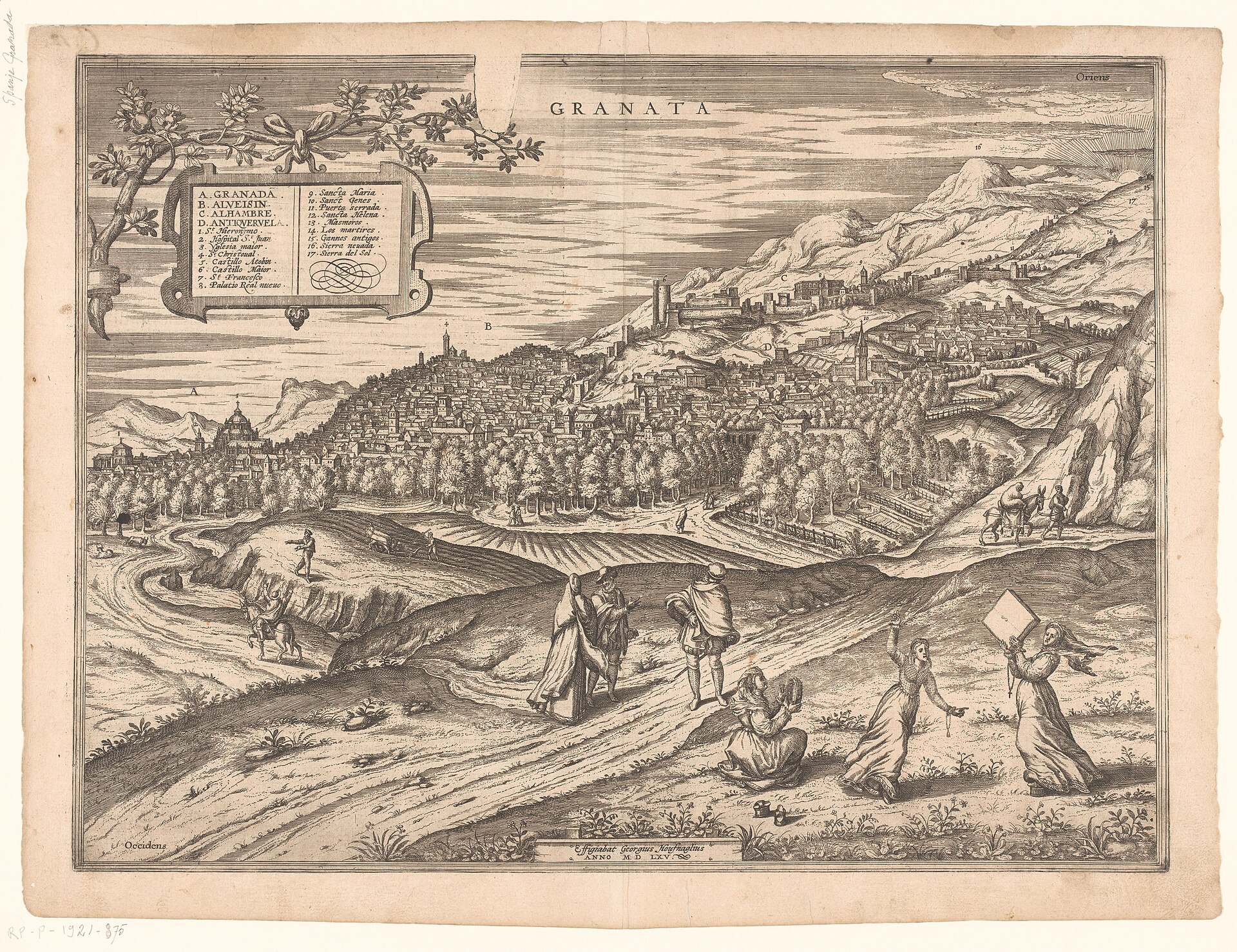
Bird's-eye view of Granada (Granata), from Braun & Hogenberg's Civitates Orbis Terrarum
Depicts the Alhambra on its hill, surrounding city walls and towers, crowded streets and the river plain, with principal buildings keyed in the cartouche.
1596 · Rijksmuseum · Wikimedia Commons
CC0 (plate dated 1596)

Castles of Granada

More cities to explore
 SpainCórdobaExplore it in AD 975 · 1300 · 1600
 SpainRondaExplore it in 1840
 SpainBarcelonaExplore it in 1350 · 1888 · 1915
 SpainMadridExplore it in 1630 · 1800 · 1925
Castles of Europe · Landmarks of Europe · create your own reconstruction.