Historic Cities · Spain
Girona through the ages
Girona, historically also known as Gerona, is the capital city of the Province of Girona in the autonomous community of Catalonia, Spain, at the confluence of the Ter, Onyar, Galligants, and Güell rivers. The city had an official population of 106,476 in 2024, but the population of the Girona–Salt urban area is estimated to be about 156,400 (2020).

Girona in 1350
City of the Call
Girona in 1350 sits crowded on its rocky hill above the Onyar, a fortified Catalan town where cathedral masters argue the shape of the nave and the Jewish Call is a centre of study. This walk follows the old approaches, gates, river fords and stepped alleys from the Lowland markets to the ramparts, where the city opens to the rivers and fields beyond.
Stone towers and tile roofs cluster on a steep spur above the Onyar and the Ter; Romanesque churches sit beside rising Gothic buttresses and unfinished walls of the cathedral. Streets are narrow, shaded and often stepped, flanked by rough-hewn stone and timber jetties over the river; riverbanks host tannery pits and open vats for dyeing. Ramparts and watchtowers frame the skyline, sunlight low and cool in spring or autumn, with mist in the river hollows at dawn.
The route: 16 streets, squares and views
Montjuïc → Pont de Sant Francesc → Portal de Sant Feliu → Sant Feliu → Plaça del Vi → Cathedral of Santa Maria → Carrer de la Força → Centre Bonastruc ça Porta → Carrer de Sant Llorenç → Mercadal Square → …
Step inside, 8 interiors
Nave with Roman Sarcophagi · Cloister of Carved Capitals · Great Gothic Nave · Study House of the Call · Mercadal Market Hall · Riverside Dyer's Workshop · Romanesque Cloister · Octagonal Pool Chamber
Planned from the Wikipedia record: Girona.
Its story
The story of Girona.
Gerunda: a Fort on the Via Augusta, c. 77 BC
The first known inhabitants of the plain were Iberians of the Indiget tribe, settled on the high ground that rings and closes it, the most important of their settlements being the one in the defile at present-day Sant Julià de Ramis. During the Sertorian Wars of 82–72 BC, around 77 BC, Pompey raised a walled oppidum on the Via Heraclea, the future Via Augusta, to hold the road against Sertorius, who had taken up arms in Roman Hispania against Sulla's faction. The new town of Gerunda was peopled from the old settlement at Sant Julià de Ramis, whose inhabitants appear to have been made to move down to it. The name has never been securely explained; it may mean “between the Undarius”, the Iberian name for the river now called the Onyar.
Because it was set on the road for strictly military reasons rather than laid out from scratch, Gerunda never took the regular grid of a planned Roman town. Its cardo maximus followed the Via Augusta through the walled area, along what is now the Carrer de la Força; the forum stood on the site of the present cathedral square, and the town's temple most probably where the cathedral now stands. Because the town sat on old river terraces, its east-to-west streets had to be built as flights of steps, most of which survive in altered form. The wall went up in two phases whose stonework is plainly different: one at the foundation, the second towards the end of the third century AD, when Germanic incursions into Hispania made new defences necessary. Inland though it was, the town was well linked to the Roman port at Empúries.
The Martyr's Tomb and the Visigothic City, 304–711
A Christian community is documented at Gerunda around 304–305, during the persecutions of Diocletian, in which Feliu of Scilla in Mauretania, who had reached the region by the sea trade routes, is believed to have been martyred in the town. Feliu became the city's first and only martyr and its original saint, until displaced by the apocryphal Sant Narcís, a devotion imported in the early medieval period. A martyrium was raised in what became the Sant Feliu quarter, where a fourth-century sarcophagus taken to be the saint's was found. A reference of 404 names a bishop of Gerunda, strongly reproved by the First Council of Toledo.
When the Western Empire came apart, Tarraconensis passed in the later fifth century to the heavily Romanised Visigothic military oligarchy established in Gaul, which fitted its authority onto the existing power of the local nobility. Girona did not follow the many former Roman towns that were abandoned or fell into marked decay: despite the plagues and calamities of the sixth and seventh centuries it became an important point in the north-east, and a Visigothic royal mint worked there whose coins have been found across the peninsula. The city hosted the provincial council of 517, presided over by the metropolitan bishop of Tarragona and attended by the bishops of Girona, Empúries, Barcelona, Ègara, Lleida and Osca. In 673 Girona took part in the revolt of Paul, one of the factional struggles that began the break-up of Visigothic power; King Wamba besieged the city before moving on to Paul's base at Narbonne.
Two Surrenders and the Carolingian Frontier, 715–982
The Muslim conquest of the peninsula began in 711 and reached Girona around 715. The city appears to have been occupied without resistance and suffered no destruction: the local elites capitulated, and the new authority imposed a personal and territorial tribute, used the earlier cathedral on the site of the present one as a mosque, and expropriated the property of the church and the Visigothic nobility. The mark left was slight, because in 785 the same local elites who had capitulated seventy years earlier handed the city over, again without a fight, to Louis the Pious, son of Charlemagne; the weakness of Muslim power in the region, the nearness of the Franks and the defection of the Septimanian towns decided them. The surrender was long credited to Charlemagne in person, and popular tradition preserved a body of stories about his visit, though he never came to Girona. The Catalan historian Ramon d'Abadal read 785 as the start of the process that led to the later Catalonia.
Under Carolingian administration the city became the seat of the County of Girona, one of the frontier counties; the count was at first a royal appointee, neither independent nor hereditary, though the Catalan counts in time made the office hereditary and detached themselves in practice from the Frankish kings. For sixteen years, until the capture of Barcelona, Girona was the forward stronghold of the Carolingian advance against Islam, and Muslim forces besieged it trying to take it back, most famously under Abd al-Malik in 793. The old Roman enclosure was restructured and new Carolingian walls extended the built area. The city was sacked in 827, 842, 845, 935 and 982. Wilfred the Hairy incorporated Girona into the County of Barcelona in 878.
The Jurats, the King's Baths and the Call, 1194–1492
Alfonso II of Aragon, count of Barcelona, declared Girona a city, and in his reign its bishop, Ramon d'Usall, granted it a charter of liberties; a royal privilege of 1284 then allowed the city to organise its own government, the Jurats of Girona, which remained the fullest expression of urban estate power for a long time afterwards. A document of 1194 records new baths built at the king's order and held as royal property, owing their form to the bathing system encountered at the conquests of Lleida and Tortosa; damaged when Philip III of France besieged the city at the end of the thirteenth century, they were rebuilt between 1294 and 1296 and stayed public until 1366. In 1385 the city was authorised to found a Consolat de Mar, and in the Middle Ages it won jurisdiction over the port of Sant Feliu de Guíxols, forty kilometres away, with the taxes that came from it, a right it no longer holds. In 1351 Peter III of Aragon made the old county a duchy when he gave the ducal title to his first-born son, John, and Ferdinand I later converted it into the title Prince of Girona for his own heir, the future Alfonso the Magnanimous.
A Jewish Catalan community is documented in Girona from about 885. Its height is placed in the twelfth and thirteenth centuries, when the city held one of the most important Kabbalistic schools in Europe and its rabbi, Moshe ben Nahman Gerondi (Nahmanides, or Bonastruc ça Porta) was appointed Great Rabbi of Catalonia. For four hundred years the Jewish cemetery lay beside the road to France, north of the old city between the hill called Montjuïc (Jewish Mountain in medieval Catalan), and the river Ter. The community declined through the fourteenth century, and on 10 August 1391 the city's Jews were shut into the Torre Gironella to force their conversion to Christianity. In 1492 the Catholic Monarchs outlawed Judaism throughout Spain and the remaining community was given the choice of conversion or exile. After the expulsion the quarter, the Call, was sealed off and new houses were built over the old ones.
The French Sieges, 1653–1713
The walls that carried the city through the early modern wars were built late: Peter the Ceremonious threw a wide circuit around the Roman city at the end of the fourteenth century, and in the sixteenth a long stretch of wall was raised on the far bank of the Onyar, which is how the Mercadal quarter came into being. Behind them Girona held out against French royal armies under Charles de Monchy d'Hocquincourt in 1653, Bernardin Gigault de Bellefonds in 1684, and Anne Jules de Noailles twice in 1694. On 18 October 1705 the city declared its obedience to the Archduke Charles, and through the War of the Spanish Succession it was the chief position blocking French incursions into northern Catalonia, garrisoned by regular troops alongside the city's own militia, the coronela.
In mid-December 1710 Adrien Maurice de Noailles appeared before Girona with twenty-five thousand men and a large siege train landed at Roses. Inside, the count of Tattenbach organised the defence with some five thousand combatants, five hundred of them from the coronela. After six weeks of unbroken attack, and heavy rain that nearly forced the siege to be lifted, the Bourbon troops opened a breach at Santa Llúcia in the north-east angle of the city, and Girona capitulated on 24 January 1711. From May 1712 the allies tried to recover it, but the English and Portuguese contingents were leaving the Catalan front and the blockade never became a formal siege; on 3 January 1713 the Duke of Berwick entered the city with a fresh army and ample supplies. Girona remained under French control past the end of the dynastic dispute.
1809: Álvarez de Castro and the End of the Fortress City
Girona has undergone twenty-five sieges in its history; the last and deadliest were those of the Napoleonic armies in 1808 and 1809. The city had already been besieged and bombarded twice when, from May to December 1809, thirty-five thousand French troops under Augereau and Gouvion Saint-Cyr closed on it. Álvarez de Castro commanded the defence and forbade any capitulation or sign of weakness on pain of summary execution. He fell ill and could no longer lead; after seven months of siege an exhausted population and garrison, under a military junta headed by Julián de Bolívar, capitulated on 12 December, disease and famine having done what the bombardment could not. A gold and silver altar frontal was carried off from the cathedral by the French that year. Álvarez de Castro is buried in the collegiate church of Sant Feliu, and the square later laid out in the Mercadal takes its name, Plaça de la Independència, from that war and its defenders rather than from any independence of Catalonia.
Girona was the seat of the Ter department under French rule, which lasted from 1809 to 1813. Its military career ended at the close of the century: in 1886 it became the first Catalan city with electric street lighting, and around 1898 the Spanish general staff struck it off the list of fortified places and allowed the partial demolition of the walls to the south. The walls on the western side came down at the turn of the twentieth century to let the city expand, while those on the east were left standing but abandoned.
Franco's Troops, and the Old Town Recovered since 1982
Francoist troops occupied Girona on 4 February 1939. Under the dictatorship the three narrow-gauge railways that had run out of the city (to Sant Feliu de Guíxols, to Olot, and the Banyoles–Palamós tramway) were closed by the state against local feeling, two of them in 1969, road competition being the reason given. The artist Enric Ansesa later described the Girona of his youth as “a city of grief and funerals, of the religious fundamentalism of the first Fridays of the month”. Interest in the region's cultural history revived after Franco's death in November 1975, and in 1980 the municipality's official name was changed from Gerona to Girona, in Spanish usage as well as Catalan.
From 1982 the council undertook a thorough rehabilitation of the Barri Vell, the city within the medieval walls and early modern bastions, and between 1983 and 2003 the missing stretches of wall on the eastern side were rebuilt, giving the walking route now known as the Passeig de la Muralla. Excavation in the Call uncovered the house of Nahmanides, sold to the city in 1987; the site of a fifteenth-century synagogue on the Carrer de la Força now holds the Girona Museum of Jewish History. Digs in the early 2000s produced some 1,200 documents, among them Talmudic commentaries, accounts of Jewish domestic life, a description of the old synagogue, and the names of Girona Jews who converted to Christianity in 1492.
Girona is the capital of its province, of the comarca of the Gironès and of the vegueria of Girona, with an official population of 106,476 in 2024. On 10 November 2009 the council became the first provincial capital to approve a motion for a consultation on Catalan independence; held on 25 April 2010, it returned 95.56 per cent in favour on a turnout of 26.97 per cent. Carles Puigdemont, elected mayor in 2011, left the office in January 2016 on being invested president of the Generalitat.
From the archive
Girona on paper: the old town as it was mapped.
A period plan or bird's-eye view of the old town, drawn between 1500 and 1850, the streets this page's reconstructions walk. Public domain, with its source named.
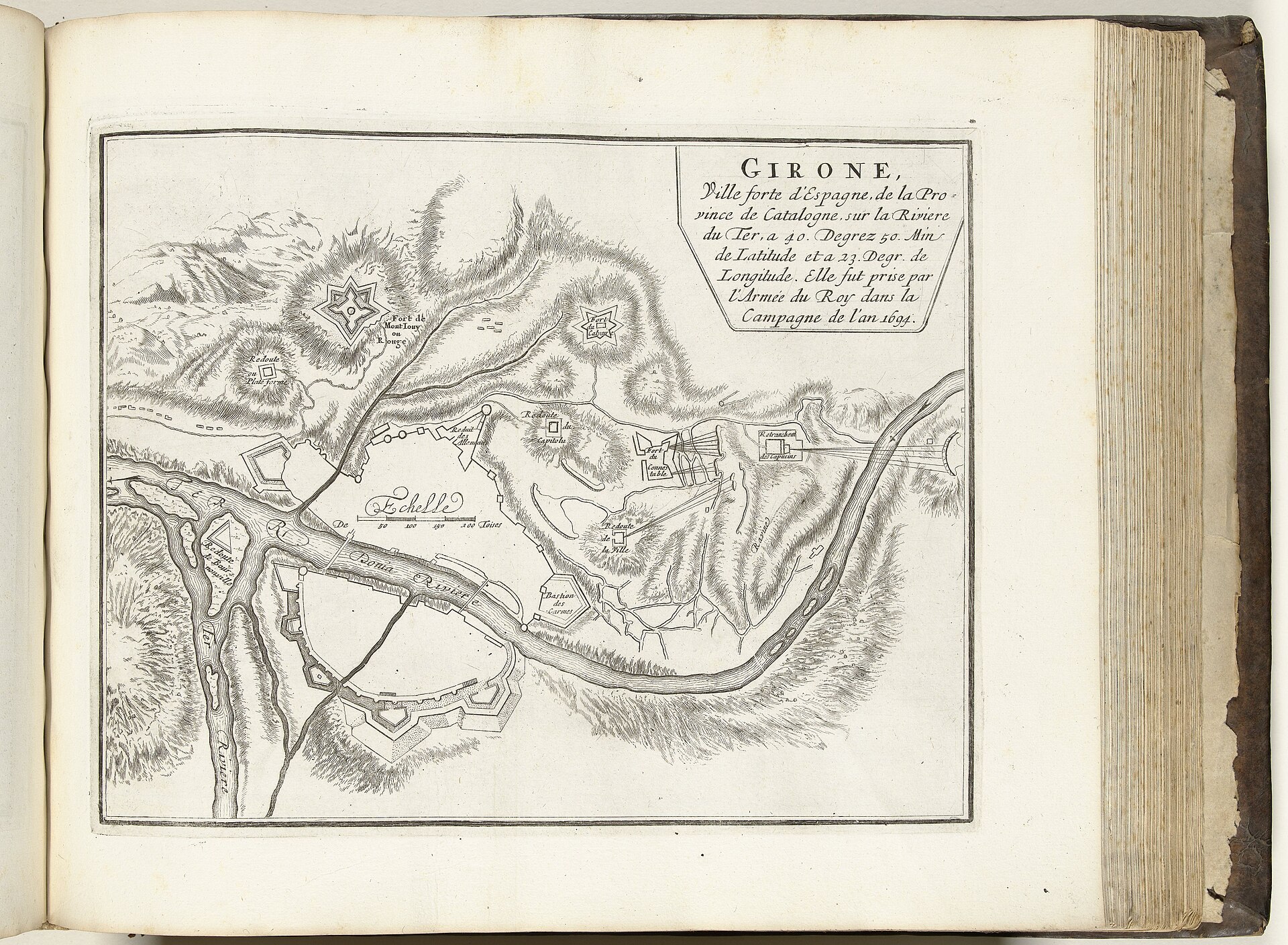
Girone (Girona), ville forte d'Espagne: plan from Les Forces de l'Europe
Walled old town with bastioned ramparts, the River Ter and bridge, outlying star forts and siege works shown around Girona.
1694 · Rijksmuseum · Wikimedia Commons
CC0 (plate dated 1694)
Castles of Girona

More cities to explore
 SpainBarcelonaExplore it in 1350 · 1888 · 1915
 FranceCarcassonneExplore it in 1300 · 1890
 SpainMadridExplore it in 1630 · 1800 · 1925
 SpainSevilleExplore it in 1200 · 1570 · 1929
Castles of Europe · Landmarks of Europe · create your own reconstruction.