Historic Cities · Spain
Toledo through the ages
Toledo is a city and municipality in Spain. It is the capital of the province of Toledo and the de jure seat of the government and parliament of the autonomous community of Castilla–La Mancha.

Toledo in 1080
Moorish Toledo
This is Toledo in its last decades as a Moorish taifa, a compact fortress-city clinging to the granite loop of the Tagus. The walk follows river terraces, fortified gates, the great congregational mosque and small domed mosques, markets and workshops where blades and leather are made.
Stone ramparts and squat towers rim a brown, terracotta-roofed knot of houses on a granite spur above the Tagus. Minarets and low mosque volumes punctuate a skyline of crenellated walls; narrow lanes fold into shaded courtyards. Sun slices the river gorge, gleaming on wooden waterwheels and the dark sheen of freshly forged blades in open workshops.
The route: 20 streets, squares and views
Tagus Bend View → Alcántara Bridge → Bisagra Gate → Alcázar Citadel → Great Mosque (al-Jami') → Zocodover Market → Jewish Quarter Entrance → Cuchilleros Street → Swordsmiths' Quarter → Tanners' Row → …
Step inside, 12 interiors
Gatehouse Passage Hall · Taifa Palace Audience Hall · Hypostyle Prayer Hall · Covered Market Hall · Congregational House · Apprentice Blade Workshop · Master Swordsmith's Forge · Tannery Loft · Riverside Bathhouse Hall · Waterwheel Mill Chamber · Nine-Domed Sanctuary · Bridge Tower Guard Chamber
Planned from the Wikipedia record: Toledo, Spain.
Toledo in 1250
Toledo of the translators
Toledo in 1250 is a multi‑lingual, multi‑faith provincial capital in transition: the great mosque's fabric gives way to a new Gothic cathedral while Jewish synagogues, Mudéjar brick houses, Arabic-speaking merchants and Latin clerics still share the streets. The walk follows the Tagus bend into the heart of the city where markets, book sellers and scribes moving between scriptoria make a visible culture of translation and exchange.
A compact hilltown looped by the Tagus, its skyline broken by the emerging vertical lines of a new Gothic cathedral planted on the old mosque, squat mudéjar and Romanesque churches, and the dark bulk of the Alcázar. Streets run narrow and sunken, paved in cobble and worn stone, flanked by ocre and whitewashed houses, tiled roofs and occasional timber balconies; Arabic, Hebrew and Latin letters appear together on banners, shop signs and the spines of chained books.
The route: 21 streets, squares and views
Puente de San Martín → Puerta de Bisagra → Plaza del Zocodover → Judería (Jewish Quarter) → Santa María la Blanca → Calle de Santo Tomé → Iglesia de Santo Tomé → Iglesia de San Román → Alcaicería (silk market) → Spice Stalls at the Market → …
Step inside, 13 interiors
Bridge Gate Tower Chamber · Zocodover Butchers' Hall · Jewish Translators' Scriptorium · White Arcaded Prayer Hall · Bookbinders' Workshop · Parish Nave with Mudéjar Arcades · San Román Mudéjar Nave · Covered Silk Market Hall · Spice Merchants' Pavilion · Gothic Nave under Construction · Chapterhouse Scriptorium · Royal Audience Hall · Horseshoe‑arched Prayer Hall
Planned from the Wikipedia record: Toledo School of Translators.
Toledo in 1580
El Greco's Toledo
Toledo in 1580 is the Spanish religious capital, its hilltop mass of stone dominated by the newly large silhouette of the Alcázar and the cathedral spire. The walk moves from the Tagus gorge and bridges into steep, paved lanes where damascened metalworkers, clergy and market traders share narrow streets beneath storm-prone sky.
A compact medieval hill-town of warm ochre and grey stone, crenellated walls and narrow, twisting streets that fall steeply to the Tagus gorge. The cathedral spire and the recent bulk of the Alcázar puncture the skyline; roofs are low, tiled and irregular. Light changes suddenly: a high, green storm-light over the valley, deep shadows in alleys, and flashes of white on the river and metalwork in workshop windows.
The route: 20 streets, squares and views
Mirador del Valle → Puente de Alcántara → Puerta de Alcántara → Alcázar de Toledo → Plaza de Zocodover → Calle Ancha → Calle de los Canónigos → Catedral Primada de Toledo → Iglesia de San Román → Santo Domingo el Antiguo → …
Step inside, 13 interiors
Alcázar Stone Staircase · Town Council Hall · High Choir Stalls · Cathedral Treasury Chamber · Tavera Hospital Chapel · El Greco's Studio · Santo Tomé Nave · Mudejar Merchant Patio · Transito Prayer Hall · La Blanca Prayer Hall · Damascened Steel Workshop · San Martín Gate Chamber · Bisagra Gate Chamber
Planned from the Wikipedia record: El Greco.
Its story
The story of Toledo.
"A Small City, But Fortified by Location": Carpetania and Roman Toletum
The Roman historian Livy described Toletum as urbs parva, sed loco munita, a small city, but fortified by its position. The position was a hill in a pronounced meander of the Tagus, closed by the river on three sides, with a single natural land approach. The first fixed settlement known here is a group of castros, over which the walled Carpetanian town was raised, one of the chief centres of the Carpetani.
In 193 BC, after heavy resistance, the Roman general Marcus Fulvius Nobilior defeated a confederation of Celtic tribes near the town and captured a king named Hilermus. Toletum entered the empire as a civitas stipendiaria, a tributary city of non-citizens, and later as a municipium, whose officials won Roman citizenship through public service. City walls, public baths, a municipal water supply and a circus were built; the circus, one of the largest in Hispania, held up to 15,000 spectators and was still staging games late in the fourth century and into the fifth.
The city had worked steel since about 500 BCE, and the trade came to Roman notice when Hannibal's forces used Toledo blades in the Punic Wars; it became a standard source of weaponry for the legions. The iron industry was substantial enough for the Roman city to strike its own coinage.
Visigothic Capital and the Councils of Toledo, 400–711
Church councils met at Toledo in 400 and 527 over the conflict with Priscillianism, the first of some thirty synods held here between the fourth century and the sixteenth. In 546, or possibly earlier, the Visigothic rulers made Toledo the capital of their kingdom; King Theudis was in the city in 546, where he issued the only law of the period of which any record survives, known from a single manuscript. At the synod of 589 King Reccared declared his conversion from Arianism to Catholicism.
The councils of the seventh century tried to reconcile competing theological positions and enacted anti-Jewish laws. The synod of 633 decreed uniformity of Catholic liturgy across the Visigothic kingdom and took stringent measures against baptised Jews who had returned to their former faith; other councils forbade circumcision, Jewish rites and the observance of the Sabbath and the festivals. Through the seventh century Jews were flogged, executed, had their property confiscated, were subjected to ruinous taxes, forbidden to trade and at times dragged to the baptismal font. The council of 681 secured to the archbishop of Toledo the primacy of Spain, and by the end of the century the bishop of Toledo led all the other bishops of Hispania, a position unusual in Europe. Nearly a hundred of the early canons of Toledo were taken into the Decretum Gratiani and shaped the development of church law.
With the Visigothic nobility divided among itself, Tariq ibn Ziyad took Toledo in 711 or 712 for the Umayyad Caliphate of Damascus. His superior, the governor Musa, landed at Cádiz and came on to Toledo, where he had the Visigothic nobles executed, destroying much of the existing structure of power.
The Rebel City of the Central March, 742–1085
The incoming population was mixed, and in the district around Tulaytulah the evidence suggests Berber settlement predominated over Arab. In 742 the Berbers of al-Andalus rose against the Arab Umayyad governors, took the north and laid siege to the city without success. Toledo held its standing as a literary and ecclesiastical centre well into the middle of the eighth century, as the Chronicle of 754 shows, and letters of the period attest the primacy its church still claimed.
Under the Umayyad emirate of Córdoba the city was the seat of one insurrection after another between 761 and 857. Verses written against the Umayyads by the Toledan poet Girbib ibn Abdallah helped provoke a revolt against the new emir in 797; by the end of the century the Umayyads had nonetheless made Toledo the administrative centre of the Central March of al-Andalus. A fresh revolt broke out in 852, the Umayyad governor being held hostage to force the return of Toledan hostages in Córdoba, and the army Emir Muhammad I sent in reprisal was beaten. Toledo allied with King Ordoño I of Asturias, and the two lost together at the battle of Guadacelete. Muhammad I negotiated a truce in 859, and for twenty years the city was effectively independent; Córdoba reimposed control in 873 after a siege forced the defenders to submit. The Banu Qasi held nominal control until 920, and Caliph Abd al-Rahman III took the city in 932 after a long siege.
In the wake of the Fitna of al-Andalus in the early eleventh century, Toledo became the centre of an independent state, the Taifa of Toledo, under the Dhu l-Nunids. Its population was then about 28,000, including 4,000 Jews, and the Mozarab community had its own Christian bishop. The taifa was drained by the parias, the tributes exacted by the Kingdom of León, and lost territory; a revolt broke out in 1079 and the Aftasid ruler of Badajoz took the city. On 25 May 1085 Alfonso VI of León took Toledo and replaced the tribute he had been extracting with direct personal rule.
Fueros, the Translators, and the Riots of 1212 and 1449
The city Alfonso VI took was of mixed composition (Mozarabs, Muslims and Jews, joined now by Christian settlers from northern Iberia and by Frankish incomers), and different fueros were in force simultaneously for each community. The Mozarab community grew after the conquest through immigration from the Muslim south. A translation centre was established in which Muslim and Jewish scholars rendered books from Arabic or Hebrew into Castilian and Castilian scholars turned them from Castilian into Latin. The Toledo School of Translators, founded under Archbishop Raymond of Toledo, continued that work, and in the thirteenth century Alfonso X made the city a centre of scholarship.
The same centuries carried sustained violence against the city's Jews. Under the Roman Catholic archdiocese there were persecutions in 633, 653 and 693 and burnings at the stake in 638; there was rioting and bloodshed against the Jews of Toledo in 1212, and the Kingdom of Toledo continued the practice with forced conversions and mass killing in 1368, 1391, 1449 and 1486–1490. The major popular revolt of 1449 combined a tax mutiny with anti-Jewish and anti-converso feeling and appeals to the civic community, and spread from the city into anti-seigneurial rioting in the settlements of the surrounding countryside.
The epithet "City of Three Cultures", used of the period when Christians, Jews and Muslims lived here together, has been called grandiose and is generally attributed to politicians and tourism promoters; critics hold that the idea of peaceful religious coexistence obscures a history of religious oppression.
Expelled and Deported: 1492, 1502 and the Granadan Moriscos
Toledo had large Muslim and Jewish communities until the expulsions, of the Jews in 1492 and of the Mudéjars in 1502. During the persecution of the late fifteenth and early sixteenth centuries, members of the local Jewish community wrote accounts of their long history in the city. Four religious buildings from before the expulsions survive in good condition: the synagogue of Santa María la Blanca, the synagogue of El Tránsito, the mosque of Cristo de la Luz and the church of San Sebastián. Among Ladino-speaking Sephardi Jews in their various diasporas the family name Toledano remains common, marking descent from the city.
A second forced movement of people followed the Alpujarras rebellion, when Moriscos deported from Granada, the moriscos nuevos, were settled in Toledo and its lands, 6,000 of them arriving in the city alone, at least temporarily. The logistics were formidable and the uneasy existing arrangement between the moros viejos, the old Moors, and the Old Christians was broken up. The Granadan newcomers met xenophobic abuse and were stigmatised as bloodthirsty and sacrilegious.
The Comuneros, the Emperor's Court and the Silk Looms, 1520–1630s
Toledo was among the first cities to join the revolt of the Comuneros in 1520, its leaders including Pedro Laso de la Vega and Juan de Padilla. After the comunero defeat at Villalar the Toledans, under María Pacheco, Padilla's widow, held out longer than anyone else against Charles V, surrendering in 1522. Once the revolt was crushed the emperor installed his court in the city, choosing it as his residence at least fifteen times from 1525, and granted Toledo a coat of arms. The population rose from 31,930 in 1528 to more than 56,000 by 1561, making it one of the most populous cities of the monarchy.
In 1561, in the first years of his son Philip II's reign, the royal court moved to Madrid, and the city began a slow decline from which it never recovered. The archbishops remained powerful brokers in the political and religious affairs of Spain for the rest of the Ancien Régime, holding large seigneurial estates across most of the southern half of the Inner Plateau.
What kept the economy standing after the court left was silk. Toledo's silk manufacture peaked in the sixteenth century, began a long decline in the closing years of that century, and had disappeared altogether by the turn of the nineteenth. The city entered a true decline in the 1630s, in the setting of a general economic recession.
The Royal Arms Factory, the Railway, and the Alcázar Besieged
Between the fifteenth and seventeenth centuries the sword-making trade boomed and Toledo steel came to be regarded as the best in Europe, blades made by individual craftsmen under a guild that policed their quality. Production began to fall away in the late seventeenth and early eighteenth centuries, and in 1761 Charles III ordered the creation of the Royal Arms Factory, which gathered all the city's sword-makers' guilds into the former mint. In 1777 the king commissioned the architect Sabatini to build new premises on the edge of the city. In the twentieth century output was cut back to cavalry weapons, and after the Spanish Civil War to swords for officers and NCOs. The factory closed in the 1980s and the building was refitted as the Toledo campus of the regional technological university.
The Peninsular War affected the city badly. Across the nineteenth century Toledo shifted from a convent city to a bureaucratic one. After the city was left off the railway to the Portuguese border in the 1850s, a branch from Castillejo to Toledo promoted by the Marquis of Salamanca was approved in June 1856 and opened on 12 June 1858; the tourism the line brought built up a hospitality trade in the late nineteenth century, and the Santa Bárbara quarter came into being after the railway arrived. By the turn of the twentieth century the population was about 23,000.
After the coup of July 1936, the acting military commander in Toledo, José Moscardó, refused to supply weapons to Madrid and shut himself in the Alcázar with a garrison of about 1,000 rebels, food, ammunition and a number of hostages. From 21 July they were besieged, unsuccessfully, by forces loyal to the Republic. Francisco Franco turned his Army of Africa aside from its advance on Madrid (giving the Republicans time to prepare the capital's defences and receive early foreign support), and relieved the Alcázar in late September 1936; the garrison's two months of resistance became a central symbol of the mythology built around the Francoist regime. The population stood at about 40,243 in 1950, and later twentieth-century growth went to the new districts of Palomarejos and the Polígono. The city had been declared a Historic-Artistic Site in 1940; in 1983 Toledo became the seat of the Cortes and government of Castilla–La Mancha, and in 1986 its historic centre was declared a UNESCO World Heritage Site. The municipality, in Toledo province since November 1833, covers 232.1 square kilometres and had 86,526 inhabitants in January 2024.
From the archive
Toledo on paper: the old town as it was mapped.
A period plan or bird's-eye view of the old town, drawn between 1500 and 1850, the streets this page's reconstructions walk. Public domain, with its source named.
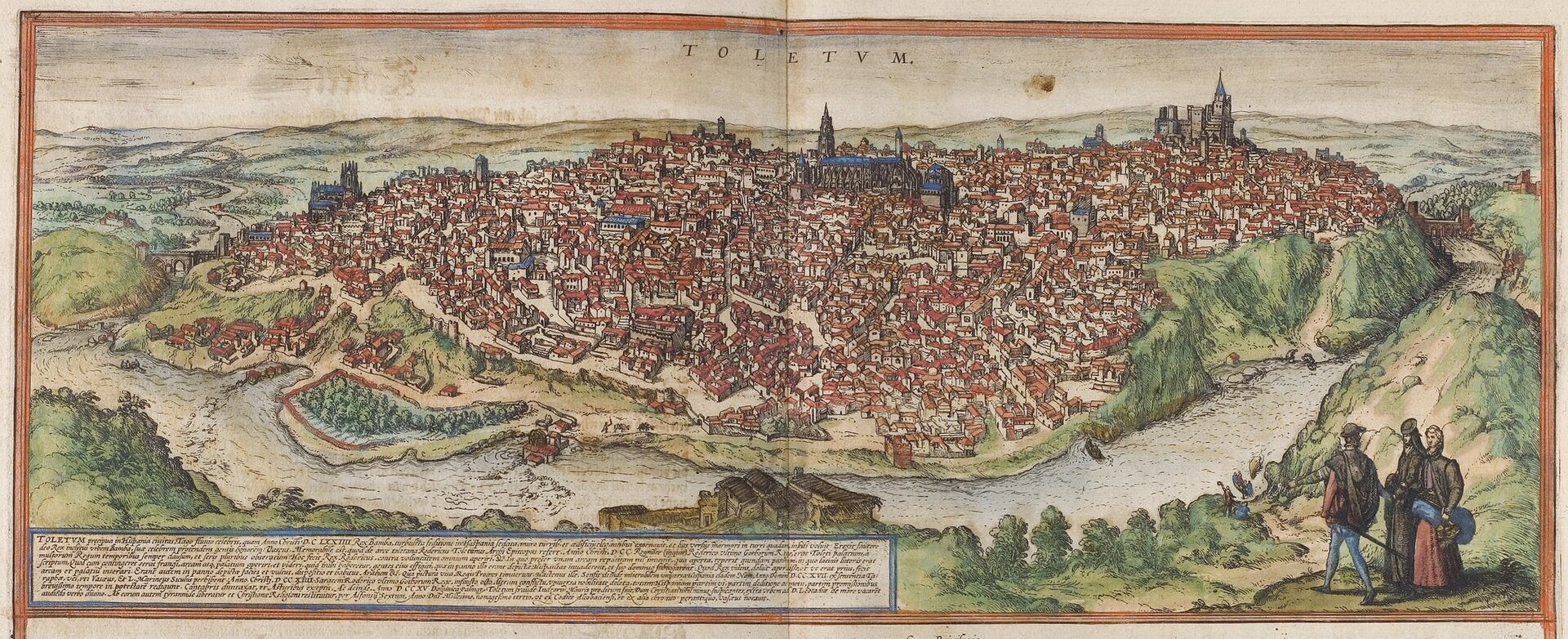
Bird's-eye view of Toledo, from Braun & Hogenberg's Civitates Orbis Terrarum
Depicts Toledo's walled old town on the Tagus, with dense street plan, the cathedral spire, the Alcázar fortress, bridges and city gates visible.
1572 · Georg Braun; Frans Hogenberg · Wikimedia Commons
Public domain (plate dated 1572)

Castles of Toledo

More cities to explore
 SpainMadridExplore it in 1630 · 1800 · 1925
 SpainSalamancaExplore it in 1580
 SpainBarcelonaExplore it in 1350 · 1888 · 1915
 SpainSevilleExplore it in 1200 · 1570 · 1929
Castles of Europe · Landmarks of Europe · create your own reconstruction.