Historic Cities · Spain
Salamanca through the ages
Salamanca is a municipality and city in the autonomous community of Castile and León in Spain, and the capital of the Province of Salamanca. Attached to the comarca of Campo Charro, the city lies on the northern half of the Meseta Central, in the western-central part of the Iberian Peninsula, straddling the Tormes river.

Salamanca in 1580
The Golden University
Salamanca in 1580 is at the height of its university prestige: a city of learned houses, lit by the honey-gold stone of its façades and filled with thousands of students in capes and gowns. This walk follows the river approach, crosses the Roman bridge, threads market square and narrow lodging lanes, and reaches the carved university front, the Patio de Escuelas, the Shell House and the twin cathedrals rising above the old roofs.
The city perches low on the Tormes with a compact medieval profile of towers, spires and domes, its roofs of red clay tile and its walls of warm Villamayor sandstone that takes a burnished, almost silvered sheen at dusk. Streets compress into alleys between dense blocks of plateresque carved stone, open squares break the pattern near market stalls, and the river and Roman bridge anchor views that include scaffolded façades where new work rises beside older, rounded Norman masonry.
The route: 16 streets, squares and views
Tormes Meadows View → Puente Romano → Plaza Mayor → Casa de las Conchas → Escuelas Mayores Façade → Patio de Escuelas → Colegio Mayor de San Bartolomé → Colegio Mayor de Oviedo → Colegio Mayor de Santiago → Colegio Mayor de Cuenca → …
Step inside, 9 interiors
Tavern of the Square · Cloister of Carved Shells · Lecture Hall of Salamanca · University Chained Library · Great Stair of San Bartolomé · Refectory of Oviedo · Student Garret · Frescoed Apse · Nave Under Construction
Planned from the Wikipedia record: University of Salamanca.
Its story
The story of Salamanca.
Helmantica and Roman Salmantica
Human habitation on the site of Salamanca has been dated to the beginning of the first millennium BC by pottery from the Cerro de San Vicente belonging to the Late Bronze Age Cogotas I culture; on the same hill has been found what is so far taken to be the first stable and continuous settlement, of the Soto de Medinilla culture of the seventh century BC. From the fourth century BC a second centre grew on the teso de las catedrales, or Cerro de San Isidro, a hillfort that lasted until the city was fully Romanised. The choice of these sites turned on the ground itself (low hills cut by streams, and above all the nearness of the Tormes) good for defending and controlling the country around.
In 220 BC, advancing through Iberia, Hannibal besieged and took the town, then called Helmantica. Plutarch's account has the inhabitants submit to avoid worse damage, offering three hundred talents of silver and as many hostages, then break their promise once the siege was lifted and, helped by their women, who had hidden weapons, defeat Hannibal's troops; the Carthaginian seized them in the end, and Polybius says that in admiration of the courage of the women he gave the men back their homeland and their wealth.
After the Second Punic War, Salamanca was annexed to the Roman province of Lusitania and restructured, its settlement confined to the teso de las catedrales and the San Vicente hill abandoned. Three things the Roman city left shaped everything after it: the Calzada de la Plata, the road that fixed the axis of the town and its trade; the Roman bridge, which from the first century carried the crossing of the Tormes, and whose northern half still stands, the other half rebuilt in the seventeenth century after the San Policarpo flood; and the Cerca Vieja, the primitive wall around the hill on the line of the earlier hillfort. Fragments of a marble statue found in 2015 under a house in the calle Libreros, probably from the forum, are read by some specialists as support for the town's promotion from indigenous oppidum to Roman civitas under Augustus.
No Man's Land and the Repopulation, 712–1102
After the Western Empire ended the Alans settled in Lusitania and the city fell within it; the Visigoths later annexed it, and by 589 Salamanca was an episcopal seat, being among the cities that sent bishops to the councils of Toledo. In 712 Musa ibn Nusayr took the city in the Muslim invasion of the peninsula. Through the early Middle Ages the area was a no man's land whose settlements were destroyed by repeated raids, and Salamanca was reduced to an almost uninhabited nucleus with a few settlers around it, though the bridge survived intact. Attempts by the Christian kingdoms to hold the ground brought repeated clashes, among them the campaign of Alfonso I of Asturias in 754, which destroyed what was left of the town.
The country stayed more or less empty until the Christian victory at Simancas in 939. Two months after the fighting ended, according to the Pelagian version of the Chronicle of Sampiro, Ramiro II of León ordered his army towards the banks of the Tormes and began repopulating: “Salamantica, the ancient seat of the castrum, Letesma, Ribas, Balneos, Alphandiga, Penna, and many other fortified places.” The incomers appear to have come chiefly from north of the Duero, and in Salamanca's case from the neighbourhood of León. After Alfonso VI took Toledo in 1085 the repopulation became definitive: in 1102 Raymond of Burgundy brought in a large and mixed body of settlers (Franks, Castilians, serranos, Mozarabs, Toroans, Portuguese and Bragançans, with Galicians, Jews and Muslims among them) recorded in the Fuero de Salamanca. Each group founded its own churches and parishes, and where each settled followed rank as much as origin: the elite in the centre on the ground of the old Celtiberian town, the serranos and the Jews to the west by the alcázar, the Franks to the east by the episcopal see and the market, and the rest outside the walls.
The Studium Generale, the Wool Trade and the War of the Bandos
The diocese was restored, its first bishop Jerome of Périgord, and work began on the Old Cathedral, with schools founded beside it that were the seed of the university. In 1218 Alfonso IX of León granted privileges that drew new settlers, among them a large Jewish community, extended the walled perimeter, and raised the cathedral schools to the rank of studium generale. By royal decree of Alfonso X in 1254 they became the University of Salamanca, and in 1255 Pope Alexander IV ruled that a master examined and found suitable at Salamanca might teach at any other studium without re-examination, “except in Paris and Bologna”, universities from which Salamanca's schools of canon and civil law drew students in their turn. Alfonso XI, born inside the walls on 12 August 1311, took the throne at fourteen and conquered Gibraltar at the head of the crown's militias, the Salamancan contingents prominent among them.
With the rise of the Mesta the city became a centre for making draperies and an exporter of wool. The fifteenth century was another matter: chronic insecurity and feuding among the urban elites broke out in the War of the Bandos, between two factions led by noble families, the Benitinos and the Tomesinos, named for the parishes of San Benito and Santo Tomé, which fought for control of the city until a concord was brokered by an Augustinian friar, John of Sahagún, later the city's patron saint. The population at the end of the century has been tentatively put at 15,000 to 25,000, nearly all of it on the north bank of the Tormes.
1492, and the School of Salamanca
The Jewish quarter lay to the north against the wall, roughly along the present avenida de Mirat. When the Jews were expelled in 1492 the quarter was walled up and left untouched by the townspeople, probably against a possible return; standing empty it filled with rabbits, and was known until recently as the barrio del Conejal. The same year Antonio de Nebrija produced his grammar of Castilian, the first study of the rules of a Western European language other than Latin. The cloister of the university met in council to consider Christopher Columbus's project for his first voyage; he won the support of the Dominicans and lodged at the convent of San Esteban, and the Salamancan astronomer Abraham Zacuto was his chief scientific support. Hernán Cortés studied here before leaving for the Americas, going home in 1501 at seventeen without finishing his course.
The sixteenth century was the city's period of greatest weight, in numbers and in university life alike: around 24,000 inhabitants, and some 6,500 students enrolling each year by about 1580. The scholars gathered around Francisco de Vitoria, mostly Dominicans, became known as the School of Salamanca. They shifted legal doctrine away from casuistry and Roman law towards a system meant to be explicitly universal and, with Spain newly colonising the Americas, took up the rights of non-Europeans: to life, to property, to freedom of thought. Through the Dominicans' links between the university and the missions, among them Antonio de Montesinos and Bartolomé de las Casas, the school was critical of the Spanish colonists and of the laws that permitted their abusive treatment of native peoples, and its work on the ius gentium fed into modern international law. Mathematicians of the university put to Gregory XIII the calendar reform that carries his name, and Luis de León made a partial translation of the Bible into Spanish.
Comuneros, Decline and the Lisbon Earthquake, 1520–1800
Like the other towns of the Crown with a seat in the Cortes, Salamanca joined the Communities of Castile in 1520, against the new taxes demanded by Charles V and in defence of its textile manufactures against the privileges of the wool exporters. After the Comuneros were beaten the king had the upper storeys of the towers taken off the palaces of the Salamancans who had joined the revolt. The city then followed the general decline of the Castilian towns of the northern meseta, falling to about 12,000 inhabitants by 1651.
An economic and cultural recovery in the eighteenth century allowed the New Cathedral to be finished after works had stood idle for almost a century, and the baroque Plaza Mayor to be built in 1729. The Lisbon earthquake of 1755 put many of the monumental buildings at risk: in the church of San Martín the pillars were left leaning and the voussoirs of arches and vaults came down out of place. Of all the Spanish cathedrals, Salamanca's was the worst affected, but the city was prosperous enough to repair much of the damage. In the last third of the century the Bourbon Enlightenment made itself felt in the university.
Occupation, Arapiles and the Provincial Capital, 1809–1877
During the Peninsular War the city was occupied by Marshal Soult's troops in 1809 and stayed in French hands until 1812. To get materials for their defences the French destroyed a substantial part of the city's buildings, above all in the quarter afterwards called Caídos, the demolished, where the university's colegios mayores had stood and of which nothing is left; the western quarter was badly damaged by cannon fire. At the Battle of Arapiles in 1812 an Anglo-Portuguese army under Wellington decisively beat Marmont's French army, thirteen thousand men being killed or wounded in a few hours. Worse for the university came when Ferdinand VII closed the Spanish universities; after the reopening Salamanca was reduced to a provincial university.
The province of Salamanca was created in 1833 within the Region of León, making the city its capital and the seat of its Diputación. Five days after the draft federal constitution of 1873 was presented under the First Republic, a cantonalist rising broke out in Salamanca; it held the city for four days and was put down on 26 July 1873, and a military pronouncement soon ended both the republic and the federalising project. The city recovered a little over the rest of the century as provincial capital, and with the railway linking France to Portugal across the meseta, which reached Salamanca in 1877.
Nationalist Headquarters, 1936–1939, and the City Since
The army's rising against the Second Republic succeeded in Salamanca from the first moment; the mayor, Casto Prieto Carrasco, was arrested and shot by the Francoist troops. The city served as the de facto headquarters of the rebel faction: Francisco Franco was proclaimed Generalissimo there on 21 September 1936, and the Episcopal Palace beside the Old Cathedral was his residence and command centre from October 1936 to November 1937. In April 1937 a Unification Decree issued in the city merged the Falange with the Carlists to create the FET y de las JONS, the single party of the dictatorship that followed. Most administrative offices were moved to Burgos as more central, but the military commands and the German and Italian delegations stayed.
After the war the documents seized by the rebel army as it occupied territory that had defended the Republic were gathered in the city as the General Archive of the Spanish Civil War. The Catalan part of the archive, with many papers of individuals and institutions from outside that region, was transferred to Barcelona in the spring of 2006 after long disputes between the city council and the Spanish government and public demonstrations; in protest the council renamed the archive's street, previously Gibraltar for the militias who went with Alfonso XI to that conquest, calle del Expolio, the plundering.
Pius XII founded the Pontifical University of Salamanca in 1940 as a continuation of the old theological studies. The Old City was declared a UNESCO World Heritage Site in 1988, and in 1998 the culture ministers of the European Union named Salamanca, with Bruges, European Capital of Culture for 2002. The city is the capital of its province, with a population of 144,458 in 2024; cultural tourism and the university carry its income, and it draws students from many countries in summer, most of them to learn Spanish. Its numbers have been static for about three decades, held down by movement to the metropolitan area, a low birth rate since the 1980s and emigration to places such as Madrid.
From the archive
Salamanca on paper: the old town as it was mapped.
A period plan or bird's-eye view of the old town, drawn between 1500 and 1850, the streets this page's reconstructions walk. Public domain, with its source named.
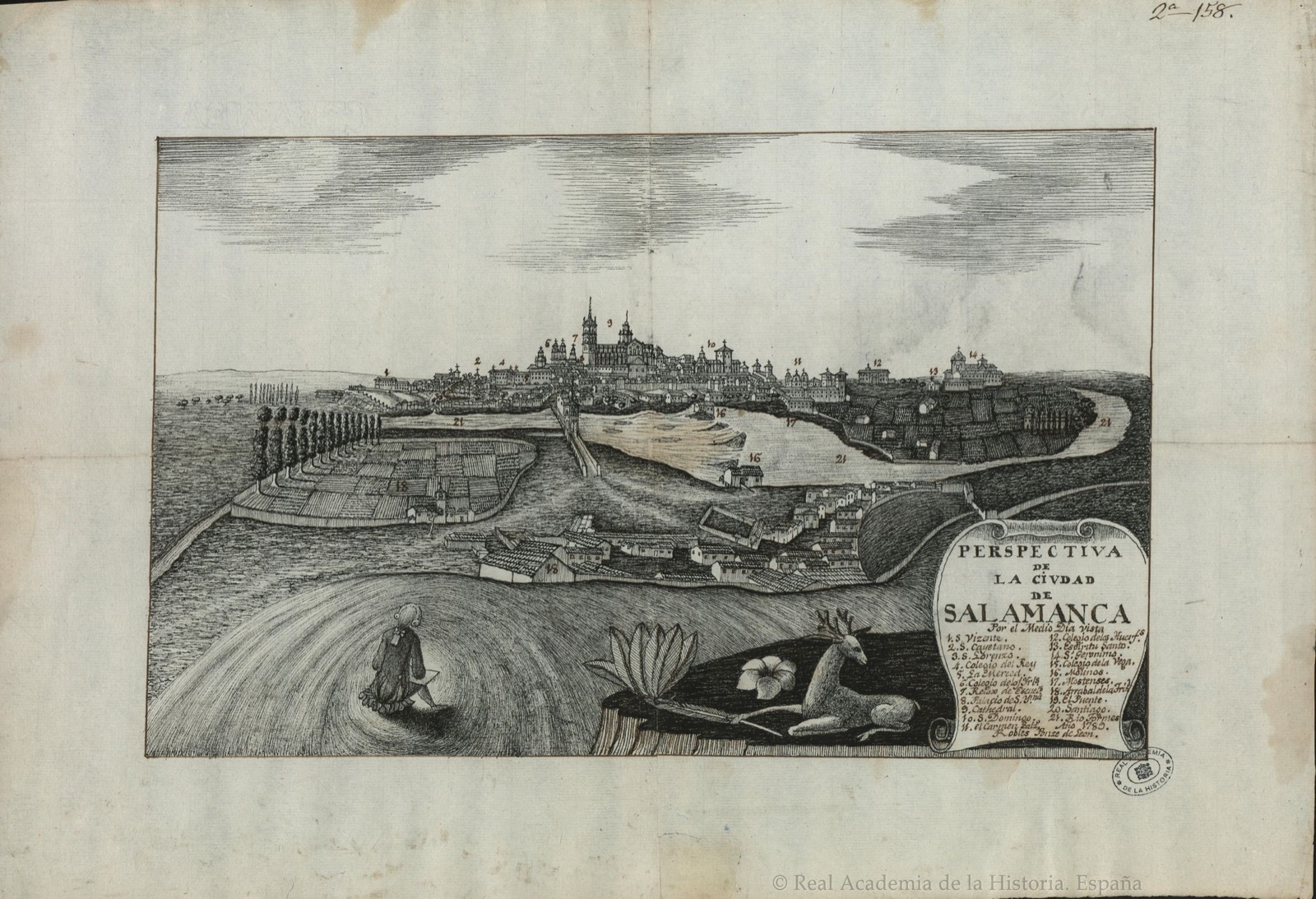
Perspectiva de la ciudad de Salamanca, vista por el mediodía
The city runs along its ridge above the Tormes with the cathedral towers at the centre and the Roman bridge crossing to the arrabal, keyed to twenty-four churches, colleges and gates.
1789 · Real Academia de la Historia · Europeana
Public domain (plate dated 1789)
More cities to explore
 SpainMadridExplore it in 1630 · 1800 · 1925
 SpainToledoExplore it in 1080 · 1250 · 1580
 SpainBarcelonaExplore it in 1350 · 1888 · 1915
 SpainSevilleExplore it in 1200 · 1570 · 1929
Castles of Europe · Landmarks of Europe · create your own reconstruction.