
Spain · Restored
Castillo de San Servando
The Castle of San Servando is a medieval fortress on the opposite bank of the Tagus River from Toledo, Spain. Originating as a monastery and later converted into a Templar fortress, it survives today as a restored monument and is used as a youth hostel.
First raised
601
Its prime
1200
Today
Restored
As it stood in 1200
What Castillo de San Servando looked like in its prime.
A compact stone fortress sited on a rocky slope above the Tagus, built of warm brown irregular rubble masonry. The silhouette is defined by a crenellated curtain wall with regular merlons, a prominent square/rectangular keep at the left and a large circular tower at the right, both topped by crenellations. A central arched gateway punctures the curtain; small slit and rounded windows are set into the walls. Pine trees and a steep grassy foreground slope frame the base.
Its story
The story of Castillo de San Servando.
The Basilica Monastery and the Roman Rite, 7th Century–1085
Before it was ever a fortress, San Servando was a monastery attached to a basilica of the same name on the bank of the Tagus at Toledo. Its beginnings are given two ways: a foundation possibly as early as the seventh century, or the start of building work in 1024. In 1080 Cardinal Richard of St Victor, a monk of the ancient abbey of that name at Marseille, was sent as legate of Pope Gregory VII to the Council of Burgos, charged with securing the adoption of the Roman Rite in place of the Mozarabic Rite the Christians of Iberia had used for centuries. He carried specific instructions for the restoration of San Servando and its adoption of Roman liturgical practice.
After several centuries under Muslim rule, Toledo was taken in 1085 by the Christian army of Alfonso VI of Castile. He and his wife, Constance of Burgundy, became generous benefactors of the basilica and rebuilt the monastery. John Ormsby, the English translator of Cervantes's Don Quixote, held that Alfonso VI named the house San Servando after a Spanish martyr, and that the name was worn down in turn into San Servan (the form it takes in the Poem of the Cid) then San Servantes and San Cervantes.
Marseille's Monks and the Mozarabic Charge, 1088–1110
On 11 March 1088 the king offered the monastery to the Holy See, with all its goods and benefits, on the condition that it be permanently administered by the abbey of St Victor at Marseille. Pope Urban II approved the arrangement and entrusted it to Cardinal Richard, by then abbot of St Victor himself. French monks came to occupy the Spanish house and brought the Rule of St Benedict with them.
Alfonso saw the monastery as a bulwark of Christian presence in the region. On 13 February 1099 he made it a donation of the church of Santa María de Alficén and of the community around it, traditionally Mozarabic territory, giving the monks the objective of maintaining that identity among the people; he also founded a house of Benedictine nuns attached to the church. Both communities were charged with care and hospitality for the poor of the region and for travellers. The monastery was destroyed by Saracen attacks in 1110 and the monks returned to Marseille, after which it passed to the Archbishop of Toledo and the cathedral chapter.
The Templars and the Puente de Alcántara, 1147–1312
In 1147 Muñoz de Cervatos took the castle from Moorish hands. Alfonso VIII granted the monastery to the Knights Templar, who converted it into a fortress in order to protect the Puente de Alcántara against a possible Muslim attack. With the disappearance of the Muslim threat and the dissolution of the Templars in 1312, the fortress lost its importance and was neglected.
Demolition Threat, National Monument and the Cervantes Poem, 1874–2005
The fortress appears in El Greco's landscape View of Toledo. After various turns of fortune, and under threat of demolition, it was declared a national artistic monument on 26 August 1874, the designation it still holds as a bien de interés cultural. A local tradition, retold on tours of the site, has the castle haunted by a miscreant knight, Don Nuño Alvear, who is supposed to have died after being shown his many victims in a vision.
By the twenty-first century the castle had been completely restored, and it has served in turn as a colegio menor, as the seat of the Cortes of Castilla-La Mancha and as a university hall of residence; it is run as a hostel and a venue for courses and conferences, and is linked to the Santa Bárbara quarter by the Cuesta de San Servando. On the hillside near the castle, a poem by Miguel de Cervantes was set up in 2005, four hundred years after he wrote it.
Step inside
8 places to explore in 1200.
The record describes 8 distinct spots at Castillo de San Servando, including 2 interiors: inner courtyard / former monastery area, site of the basilica / monastic church. Create your own photoreal reconstruction and explore every one, more scenes means more rooms, more angles, and more of the place to stand in.
Build Your Own Castle
Recreate Castillo de San Servando with AI to explore it.
The artist rebuilds it as it stood in 1200, a photoreal reconstruction that belongs to you alone. Pay with coins, no subscription needed.
Recreate this castle →Defend this castle →From the archive
Castillo de San Servando on paper: the measured plan and period views.
The survey plan and photographs below are the ground truth this page's reconstructions are checked against, drawn and photographed while the castle was still a working garrison. Every image is public-domain or openly licensed, with its source named.
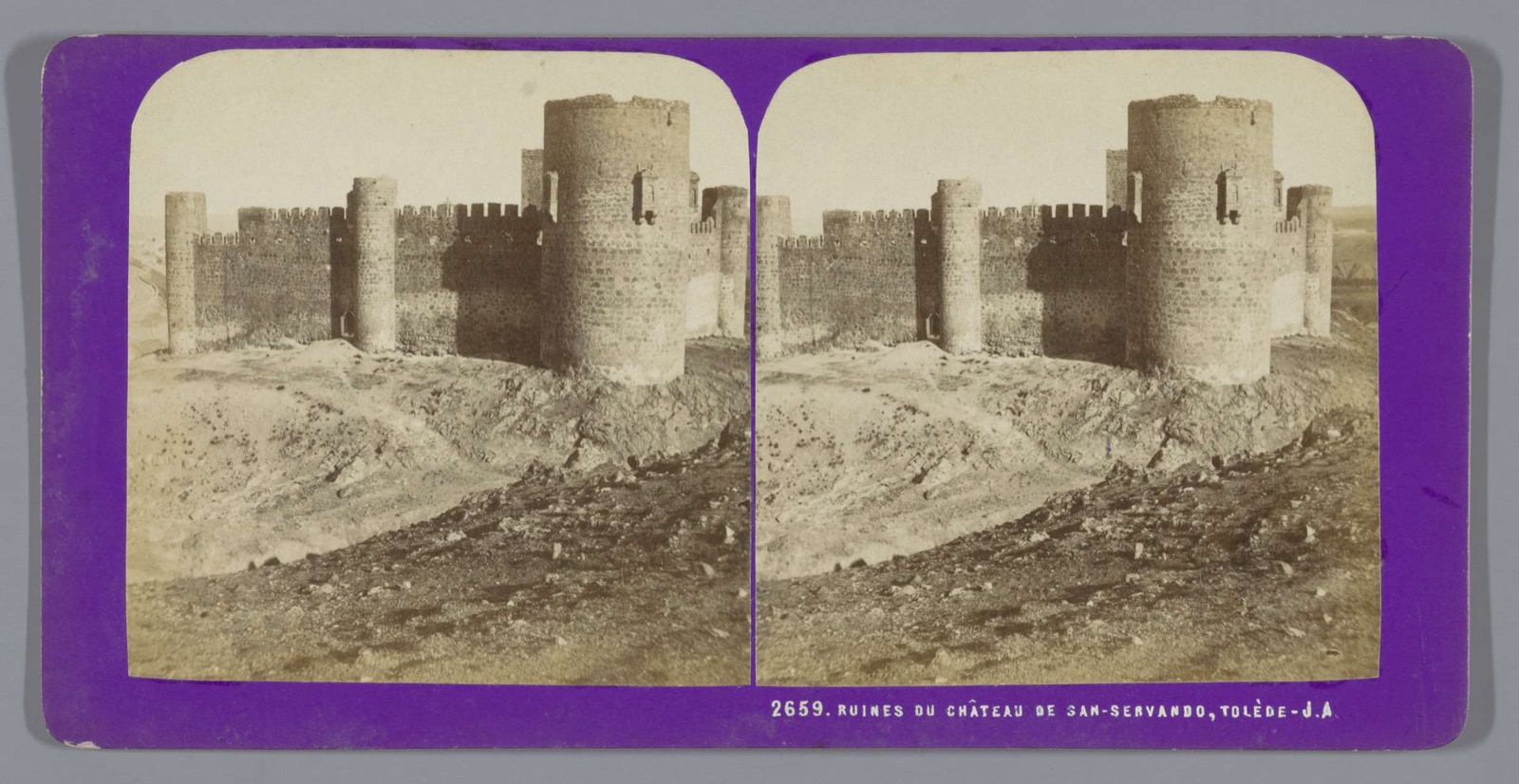
Gezicht op het Castillo de San Servando te Toledo
· Rijksmuseum (via Europeana)
Public domain

Questions about Castillo de San Servando
What is the history of Castillo de San Servando?
What is inside Castillo de San Servando?
Why was Castillo de San Servando built, and what was it used for?
Does anyone live in Castillo de San Servando now?
Where is Castillo de San Servando?
When was Castillo de San Servando built?
Was Castillo de San Servando ever attacked or besieged?
What did Castillo de San Servando look like in its prime?
Is Castillo de San Servando still standing, or is it a ruin?
More castles of Spain


Explore the city


