Clan Rising
St. Philip's Castle today

Spain · Partial ruin

St. Philip's Castle

Castillo de San Felipe

St. Philip's Castle (Castell de Sant Felip) is a coastal fortress on the Sant Carles point guarding the entrance to Mahón harbour on Menorca. Rebuilt by the British in the 1760s around an earlier 16th-century fort, it saw major action in the 18th century and was partly demolished after 1781. Today only low sections of the ashlar curtain walls, fragments of columns and vaulted openings survive as a partial ruin.

Photograph via Wikimedia Commons

First raised

1600

Its prime

1770

Today

Partial ruin

As it stood in 1770

What St. Philip's Castle looked like in its prime.

Low, thick curtain walls of pale beige limestone ashlar laid in horizontal courses form a roughly rectangular enclosure on a flat coastal point. Surviving masonry is generally single-storey height with large rectangular blocks and occasional dressed column shafts or pilaster bases built into wall faces. A deep rectangular arched opening pierces the seaward wall. The interior is a flat, grass-covered parade with scattered rubble, flagstone fragments and a narrow path beside the inner wall; low scrub lies beyond the walls toward the harbour.

Its story

The story of St. Philip's Castle.

St Philip's Castle, Castell de Sant Felip, often known as Fort St Phillip, guarded the entrance to the port of Mahón from the Sant Carles point on Menorca, in the municipality of Es Castell. A Spanish fort was established here about 1554; the fortress that followed was rebuilt by British forces in the 1760s around that earlier work.

The castle is best known for its two unsuccessful British defences: the Siege of Fort St Philip in 1756 and the Invasion of Minorca in 1781, after which it was partly demolished. Today only low sections of the ashlar curtain walls, fragments of columns and vaulted openings survive as a partial ruin.

Step inside

6 places to explore in 1770.

The record describes 6 distinct spots at St. Philip's Castle, including 4 interiors: parade ground / inner courtyard, arched casemate / seaward opening, inner wall walk alongside curtain wall and more. Create your own photoreal reconstruction and explore every one, more scenes means more rooms, more angles, and more of the place to stand in.

Exterior approach across the coastal pointParade ground / inner courtyardArched casemate / seaward openingInner wall walk alongside curtain wallTruncated column shafts and basesSea-facing battery and parapet

Build Your Own Castle

Recreate St. Philip's Castle with AI to explore it.

The artist rebuilds it as it stood in 1770, a photoreal reconstruction that belongs to you alone. Pay with coins, no subscription needed.

Recreate this castle →Defend this castle →

From the archive

St. Philip's Castle on paper: the measured plan and period views.

The survey plan and photographs below are the ground truth this page's reconstructions are checked against, drawn and photographed while the castle was still a working garrison. Every image is public-domain or openly licensed, with its source named.
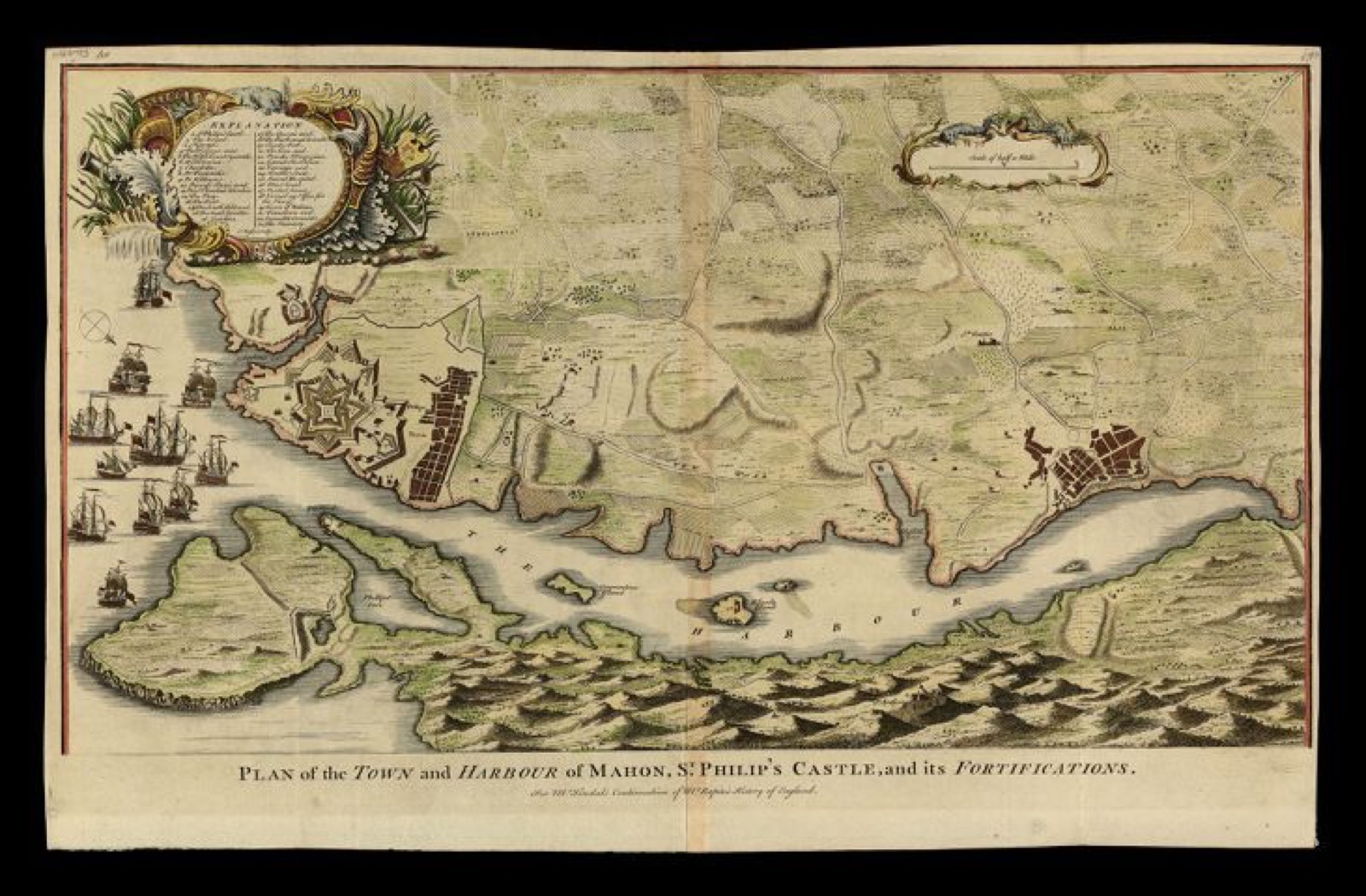
Plan of the town and harbour of Mahon, St. Philip's castle, and its fortifications / for Mr. Tindal's Continua, St. Philip's Castle

Plan of the town and harbour of Mahon, St. Philip's castle, and its fortifications / for Mr. Tindal's Continua

1744 · Cartographic and Geological Institute of Catalonia (via Europeana)

Public domain

Questions about St. Philip's Castle

What is the history of St. Philip's Castle?

St. Philip's Castle began as a 16th-century Spanish fort built to defend Menorca and the port of Mahón against attacks by Turkish fleets. It was rebuilt by British forces in the 1760s around the earlier fort. The British lost it during the 1756 siege, and after the 1781 invasion it was partly demolished.

What is inside St. Philip's Castle?

Inside St. Philip's Castle are a flat, grass-covered parade ground, an inner wall walk and a deep arched casemate opening in the seaward wall. Scattered rubble and flagstone fragments lie across the parade, while truncated column shafts and bases survive in the masonry. Part of the underground galleries has also been partially recovered.

Why was St. Philip's Castle built?

St. Philip's Castle was built to oppose repeated attacks by Turkish fleets in the western Mediterranean and to defend the entrance to Mahón harbour. Its position also supported Spanish communications with Italy in the 16th and 17th centuries. During the British occupation, it served as a naval arsenal supporting Gibraltar.

Where is St. Philip's Castle?

St. Philip's Castle is on the Sant Carles point at the southern side of the entrance to Mahón harbour, in the municipality of Es Castell on Menorca. It is a coastal fortress overlooking the harbour entrance.

When was St. Philip's Castle built?

St. Philip's Castle was first raised in the 16th century, about 1554, although its recorded inception year is 1600. The fort was rebuilt by British forces in the 1760s around the earlier Spanish work.

Was St. Philip's Castle ever attacked or besieged?

St. Philip's Castle was attacked and besieged more than once. French forces assaulted it in late June 1756 after the naval battle of Menorca, and the castle fell; Spanish forces captured it during the 1781 invasion of Menorca, after which it was partly demolished.

What did St. Philip's Castle look like in its prime?

In its prime, St. Philip's Castle had low, thick curtain walls of pale beige limestone ashlar arranged in horizontal courses around a roughly rectangular enclosure. The walls were generally single-storey in height, with large rectangular blocks and occasional column shafts or pilaster bases. A deep rectangular arched opening pierced the seaward wall.

Is St. Philip's Castle still standing or is it a ruin?

St. Philip's Castle is a partial ruin, with only low sections of the ashlar curtain walls, fragments of columns and vaulted openings surviving. It was partly demolished after the 1781 invasion, rebuilt in 1798, left partly rebuilt in 1802 and demolished again in 1805, leaving the batteries needed to defend the harbour.

Who built St. Philip's Castle?

St. Philip's Castle was designed in its early form by the Italian engineer Juan Bautista Calvi. He was appointed in 1554, produced a new design and moved the fort to its present site. An earlier design had been commissioned from Count Hugo of Cessane, but construction began before Calvi's appointment.

Can you visit St. Philip's Castle?

St. Philip's Castle can be visited, as part of its installations have recently been opened to the public. Since 1998, its ruins have been managed with other fortifications of Mahón harbour by the Consorcio del Museo Militar de Menorca y el Patrimonio Histórico-Militar del puerto de Mahón y Cala San Esteban.
All castles of Spain · Castles of Europe · the best castles in Europe · explore the finished reconstructions.