
Sweden · Ruin
Borgholm Castle
Borgholms slott
Borgholm Castle is a large Swedish fortress on the island of Öland that was rebuilt as a 17th-century baroque palace and completed in the early 18th century. The palace was gutted by fire in 1806 and today survives as an open ruin managed by the Swedish state, with the inner courtyard used for events and a museum on the site.
Its prime
1709
Today
Ruin
Ranked among Europe’s castles
As it stood in 1709
What Borgholm Castle looked like in its prime.
As it stood in its prime, the castle was a compact, rectangular baroque palace raised on a stone bastion: three-storey wings forming a closed quadrangle with a long, regular façade pierced by rows of tall rectangular windows and a ground-level arcade of arches. Massive, cylindrical corner towers projected above the wings; the masonry of the lower bastion is visibly thicker with small arched openings. The complex sat on a slight rise above open meadowland on Öland, rooflines continuous across the wings.
Its story
The story of Borgholm Castle.
A Kastal on Öland, and Valdemar Atterdag's Attack of 1361
A powerful tower, a kastal, was raised on the site late in the twelfth century and was soon ringed by a wall. That first work was probably ordered by King Canute I, who reigned 1167–1195 and had fortresses built along the Swedish east coast against enemies from across the Baltic, though the attribution is not certain. The fortress proper followed in the later thirteenth century and is reckoned to have stood complete by 1281.
Borgholm's importance was military: it sat on the sea roads between north and south, opposite Kalmar. Over the following centuries new towers went up and a thicker wall was built, and it was damaged on a number of occasions, among them in 1361, when Valdemar IV Atterdag of Denmark attacked.
Duchess Ingeborg to Nils Dacke, 1316–1543
Duke Valdemar Magnusson moved into Borgholm in 1316 with his wife, Ingeborg Eriksdotter of Norway. After the Nyköping banquet, at which Valdemar and Erik were killed, Ingeborg went on living at the castle until her death in 1356.
In February 1440 Karl Knutsson laid siege to Borgholm, held by Magnus Gren, and in July the castle capitulated. Another siege came in 1456, and when it changed hands that October Erik Eriksen Gyldenstierne the elder was carried off into Danish captivity. In 1487 Sten Sture besieged it while Ivar Axelsson Thott held the fief; Ivar fled and left the defence to his wife, Magdalena Karlsdotter Bonde, and the couple were allowed to surrender it and carry off their property.
The Danish commander Knud Rud surrendered Borgholm and the island to the Swedes in 1510 after an eighteen-week siege. Søren Norby took the fortress in 1519 and was granted Öland as a fief by Christian II, but by the summer of 1522 Swedish forces, helped by pro-Swedish peasants, held the island and the Danish garrison was shut inside the walls. In 1542 Nils Dacke stormed Borgholm and murdered the bailiffs Jöns Nilsson and Jacob Andersson along with the lawman Johan Kyle, and the year after declared the whole island free of tax.
The Pahr Brothers' Bastion Fortress and the Kalmar War, from 1572
The castle was destroyed in the Danish wars early in the sixteenth century and not put back into order until the reign of John III. From 1572 the works were directed first by Johan Baptista Pahr and then by his brother Dominicus, engineers from Milan; the rebuilding made Borgholm a Renaissance castle and one of Sweden's first bastion fortresses, in the Italianate bastion style. Building stopped in 1593 on Duke Karl's orders, but from 1602 the defence works were strengthened again, up to the outbreak of the Kalmar War.
On 8 August 1611 the Danes closed round the castle and the next day its commander, Johan Månsson, gave it up. Gustav Adolf surrounded Borgholm on 27 September, but only on 7 October did he force the Danish commander Kristen Hansen to capitulate. The Danes returned on 2 June 1612, and after nine days' bombardment Peder Mikaelsson Hammarskjöld surrendered the castle to Gert Rantzau. Under the peace of Knäred in 1613 the castle came back to Sweden plundered and badly knocked about; the repairs then begun were broken off after a decade or so.
Tessin's Unfinished Palace and the Fire of 1806
From 1651, when Öland was granted in fief to Charles X Gustav, building resumed under Nicodemus Tessin the Elder, for a baroque palace. When war with Denmark broke out again the place was fortified enough that Captain Henrik Julius Heideman could hold it against a Danish attempt to storm it on 17 August; the next day Admiral Wachtmeister relieved the castle and drove the Danes off.
Work halted at Charles X Gustav's death in 1660, was taken up again in 1681 and soon laid down once more. Whether the palace was ever finished is disputed: by one account it was completed in 1709, while Swedish tradition holds that Tessin's plan was never carried through, and that Erik Dahlbergh's stately view of it in Suecia antiqua et hodierna is inaccurate for that reason. The finished part decayed in its turn; the last usable rooms ended up housing a school and a textile dyeworks. On 14 October 1806 an accidental fire that began in the roof of the north wing completed the destruction.
The Listed Ruin and Its Concert Yard
What stands is the ruin of the baroque palace begun for Charles X Gustav. It is state-owned and managed by the National Property Board of Sweden, with Borgholm Municipality as operator, was designated a governmental listed building complex on 25 January 1935 and is recorded as an ancient monument in the Fornminnesregistret. It is open to visitors and houses a museum. The inner courtyard is used for concerts and theatre; Johnny Cash played there on 19 July 1997 and Bob Dylan in July 2001.
Step inside
7 places to explore in 1709.
The record describes 7 distinct spots at Borgholm Castle, including 1 interior: upper gallery of the north wing. Create your own photoreal reconstruction and explore every one, more scenes means more rooms, more angles, and more of the place to stand in.
Build Your Own Castle
Recreate Borgholm Castle with AI to explore it.
The artist rebuilds it as it stood in 1709, a photoreal reconstruction that belongs to you alone. Pay with coins, no subscription needed.
Recreate this castle →Defend this castle →From the archive
Borgholm Castle on paper: the measured plan and period views.
The survey plan and photographs below are the ground truth this page's reconstructions are checked against, drawn and photographed while the castle was still a working garrison. Every image is public-domain or openly licensed, with its source named.
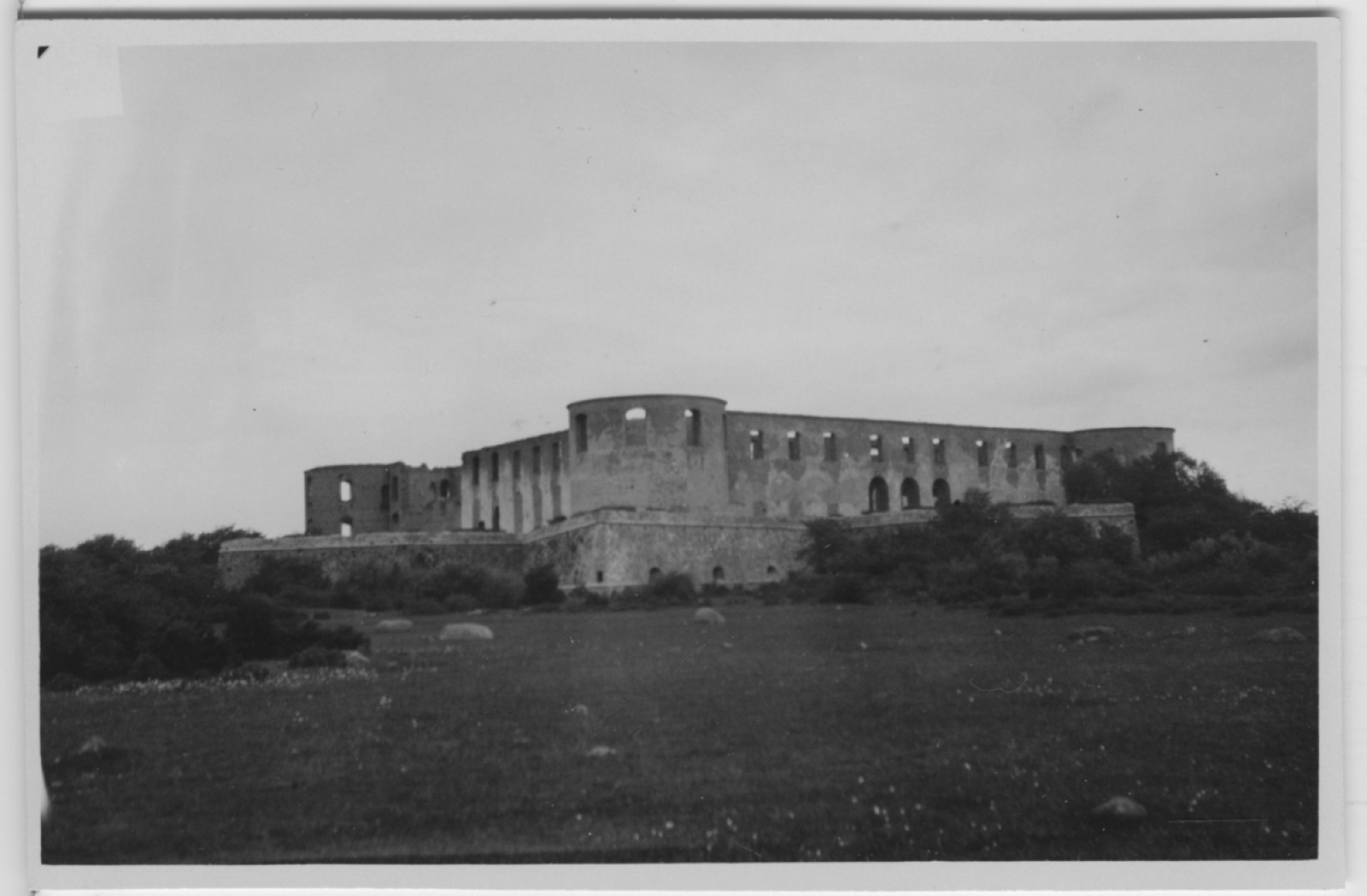
'Biologiska föreningens utfärd till Öland: :: :: Vy med Borgholms slottsruin. :: :: Se även fotonr. 2607-262
· Gothenburg Museum of Natural History (via Europeana)
CC BY


