Sweden · Restored
Malmö Castle
Malmöhus
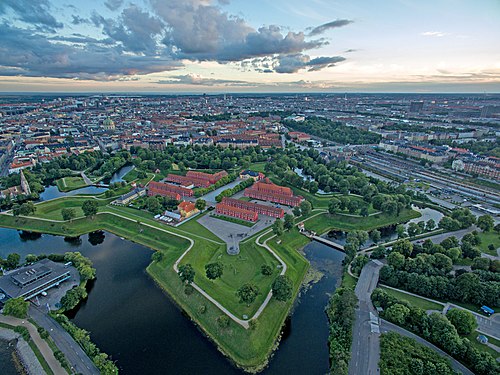
Malmö Castle (Malmöhus) is a Renaissance-era brick castle on a small island in Malmö, Sweden, now housing museum collections. The surviving complex includes a long rectangular main building, curtain walls and a surrounding moat, with ancillary buildings such as the Commandant's House and the Castle Mill nearby.
First raised
1434
Its prime
1540
Today
Restored
Ranked among Europe’s castles
As it stood in 1540
What Malmö Castle looked like in its prime.
A long, rectangular red-brick main building with regularly spaced windows and a pronounced stepped-gable roofline faces a wide water-filled moat. In the foreground a low, cylindrical red tower sits on its own islet with small rectangular embrasures and a shallow metal roof. Thick curtain walls connect the tower and main block; a stone bridge or causeway crosses the moat. Reed beds fringe the water and the castle’s brick surfaces reflect in the moat.
Its story
The story of Malmö Castle.
Eric of Pomerania's Sound Toll, 1429–1434
The Øresund toll was introduced in 1429 by King Eric of Pomerania: any foreign ship crossing the line between Helsingør and Helsingborg had to pay. To hold that line the king fortified the Sound on every side: he built the castle of Krogen at Helsingør, the forerunner of Kronborg, reinforced Helsingborg Castle facing it, made Copenhagen his capital, and in 1434 began a fortress at Malmö.
Malmö had carried a simple fortification since the fourteenth century and a seawall had been rising since the early 1400s; royal order now accelerated that work, and the new fortress became its western defence point. It was of the kastell type (a rectangular block inside high walls with a gate tower), and was known as Møntergaarden, the Mint, later the site of all Denmark's coin production. An outer bailey stood to the east until the present moat was dug in the 1530s.
Ravensberg's Castle and the Count's Feud, 1525–1540
In 1525 Frederick I ordered Albert Jepsen Ravensberg, his lord at Malmö, to build a new castle; the following year the newly formed Malmöhus fief took it as its residence. In 1530 Ravensberg was paid 5,690 marks, a very considerable sum, for four years of building work, and it was in that stretch that the present main building went up; a three-storey firing gallery was to frame the inner courtyard, with four-storey galleries reaching west and east. A fire broke out in 1529, though nothing survives to say how serious it was, and the fief revenues for the building rose from 300 marks to 500 the next year and to 888 by 1532.
When the Count's Feud broke out in 1534, the burghers tore down the great wall and its firing galleries running from the main building around the inner courtyard. The scars of that wall are still legible in the masonry of the main building, evidence that the present castle already stood before 1534, against the frequent claim in the literature that it was built after the feud ended. The master builder Marten Bussert, drawing on Netherlandish and Italian fortification, was probably responsible for the new work. Between 1537 and 1540 Christian III had the castle strengthened with a moat and ramparts carrying four large brick corner towers.
A National Castle, and Bothwell's Six Years
Malmöhus län was created in 1526 out of the withdrawn Lindholm fief, whose revenues made it possible to run a national castle on this scale. The lords of Malmöhus were appointed by the king in person and came, as a rule, from Denmark's wealthier noble houses. The heir to the throne, later Frederick II, resided here from 1554 to 1559. The Earl of Bothwell, Mary Stuart's third consort, was held prisoner in the castle from 1567 to 1573. Frederick III, staying briefly in 1652, was the last Danish king to live here.
Turned Against Copenhagen after 1658
In the Swedish period that opened in 1658 the castle lost its role as a royal residence and passed to the castle commandants. It was recast as a riksfästning, a national fortress, now aimed at Copenhagen, capital of a hostile Denmark. After 1710 that strategic importance fell away and the buildings began instead to hold prisoners, among them Jörgen Krabbe and Carl Gustaf Armfeldt the Younger, counted among the Anjala men, who died here in 1792.
From Prison Yard to Museum Island, 1822–1937
In 1822 the buildings were handed over to the Prison Board, and in 1828 the Malmö Correctional Workhouse opened, then Sweden's largest and most modern prison. A county prison built on the separate system went up outside the eastern side of the moat in 1854–55, with 102 light cells and five dark ones. Among those held were Carl Fredrik Lilja, imprisoned from 1846 to 1848 after a raid on the Ystad savings bank, and Axel Danielsson, founder of the newspaper Arbetet, who served eighteen months in 1889–90 for criticising Malmö's city court.
Fire struck the castle on 4 September 1870. Christian IV's large western wing was demolished and replaced in 1876 by a central prison of 137 cells with 304 accommodation places, where the robber and murderer Lars Nilsson was executed in 1900 by the executioner Anders Gustaf Dalman. When the new central prison opened on Lundavägen in 1914 the Malmöhus facilities went out of use, though prisoners were received again briefly between 1919 and 1921. The county prison served as emergency housing until it was pulled down in 1927, and the central prison buildings were demolished in 1933.
The castle building had already been restored in 1928, and in 1935 Malmöhus was made a state listed building. New museum premises rose on the castle islet through the 1930s to designs by C. A. Stoltz, winner of the 1931 competition, and in 1937 the museum moved in.
Step inside
9 places to explore in 1540.
The record describes 9 distinct spots at Malmö Castle, including 2 interiors: three-storey gateway / main entrance, inner courtyard. Create your own photoreal reconstruction and explore every one, more scenes means more rooms, more angles, and more of the place to stand in.
Build Your Own Castle
Recreate Malmö Castle with AI to explore it.
The artist rebuilds it as it stood in 1540, a photoreal reconstruction that belongs to you alone. Pay with coins, no subscription needed.
Recreate this castle →Defend this castle →Nearby