
Sweden · Restored
Kalmar Castle
Kalmar slott
Kalmar Castle is a major Swedish Renaissance castle on the Baltic coast at Kalmar, originally founded as a 12th-century defensive tower and expanded with curtain walls, corner towers and gatehouses. Rebuilt and remodelled most extensively under King Johan III in the late 16th century, it became a royal residence and administrative fortress and later underwent 19th–20th century restorations; today it is a preserved Renaissance castle open to the public.
First raised
1200
Its prime
1590
Today
Restored
Ranked among Europe’s castles
As it stood in 1590
What Kalmar Castle looked like in its prime.
Sited on the harbour edge of Kalmarsund, the castle presents a compact silhouette of white-painted masonry curtain walls punctuated by round corner towers and two square gatehouses; most towers have been reduced to a uniform height with lead-clad roofs while three older towers (southeastern, northeastern and Kuretornet) retain their original profiles. Gable roofs are covered in red clay tiles, windows are squared, and the central older round defensive tower rises within the walled enclosure.
Its story
The story of Kalmar Castle.
From Watchtower to Kalmar Union
Kalmar Castle grew up on Slottsholmen, an islet at the mouth of Kalmar's medieval harbour on the Baltic sound. Probably towards the end of the twelfth century, in the time of King Knut Eriksson, a round defensive tower, a kastal, was raised on the already-settled islet. In the 1280s King Magnus Ladulås had a proper fortress built around it: a curtain wall, round corner towers and two square gatehouses, with the old kastal absorbed as the keep. Magnus Eriksson enlarged the castle again in 1337, raising at least the ground floors of new wings and adding a further outer wall with small towers and a projecting barbican.
In 1397 the castle was the setting for one of the most significant political events in Scandinavian history: the formation of the Kalmar Union, joining Denmark, Norway and Sweden, with Finland, under Queen Margaret I. Kalmar was reckoned, alongside Tre Kronor, Viborg Castle and the fortress of Älvsborg, one of the four strongholds that held the kingdom together.
The Rebellion Against Denmark, 1520–1525
During the Swedish rebellion against Danish rule, Anna Eriksdotter (Bielke) took command of Kalmar on the death of her husband, Johan Månsson Natt och Dag, in 1520. What she did with that command is told two ways: one tradition has her holding the castle against Denmark, another that she received the returning Gustav Vasa there, a claim the historian Herman Lindqvist has disputed, arguing Vasa moved on from Kalmar within days. Kalmar held out longer than anywhere in the kingdom but Stockholm: it was not until 1523 that its German garrison capitulated, after the townspeople (learning the garrison meant to burn Kalmar and carry off its provisions to Visby) secretly treated with the besieging Swedish forces of Arvid Gustafsson Västgöte. A surprise attack on the fourth day of Pentecost delivered the town; the castle surrendered eight days later, opening the way to conquer Öland.
The castle's troubles were not over. Its appointed bailiff, Berent von Mehlen, fell out of favour with King Gustav Vasa in 1525 and was besieged in his own castle; the king took Kalmar back by storm, at heavy cost on both sides.
Johan III's Renaissance Rebuilding
Kalmar's transformation from medieval fortress into a residence fit for a Renaissance king began under Gustav Vasa and continued under his sons, Eric XIV and Johan III. Johan III pressed the work hardest, starting almost as soon as he was crowned: the architect Johan Baptista Pahr took charge of the rebuilding, succeeded in 1575 by his brother Dominicus Pahr. All the towers but three (the south-eastern, the north-eastern and the one called Kuretornet) were brought to a uniform height and roofed in lead; the windows were reshaped into squares, the old roofing replaced with clay-tiled gables, the facade painted white and the roof red.
Interior work followed from 1587, two years after Johan III had visited the finished exterior: the old throne room, the chequered hall and the grey hall were remodelled, and the new throne hall took the interior it still shows today, decorated with 2,200 gold-painted leaves. A castle church was added in 1589–92. By the time the four round corner towers begun under Gustav Vasa were finally completed early in the next century, Kalmar's armament stood at 287 guns.
The Second Kalmar Bloodbath, 1599
When Duke Charles rose against King Sigismund, Kalmar's garrison stayed loyal to the king and held out even after Sigismund's decisive defeat at the Battle of Stångebro. The Duke's forces besieged the castle from March 1599 and forced its surrender on 12 May. Its three commanders were executed along with nineteen other members of the garrison, a mass killing remembered as the Second Kalmar Bloodbath.
The Kalmar War, 1611–13, and a Slow Decline
Kalmar was fought over again in the Kalmar War. A Danish army took the town in 1611 while a Swedish army under Karl IX marched south to relieve it; the castle itself was besieged, and its newly appointed commander, Christer Somme, capitulated; whether for want of ammunition or through treachery was never settled. Sweden recovered Kalmar in 1613; its shattered armament was soon replaced, and by the second half of the century the castle could still pass for a strong fortification.
Fire badly damaged the castle in 1642, and from the end of the seventeenth century it was left to decline, its repairs begun but not sustained. Restoration began in 1856 under the architect Fredrik Wilhelm Scholander and continued in the 1880s under his pupil Helgo Zettervall, working from plans drawn up by Carl Möller; by 1891 the castle had regained the silhouette it carries today. Professor Martin Olsson took charge of restoring the earthworks, moat, bridge and drawbridge from 1919, and by 1941 Kalmar was once again surrounded by water, one of Sweden's best-preserved Renaissance castles.
Step inside
11 places to explore in 1590.
The record describes 11 distinct spots at Kalmar Castle, including 4 interiors: nya kungamaket (new throne hall), gamla kungamaket (old throne room), rutsalen (chequer hall) and more. Create your own photoreal reconstruction and explore every one, more scenes means more rooms, more angles, and more of the place to stand in.
Build Your Own Castle
Recreate Kalmar Castle with AI to explore it.
The artist rebuilds it as it stood in 1590, a photoreal reconstruction that belongs to you alone. Pay with coins, no subscription needed.
Recreate this castle →Defend this castle →From the archive
Kalmar Castle on paper: the measured plan and period views.
The survey plan and photographs below are the ground truth this page's reconstructions are checked against, drawn and photographed while the castle was still a working garrison. Every image is public-domain or openly licensed, with its source named.
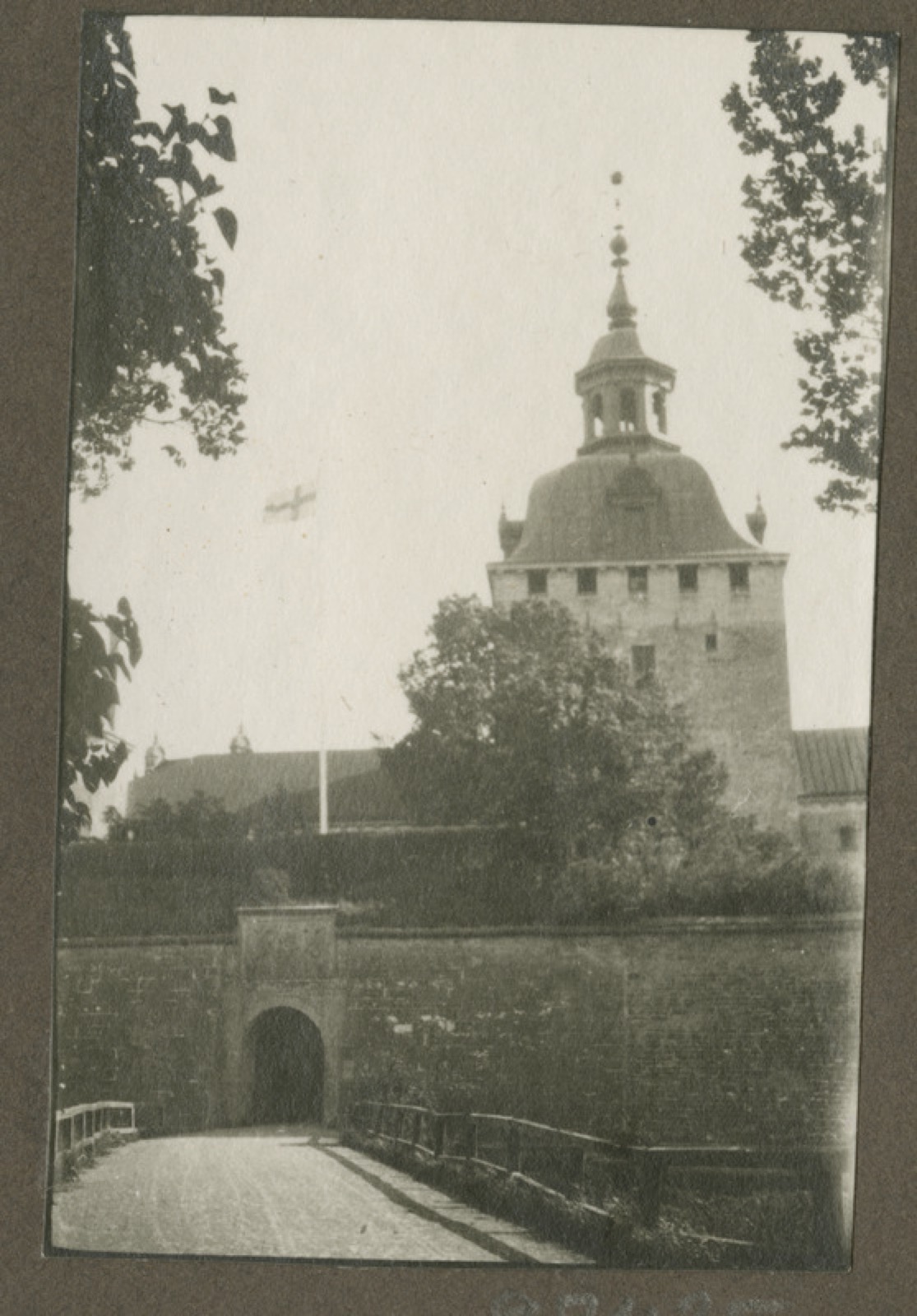
Kalmar Castle
· Estonian Maritime Museum (via Europeana)
CC0 (no rights reserved)
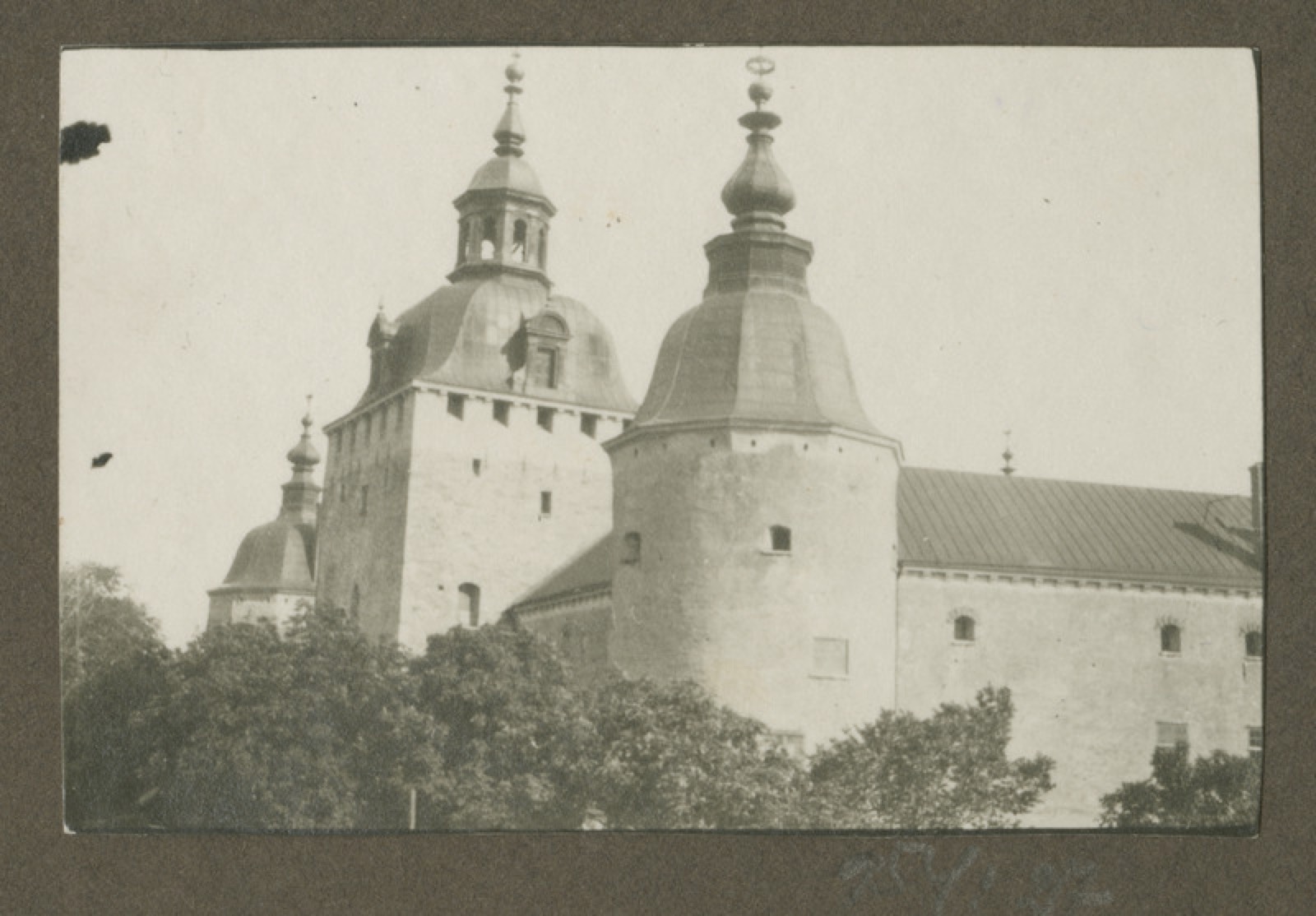
Kalmar Castle, Sweden
· Estonian Maritime Museum (via Europeana)
CC0 (no rights reserved)
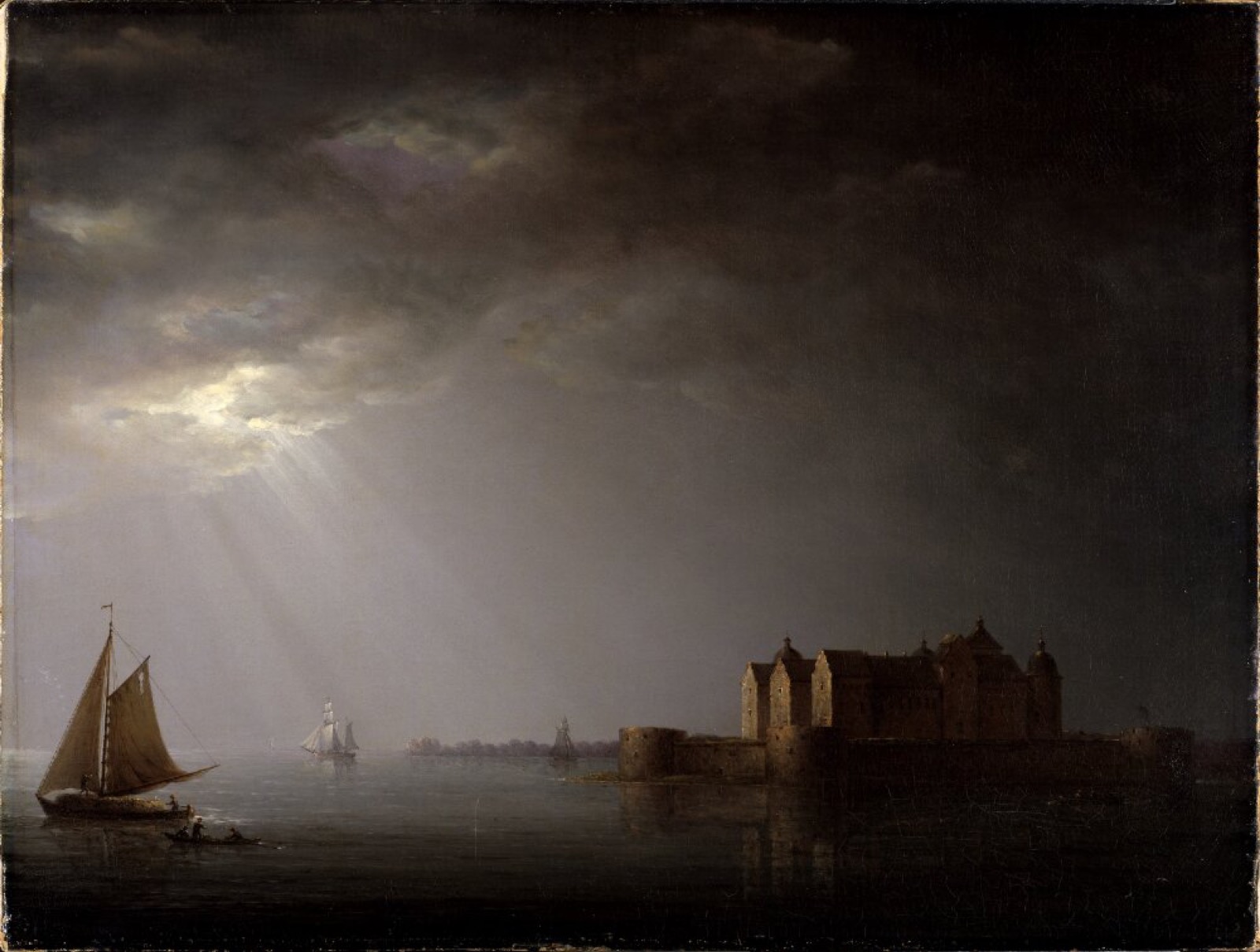
Kalmar slott i månsken
1835 · Nationalmuseum Sweden (via Europeana)
Public domain


