Sweden · Still standing
Örebro Castle
Örebro slott
Örebro Castle is a stone castle on a small island in the Svartån river in Örebro, Sweden. It originated as a medieval defensive tower, was expanded into a Renaissance residence under the House of Vasa and was finally rebuilt around 1900. Today the building is intact and houses public functions including some school rooms.
First raised
1400
Its prime
1900
Today
Still standing
Ranked among Europe’s castles
As it stood in 1900
What Örebro Castle looked like in its prime.
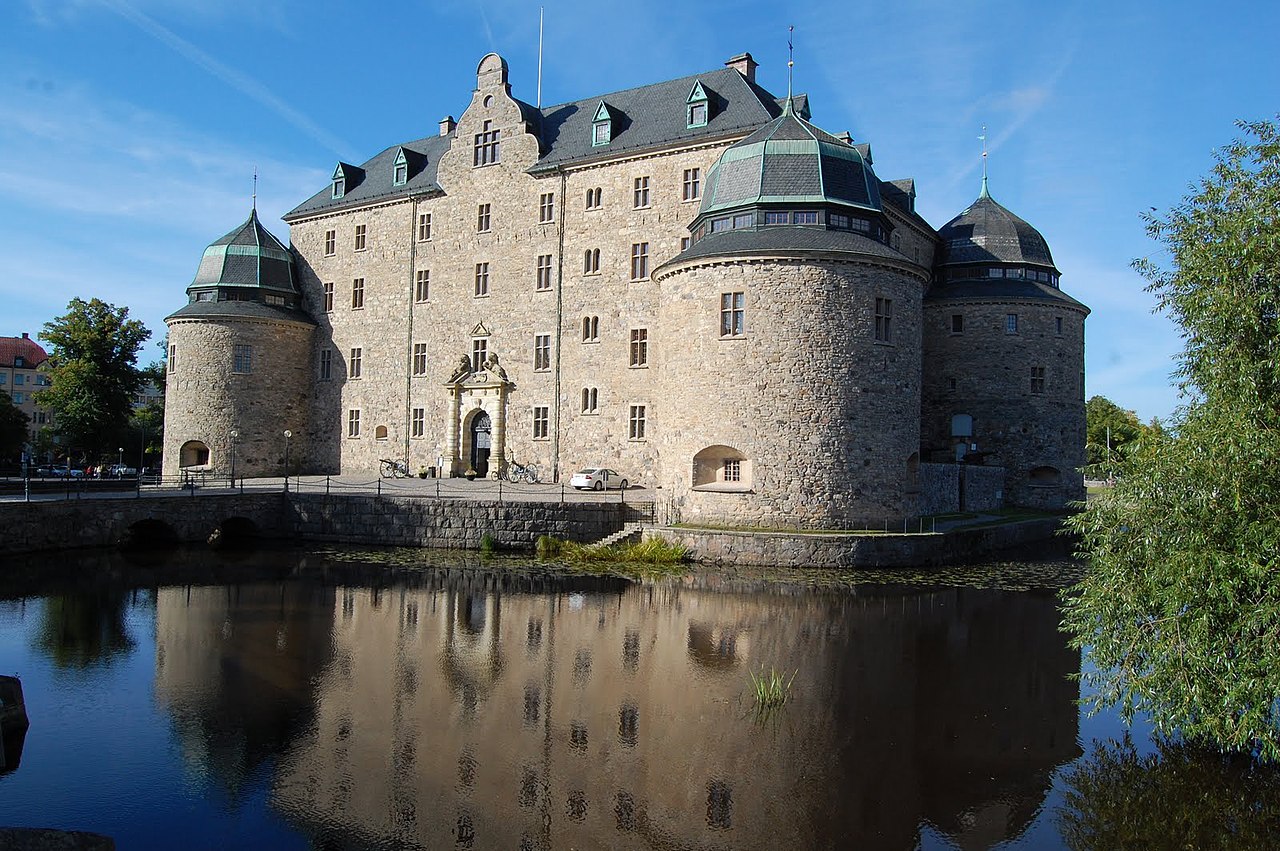
A compact rectangular main block of roughly five storeys, flanked symmetrically by large cylindrical round towers built of roughly coursed grey fieldstone; roofs are steep, dark slate with small dormer windows and copper-clad conical/hexagonal caps on the towers showing a green patina. A carved stone entrance portal sits centrally on the river-facing façade. The castle stands on a low stone quay on a small island in the brown water of the Svartån, with a short stone bridge giving access.
Its story
The story of Örebro Castle.
The Castrum on the Svartån, 1347–1364
A royal manor at Örebro is mentioned in 1347, probably unfortified; from the mid-1360s the records speak of a castrum, a royal castle, on the holm in the Svartån, usually credited to King Magnus Eriksson in the 1350s. A thirteenth-century origin has often been claimed for the first defensive work, but no archaeological find or document attests a castle of that date.
It seems to have gone up in three stages: a seven-metre grey-stone ringwall with a wooden fighting gallery to the west; a tower at least 25 m high in the south-west corner; then ranges on three sides of the courtyard, the southern one probably the oldest. The Svartån ran round the island as a moat, crossed by a drawbridge. The castle was a cavalry base and held a prison in the lower keep. In 1364 Duke Albrekt of Mecklenburg reckoned he had taken the castles of Örebro and Sundby.
Engelbrekt, the Siege of 1501 and Gustav Vasa, 1434–1540
Engelbrekt took Örebro hus in 1434 and later held it as his fief. Arvid Trolle and Magnus Bengtsson (Natt och Dag) besieged it in 1467, and after its fall Karl Knutsson held a lords' assembly at Örebro in 1468. A peasant army besieged the castle in 1501, held by the Danish union bailiff Jöns Falster; after seven months, in February 1502, Svante Nilsson took it. Christian II of Denmark retook it in 1520 in his struggle with the Swedish nobles.
Gustav Vasa besieged the castle in 1521 on his way to the crown and took the badly battered place after nine months, at the beginning of 1522. He had it repaired, and important meetings followed: the church assembly of 1529, the Örebro council, which abolished the vow of celibacy and the fast, and the 1540 meeting at which he made the monarchy hereditary.
Duke Karl's Renaissance Castle and Its Decay, from 1568
The last fighting at Örebro came in 1568, when the dukes Johan and Karl rose against Erik XIV. Karl inherited the castle and began a great rebuilding in 1573, modelled on the Renaissance châteaux he had seen in France. Four ranges rose in a square around the courtyard, the new main building as high as the old keep; the corner towers were begun as postejer, low rounds for heavy guns, obsolete as they neared completion. Earth ramparts ran round the whitewashed castle, partly surviving on the north side.
Six diets sat here between 1602 and 1617 under Karl IX and Gustav II Adolf; between them the castle served as prison, gun depot and grain store. Karl IX's widow, Kristina of Holstein-Gottorp, saw the work finished in 1625, by which time Örebro no longer held its old strategic position and there was no real task for it to fill. Without maintenance it began to decay.
Gaol and Governor's Residence, 1631–1859
A tower collapsed early in the eighteenth century, and repair waited until the 1750s, when drawings by Carl Hårleman turned Örebro into a plain classicist castle: domed tower roofs gave way to flat conical ones, the ramparts to terraces. The royal apartment was remade in rococo as the residence of the county governors, in use from the 1760s. In 1810 the castle housed Karl XIII while the Riksdag at Örebro elected Jean Baptiste Bernadotte heir to the throne.
Prison rooms lay on the lowest floor of the two southern rounds. Olof Fant's wife, the only person executed for witchcraft at Örebro, was held in the 'witch chamber' from 1631 to 1633, and those accused in the Södra Ny witch trial were imprisoned here in 1720–21. On 25 October 1859 some fifteen prisoners were moved to the newly built county cell prison on Slottsgatan, and the castle's gaol appears to have closed by the following year.
The Restoration of 1897–1901 and the Castle Since
Money was collected at the end of the nineteenth century to restore the decayed castle, on the model of Gripsholm's historicist restoration. The work of 1897–1901 followed drawings by Thor Thorén after ideas of Adolf Kjellström: the façade plaster was knocked off to bare the raw limestone, and the two western towers were raised by a storey on the mistaken belief that they had once been higher. The result is not a recovered Renaissance castle but a late nineteenth-century idea of one.
Örebro Castle has been a state building monument since 1935, owned by the National Property Board of Sweden. It is still the county governor's residence, closed to the public, while other parts hold exhibitions, tours, conferences and a restaurant; the governor's stable, built a few years after the 1750s works, holds teaching rooms of the Karolinska school. Guns raised in 1909 from the Danish ship Enigheden, sunk in Kalmarsund in 1679, stand on the rampart outside. Charcoal found in the cellar in 2018 was radiocarbon-dated to the seventh century, though its origin is unclear.
Step inside
7 places to explore in 1900.
The record describes 7 distinct spots at Örebro Castle, including 2 interiors: defence tower interior (interior), interior rooms used as classrooms (interior). Create your own photoreal reconstruction and explore every one, more scenes means more rooms, more angles, and more of the place to stand in.
Build Your Own Castle
Recreate Örebro Castle with AI to explore it.
The artist rebuilds it as it stood in 1900, a photoreal reconstruction that belongs to you alone. Pay with coins, no subscription needed.
Recreate this castle →Defend this castle →Whose castle
Clans who held Örebro Castle.
The families that held Örebro Castle for a decade or more across its history, follow a name to its clan.
Vasa
Expanded into a Renaissance residence during the reign of the royal House of Vasa.


