
Switzerland · Still standing
Valère Castle
Château de Valère
Valère (Basilique de Valère) is a fortified church complex and former castle on Valère hill above Sion in the canton of Valais, Switzerland. The site combines a Romanesque-Gothic basilica with surrounding curtain walls, towers and a fortified village and contains one of the world's oldest functioning pipe organs.
First raised
1000
Its prime
1435
Today
Still standing
Ranked among Europe’s castles
As it stood in 1435
What Valère Castle looked like in its prime.
Perched on a rocky hilltop, the complex is a compact cluster of grey stone buildings: a tall square central tower with a hipped/slate roof rises above a long nave with buttressed side aisles and a semi-circular apse. Thick curtain walls and round and rectangular towers enclose terraces and a small fortified village; several roofs are slate and one white-painted residence sits against the inner wall. The hill drops steeply on all sides and the castle overlooks the town below.
Its story
The story of Valère Castle.
The Prince-Bishops of Sion, 6th Century to 1049
The Diocese of Sion had shifted its cathedral seat from Octodurum (Martigny) to Sion in 589, after Bishop Heliodorus judged the lower town too exposed to flooding from the Rhône and the Drance. In the late tenth century Rudolph III, the last King of Upper Burgundy, granted the County of Valais to Bishop Hugo, who held the see between 998 and 1017. The grant fused spiritual and secular authority in one office, making the Prince-Bishops of Sion the most powerful nobles in the upper Rhône valley. On the hill above the town, Valère became the residence of the cathedral chapter, while the Prince-Bishop himself governed from Tourbillon Castle on the opposite hill. The name Valère is first recorded in 1049, naming it as the seat of that chapter.
From Romanesque Chapel to Gothic Basilica, 1100–1267
The earliest parts of the church were raised between 1100 and 1130 in the Romanesque style. A second building campaign, begun after 1130, added the semicircular apse, the walls, the windows and a roof. A third phase carried the building into the new Gothic idiom: between 1235 and 1267 the nave was extended and flanked with two side aisles, the choir was covered with a ribbed vault, and a rood screen was installed to separate the chancel from the nave.
The Valère Organ, 1430s–1700s
Around 1430–1435 a pipe organ was installed on the west side of the church, probably brought there by Guillaume de Rarogne, who later became bishop of Sion. Its pipes are arranged to suggest the outline of a church, the largest forming two towers and the smaller ones a triangular roof; murals in the building date from the same years, and a Gothic marble statue of the Madonna and Child was placed over the high altar in the 15th century. Choir stalls were added in the mid-17th century, and in the 1700s the organ was modified to play Baroque music, otherwise remaining essentially as built, believed to date to 1435, it is among the oldest organs in the world still in playing condition.
Restoration and the Minor Basilica, 1954 to the Present
The organ fell silent before being restored in 1954 by the Kuhn workshop, which returned it to use. The church was raised to the rank of minor basilica during a visit by Pope John Paul II, dated 7 October 1987 in some accounts and 1984 in others. A further restoration of the organ followed in 2004, carried out by the Füglister workshop of Sion, which lowered its pitch to around 450 Hz, a quarter-tone above modern concert pitch, so that it can now be played alongside other instruments only with difficulty. Valère's canons occupied the site until the French Revolution; their former lodgings now house the History Museum of Valais, founded in 1883 and rebuilt from 2008. A restoration campaign covering the whole site has run since 1987, its fifth stage approved by the Valais parliament in March 2015 and begun in 2016. Valère is registered as a class A Swiss cultural property of national significance, and the basilica remains in use as a Roman Catholic church, open to visitors and host to an annual festival of early organ and early music.
Step inside
11 places to explore in 1435.
The record describes 11 distinct spots at Valère Castle, including 5 interiors: nave and aisles, choir and high altar, west organ gallery and more. Create your own photoreal reconstruction and explore every one, more scenes means more rooms, more angles, and more of the place to stand in.
Build Your Own Castle
Recreate Valère Castle with AI to explore it.
The artist rebuilds it as it stood in 1435, a photoreal reconstruction that belongs to you alone. Pay with coins, no subscription needed.
Recreate this castle →Defend this castle →From the archive
Valère Castle on paper: the measured plan and period views.
The survey plan and photographs below are the ground truth this page's reconstructions are checked against, drawn and photographed while the castle was still a working garrison. Every image is public-domain or openly licensed, with its source named.
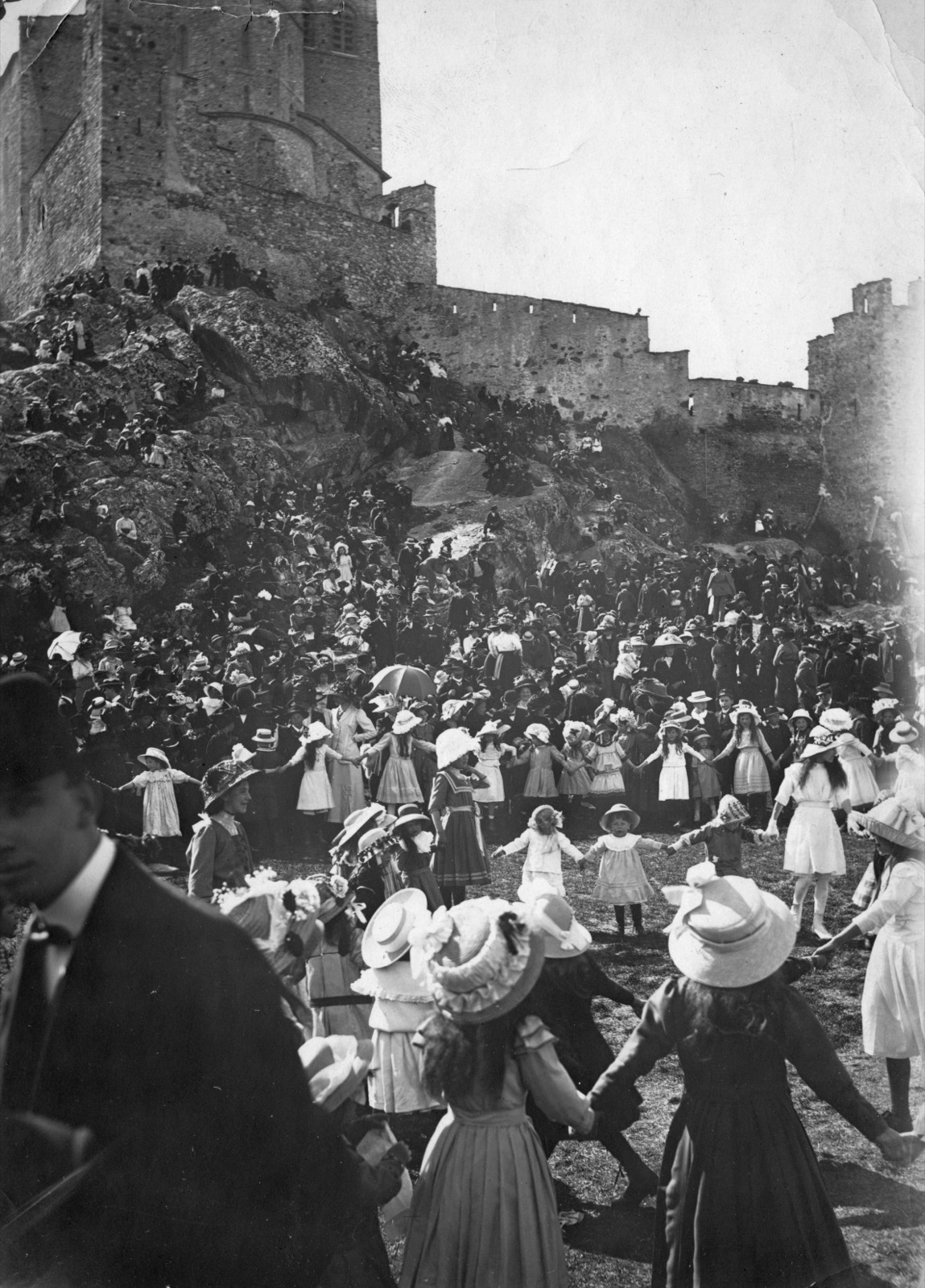
Valère bazilika
1912 · Fortepan (via Europeana)
CC BY-SA
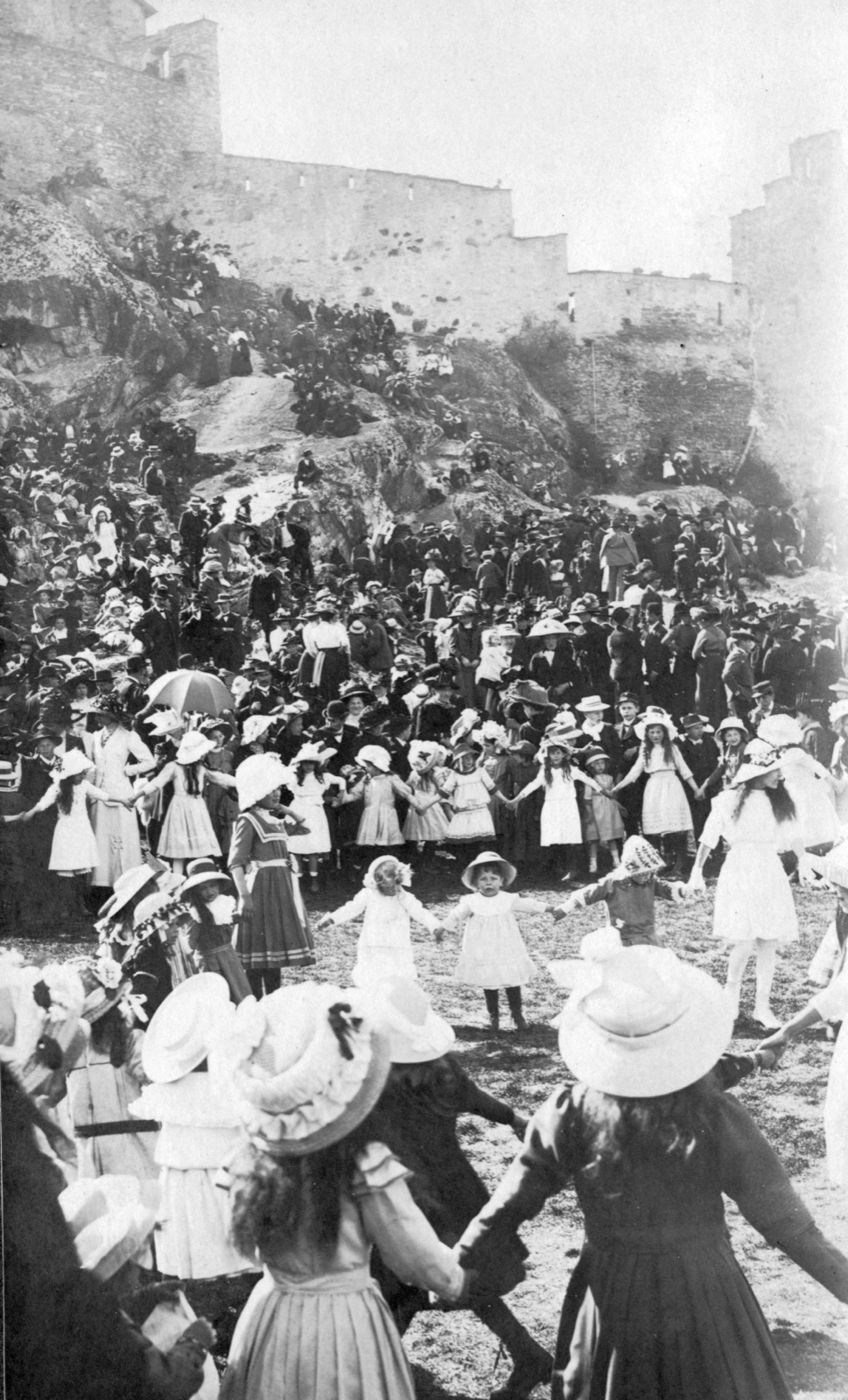
Körtánc, Valère-bazilika
1912 · Fortepan (via Europeana)
CC BY-SA


