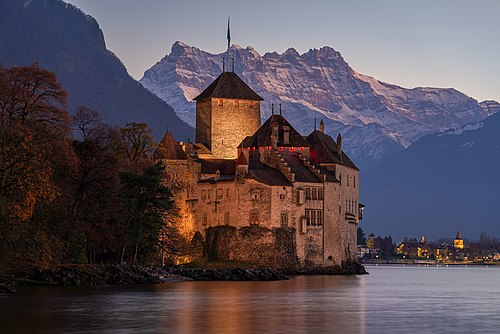
Switzerland · Restored
Wildenberg Castle
Planta‑Wildenberg (Wildenberg) Castle is a historic L-shaped castle in Zernez, Canton of Graubünden, and is listed as a Swiss heritage site of national significance. Originating in the late 13th century, it was rebuilt and expanded in the 17th and 18th centuries by the Planta‑Wildenberg family and was restored in 1989–94; since 2007 it houses the Swiss National Park administration.
Its prime
1760
Today
Restored
As it stood in 1760
What Wildenberg Castle looked like in its prime.
An L-shaped stone castle with a central medieval tower rising at the inner corner of the L; the tower was later finished with an 18th‑century spire. Thick stone curtain walls enclose small gardens within the north‑west angle of the L and along the south side, while an enclosed courtyard lies to the east and north‑east. A gate into the garden bears a combined 1650 coat of arms; an external stair (dated 1760) has heraldic panels above it. Two residential wings connect via a large interior staircase with a richly stuccoed and painted classical ceiling from the 17th century.
Its story
The story of Wildenberg Castle.
Wildenberg Castle in Zernez was first mentioned in 1280/90 as the home of the Wildenberg family, a cadet branch of the Greifenstein family of Filisur who, in addition to their Wildenberg castle at Falera, owned castles and estates throughout the valleys of Graubünden.
In 1296 the Bishop of Chur took the right to collect the Wildenberg tithes and pledged it to the Lords of Planta; by the 14th century the castle was owned by the bishop and held by the Planta family. In 1365 representatives from the communities around Chur met at the castle for the first time under Planta auspices, and by around 1400 the branch, now styling itself von Wildenberg or Planta-Wildenberg, held the castle as a permanent fief.
The Planta-Wildenbergs often lent money to the bishop, though relations were not always good, and late in the 15th century they supported him against the emperor; Balthasar von Planta-Wildenberg, married six times, had numerous children who helped increase the family's wealth and power. Rebuilt and expanded in the 17th and 18th centuries, the L-shaped castle was restored in 1989–94 and has housed the administration of the Swiss National Park since 2007.
Step inside
7 places to explore in 1760.
The record describes 7 distinct spots at Wildenberg Castle, including 1 interior: large interior staircase and stuccoed ceiling. Create your own photoreal reconstruction and explore every one, more scenes means more rooms, more angles, and more of the place to stand in.
Build Your Own Castle
Recreate Wildenberg Castle with AI to explore it.
The artist rebuilds it as it stood in 1760, a photoreal reconstruction that belongs to you alone. Pay with coins, no subscription needed.
Recreate this castle →Defend this castle →Whose castle
Clans who held Wildenberg Castle.
The families that held Wildenberg Castle for a decade or more across its history, follow a name to its clan.
Wildenberg
First mentioned in 1280/90 as the home of the Wildenberg family, a cadet branch of the Greifensteins of Filisur.
Planta
Held by the Planta family from the 14th century, as a permanent fief from around 1400, when the branch took the name Planta-Wildenberg.