
Ukraine · Restored
Olesko Castle
Olesko Castle is a historic hilltop castle in western Ukraine, recorded from 1390 and later remodelled in Renaissance style. It served as a noble residence and is today a restored museum displaying 16th–17th century furnishings and artworks. The compact oval stronghold stands on a small 50 m hill and is part of a local ring of castles known as the "Golden Horseshoe."
Its prime
1682
Today
Restored
As it stood in 1682
What Olesko Castle looked like in its prime.
Olesko Castle sits oval on a low, wooded hill surrounded by a former moat and swamp. The plan is compact: joined rectangular residential blocks around an inner courtyard, a rounded stone bastion on the lower slope and a low curtain wall. Rooflines alternate steep slate gables and a larger hipped roof, plus a small pavilion capped by a green copper roof. Exterior walls are pale stone or plaster over masonry; an arched loggia opens onto the courtyard. The fabric appears complete and occupied.
Its story
The story of Olesko Castle.
A Fortress on the Volhynia–Galicia Line, 1327–1382
Olesko was probably raised on its hill above the Libertsia by a son of the Galician-Volhynian prince Yuri Lvovych. The first castle was a low oval enclosure whose stone wall partly survives as the lower tier of the building today. Olesko is first named in a document of 1327, when it passed to Prince Yuri II of Galicia-Volhynia; other accounts date the first record instead to 1390, when Pope Boniface IX gave Olesko and Tustan to a Catholic bishop of Halych.
The castle sat on the boundary of Volhynia and Galicia, on the shifting Polish–Lithuanian frontier, and was fought over continually. The Lithuanian prince Liubart held it from 1340 until Casimir III the Great took it in 1366; Władysław of Opole then handed Olesko, Rohatyn and Tustan to the new Latin archbishopric of Halych in 1375, and rebels seized the castle briefly in protest. Hungarian troops garrisoned it from 1377 and gave it up to Liubart for a ransom five years later.
Holding for Svidrigailo and the Fall of the Fortress, 1431–1432
Olesko held out against the Polish magnates for half a century. In 1431, while Jagiełło was besieging Lutsk, Prince Casimir II of Belz marched on Olesko; the fortress did not yield, its defence led by the castle's holder and joined by local boyars. Under the truce of 2 September a string of frontier castles passed to the Poles while Olesko remained Svidrigailo's.
A charter of October 1432 assigned Olesko to the Polish Crown; neither Svidrigailo nor the Olesko landholders accepted it, and Jagiełło sent his best court regiments against them. The fortress fell late that year after a long siege and was granted in perpetuity to Jan of Sienno, whose descendants came to be called Oleski.
Tatar Raids and the Daniłowicz Rebuilding, 1442–1629
Tatar hordes came through in 1442 and 1453. In 1512 the villagers around gathered behind the walls again, and this time the fortress did not survive the siege. Seven years later the raiders returned: one of its lords, Marcin Kamieniecki, fled, while the other, Fryderyk Herburt, was killed with his retainers at the battle of Sokal on 2 August 1519. That was the last Tatar raid on Olesko.
In 1605 the castle came to Jan Daniłowicz, voivode of the Ruthenian Voivodeship from 1614, under whom the old oval enclosure was absorbed into two-storey east and west ranges. Mykhailo Khmel, father of Bohdan Khmelnytsky, served him here and followed him to Chyhyryn as deputy starosta. Two Polish kings were born in the castle: Michał Korybut Wiśniowiecki, and (to Daniłowicz's daughter Teofila and her husband Jakub Sobieski, on 17 August 1629) the future Jan III Sobieski, victor over the Turks at Vienna.
Sobieski's Repairs and the Rzewuski Palace, 1648–1796
In 1648, during the war led by Bohdan Khmelnytsky, Cossack and peasant companies freed Olesko and the lords fled; the Koniecpolskis soon returned and divided the estates among seventeen creditors. In the early 1680s Jan III Sobieski, born in the castle and by then king, took it from the family, by one account for 400,000 złoty and by another in settlement of their debts, and had the whole building re-roofed and the park restored.
The war with the Swedes and Peter I's alliance with the Poles brought Russian troops to Olesko, quartered there from 1707 for five years. In 1716 the castle passed to the king's son Jakub, who sold it three years later to Stanisław Mateusz Rzewuski, whose son Seweryn turned it into a lavish palace in the taste of the century. In 1755 the valuables went to Pidhirtsi Castle, and in 1796 Olesko was bought by Aleksander Zieliński.
Earthquake, Ruin and Rescue, 1806 Onwards
Fire took hold in 1806, and under the Lityński family, owners from 1824, the building suffered its heaviest losses. The earthquake of 23 January 1838 cracked the walls and left a run of rooms unfit to live in, and the owners did comparable damage themselves: the hunt for more of a treasure found walled up in one room tore open painted walls and lifted floors. The castle's deep well collapsed in 1875, and by the end of the century Olesko was a ruin.
Money raised at Lviv in 1882 bought the castle for the state, the Committee of Preservation of the Olesko Castle taking charge of a monument by then regarded as Polish national property. The roof and some rooms were restored at the start of the 1890s. Both world wars undid earlier restoration work, lightning struck in 1956, and the last long programme ran from 1961 to 1985. Olesko is now a museum of 16th- and 17th-century furnishings and art, listed on the State Register of Immovable Monuments of Ukraine as architectural heritage of national importance and standing with Pidhirtsi and Zolochiv as one of the three castles of the "Golden Horseshoe".
Step inside
7 places to explore in 1682.
The record describes 7 distinct spots at Olesko Castle, including 2 interiors: residential rooms and gallery (museum chambers), basement well and vaults. Create your own photoreal reconstruction and explore every one, more scenes means more rooms, more angles, and more of the place to stand in.
Build Your Own Castle
Recreate Olesko Castle with AI to explore it.
The artist rebuilds it as it stood in 1682, a photoreal reconstruction that belongs to you alone. Pay with coins, no subscription needed.
Recreate this castle →Defend this castle →Whose castle
Clans who held Olesko Castle.
The families that held Olesko Castle for a decade or more across its history, follow a name to its clan.
Koniecpolski
Held the castle until 1682, when Jan III Sobieski bought it from Stanislaw Koniecpolski for 400,000 zlotys.
Sobieski
Bought and renovated by Jan III Sobieski in 1682.
Rzewuski
Bought Olesko in the early 18th century, moving its antique collection to their Pidhirtsi Castle.
From the archive
Olesko Castle on paper: the measured plan and period views.
The survey plan and photographs below are the ground truth this page's reconstructions are checked against, drawn and photographed while the castle was still a working garrison. Every image is public-domain or openly licensed, with its source named.
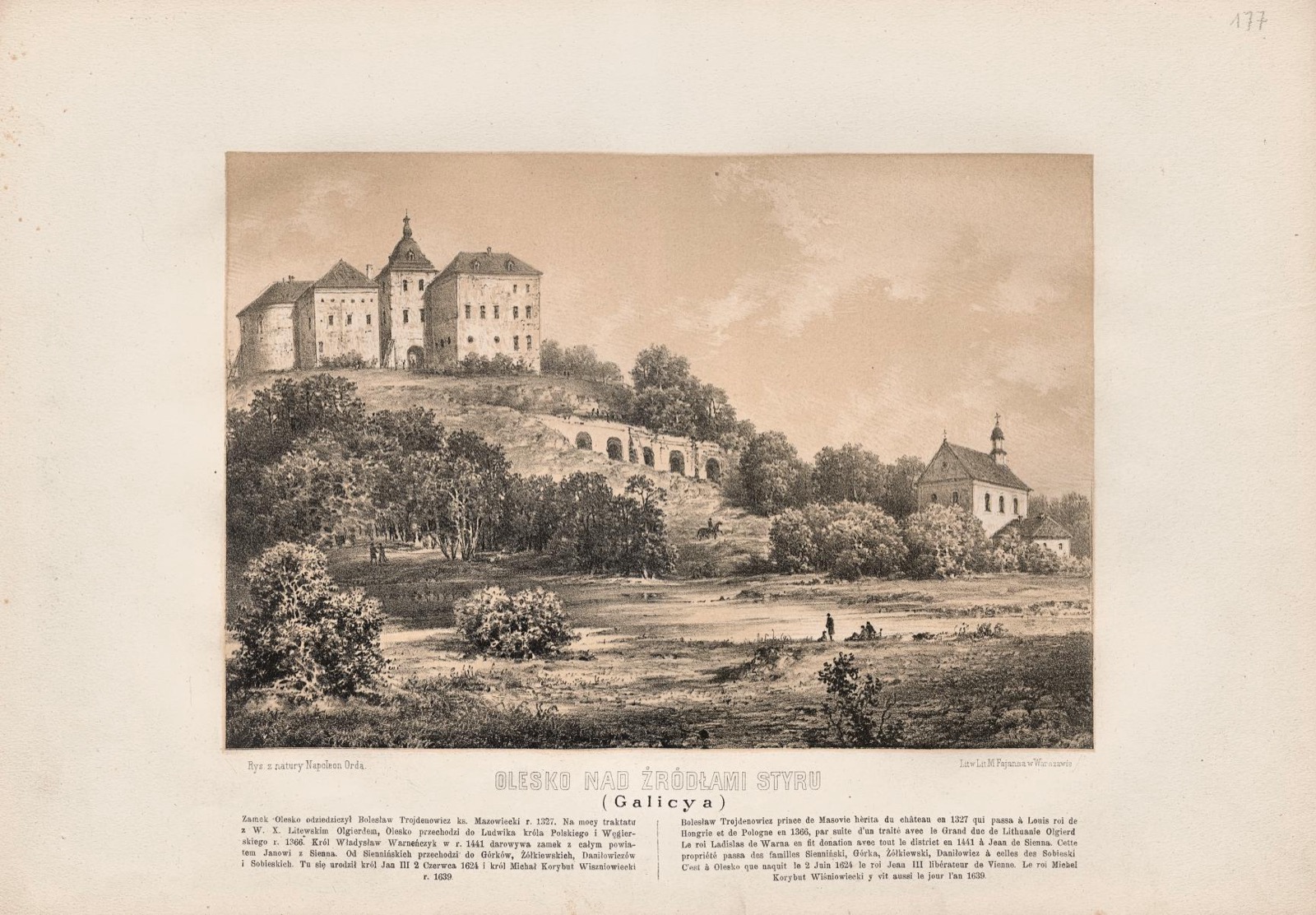
An album of views showing the historical sites of the Kingdom, Galicia and Krakow Territories
· Jagiellonian Library (via Europeana)
Public domain


