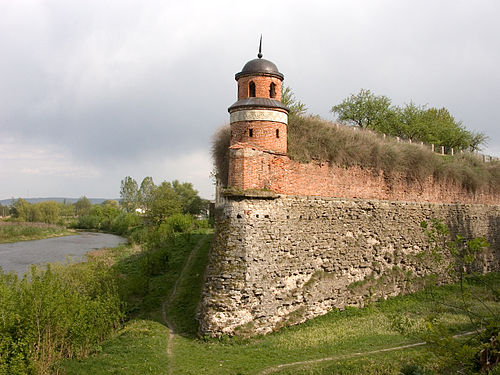
Ukraine · Restored
Zolochiv Castle
Zolochiv Castle is a 17th-century rectangular fort and noble residence in Zolochiv, Galicia, built with four pentagonal corner towers and a long 'grand palace' range. A distinctive mauve rotunda known as the Chinese Palace with one-storey wings stands beside formal parterre gardens; the complex sits on a hill at the confluence of two small rivers and has been restored and opened to visitors in recent decades.
Its prime
1690
Today
Restored
As it stood in 1690
What Zolochiv Castle looked like in its prime.
A compact rectangular fortress set on a grassy hill above two small rivers, defined by solid, pale plastered curtain walls and four pentagonal corner towers; a long two-storey rectangular palace block with evenly spaced windows and a steep red metal roof runs along one side. Adjacent to the palace is a small mauve rotunda with a conical dark roof and low one-storey wings. Formal parterre gardens with clipped hedges and a circular fountain lie before the main façade.
Its story
The story of Zolochiv Castle.
Jakub Sobieski's Fortress, 1634–1636
The castle stands on a hill above the confluence of two small rivers in the south-eastern part of Zolochiv, the Złoczów of Polish Galicia, and was a residence of the Sobieski family. Jakub Sobieski raised the rectangular fort between 1634 and 1636 on the site of an older wooden castle, to the design of an Italian architect whose name is not recorded, using the labour of enslaved Crimean Tatars.
Its walls followed the Dutch manner then in fashion, with four pentagonal towers at the corners and the building known as the grand palace inside. The result belongs to the palazzo in fortezza type, residence and fortification in one.
Kapudan Pasha's Siege and King John's Rotunda
In 1672 the Turks under Kapudan Pasha took the castle after a siege of six days, and three years later it withstood a fresh siege by the Ottoman army. Later in the century John III Sobieski gave his French-born queen, Marie, a small mauve rotunda in the courtyard; the one-storey side wings that earned it the name of the Chinese Palace came in the eighteenth century.
Radziwiłłs, Komarnicki-Pawlikowicz and the Austrian Crown, 1737–1834
Jakub Ludwik Sobieski died in 1737 and the castle passed to the Radziwiłł princes. In 1801 it went to Count Łukasz Komarnicki-Pawlikowicz of the House of Sas, whose heirs sold it to the Austrian crown in 1834.
Hospital, Barracks and Prison, to 1941
Through the nineteenth century the fortress was adapted as a hospital and barracks, and in 1872 it was turned into a prison, a use that continued after the September Campaign. Before the Bolshevik retreat of June 1941, prisoners were tortured to death in the castle by the NKVD. Thousands of Zolochiv's Jewish inhabitants were taken from the town and killed by the Germans at the outbreak of Operation Barbarossa.
The Lviv Art Gallery's Museum-Preserve, since 1985
Since 1985 the complex has been supervised by the Lviv Art Gallery, whose museum-preserve occupies it; it is carried on the State Register of Immovable Monuments of Ukraine as a monument of history and culture of national significance, and forms one stop on the Golden Horseshoe of Lviv region route. Restoration brought the memorial chapel to the victims of the NKVD, opened at the entrance in July 1995, the Museum of Eastern Cultures in the Chinese Palace in 2004, the rebuilt ravelin in 2007 and the Great Palace in 2009. More than 20 million hryvnia towards the restoration was given by Petro Pysarchuk, and the grounds are open to visitors.
Step inside
8 places to explore in 1690.
The record describes 8 distinct spots at Zolochiv Castle, including 2 interiors: grand palace, great hall, chinese palace, rotunda interior. Create your own photoreal reconstruction and explore every one, more scenes means more rooms, more angles, and more of the place to stand in.
Build Your Own Castle
Recreate Zolochiv Castle with AI to explore it.
The artist rebuilds it as it stood in 1690, a photoreal reconstruction that belongs to you alone. Pay with coins, no subscription needed.
Recreate this castle →Defend this castle →Whose castle
Clans who held Zolochiv Castle.
The families that held Zolochiv Castle for a decade or more across its history, follow a name to its clan.
Sobieski
Residence of the Sobieski family from Jakub Sobieski's fort of 1634–36 until Jakub Ludwik Sobieski's death in 1737.
Radziwiłł
Held by the Radziwiłł princely family from 1737 to 1801.
Komarnicki
Held by Count Łukasz Komarnicki-Pawlikowicz of the House of Sas from 1801; his heirs sold the castle to the Austrian crown in 1834.