Wales · Restored
Brecon Castle
Castell Aberhonddu
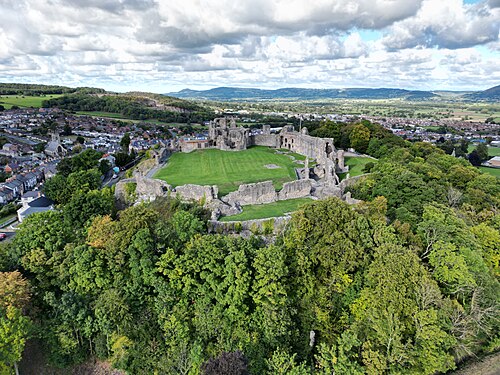
Brecon Castle is a Norman castle founded in 1093 on the confluence of the Usk and Honddu in Brecon, Wales. It developed through the 12th–14th centuries with a stone shell keep, curtain walls, and towers, and after periods of ruin was renovated in the 19th century and now serves as a hotel; it is a Grade I listed building.
Its prime
1300
Today
Restored
As it stood in 1300
What Brecon Castle looked like in its prime.
Compact stone castle set on a raised slope above a river bend, built of warm pink-brown sandstone with a crenellated curtain wall. A tall cylindrical corner tower (round tower) and a slightly set-back semi-octagonal tower punctuate the curtain; the hall block has tall narrow pointed-arch windows. The walls are relatively plain ashlar with narrow slit windows and crenellations along the parapet, and the castle overlooks adjacent stone buildings on the slope and the river below.
Its story
The story of Brecon Castle.
Bernard de Neufmarché and the Fall of Brycheiniog, 1093
Bernard de Neufmarché, sometimes claimed as a brother of William the Conqueror, took Brycheiniog after killing Rhys ap Tewdwr at the battle of Brecon around Easter 1093, and the Normans went on to invade the whole of south Wales and defeat its rulers. Bernard took the title Lord of Brecon and began his motte-and-bailey castle the same year, at the meeting of the Usk and the Honddu (a site that offered protection and water power for mills) using stone taken from the Roman town of Caer Badden. The work is credited with producing the first stone castle in Wales, though the keep was timber at the outset and was only replaced by a stone shell keep in the late 12th century.
Welsh Assaults and Changing Hands, 1207–1403
The castle passed to the de Braose family, and when they rebelled against King John he captured it from them in 1207; they took it back during the First Barons' War. The Bohuns received Brecon in 1241 and held it until 1373, when Humphrey de Bohun, 7th Earl of Hereford, died without male issue. The Welsh attacked in 1215, 1231, 1233, 1264, 1265, 1273 and 1403, capturing the castle in 1215 and again in 1264 and 1265; the assaults of 1273 and 1403 left serious damage.
The defences grew in stone by stages across those years: a bailey wall in 1233, a round tower in the 13th century, a hall block in 1300 and a semi-octagonal tower in the early 14th century.
The Staffords, the Attainder of 1523 and the Siege of 1645
Brecon came to the Staffords through the marriage of Edmund Stafford, 5th Earl of Stafford, to Anne of Gloucester, daughter of Thomas of Woodstock, youngest son of Edward III, by Eleanor de Bohun, elder daughter and co-heiress of Humphrey de Bohun. Edward Stafford, 3rd Duke of Buckingham, was born in the castle in 1477, executed for treason in 1521 and posthumously attainted in 1523, when the family's estates escheated to the crown. His descendants later recovered some of those estates; the castle itself had begun to fall into dilapidation. It was besieged for the last time in 1645, by Rowland Laugharne, a commander for Parliament.
Sir Charles Morgan's Repairs and the Hotel Conversion
By the end of the Georgian era the castle was in ruins. Sir Charles Morgan of Tredegar House began repairs in 1809, and by 1814 more than £7,000 had been spent on them; the building was turned into a hotel and remains one. The site is a scheduled monument and a National Monument of Wales, and the building is listed Grade I.
Step inside
8 places to explore in 1300.
The record describes 8 distinct spots at Brecon Castle, including 1 interior: great hall interior. Create your own photoreal reconstruction and explore every one, more scenes means more rooms, more angles, and more of the place to stand in.
Build Your Own Castle
Recreate Brecon Castle with AI to explore it.
The artist rebuilds it as it stood in 1300, a photoreal reconstruction that belongs to you alone. Pay with coins, no subscription needed.
Recreate this castle →Defend this castle →Whose castle
Clans who held Brecon Castle.
The families that held Brecon Castle for a decade or more across its history, follow a name to its clan.
Neufmarché
Built by the Norman lord Bernard de Neufmarché, Lord of Brecon, in 1093.
Braose
Held by the de Braose family, who retook the castle during the First Barons' War.
Bohun
Held by the Bohun family from 1241 to 1373.
Stafford
Held by the Staffords until Edward Stafford, 3rd Duke of Buckingham, was executed in 1521 and the estates escheated to the crown.