Wales · Restored
Caldicot Castle
Castell Cil-y-coed
Caldicot Castle is a medieval stone castle in Caldicot, Monmouthshire, built by the Norman earls of Hereford with major stone works from the 12th century and further additions in the late 14th century by Thomas of Woodstock. The site contains a cylindrical stone keep, continuous curtain walls and later towers; it is a Grade I listed building and has been restored and opened to the public.
Its prime
1385
Today
Restored
As it stood in 1385
What Caldicot Castle looked like in its prime.
A tall cylindrical stone keep sits on the inner edge of a broad grassy bailey, joined to a continuous curtain wall that sweeps away to an attached multi-bay range; a raised earthen mound sits before the keep with a timber bridge crossing to a gate entrance. The keep’s face shows narrow vertical openings and a single low entrance; the curtain is built of pale-brown local stone with irregularly spaced window and arrow-slit openings and several flanking towers.
Its story
The story of Caldicot Castle.
Durand’s Manor and the Constableship of England
Caldicot appears in the Domesday survey of 1086 not as a castle but as an agricultural holding of Durand of Gloucester, sheriff of Gloucestershire. Durand’s nephew Walter FitzRoger inherited those lands along with his father’s office of Constable of England, an office that then stayed with the lords of Caldicot, and Walter’s son Milo added the earldom of Hereford to his titles. The Norman earls of Hereford began building here from about 1100, near the site of Harold Godwinson’s earlier Saxon castle; in the reign of Henry I the place was probably still a simple motte-and-bailey.
The Bohun Inheritance, c.1170–1376
Milo’s five sons died childless, so his eldest daughter Margaret carried the earldom of Hereford, the Constableship of England and Caldicot into her marriage with Humphrey II de Bohun. Their son Humphrey III was the probable builder, in about 1170, of the stone keep and curtain walls of the castle that stands today. The Bohuns held the manor and castle for more than two centuries and eight generations, until in 1376 Caldicot passed with seventy other manors to Thomas of Woodstock, fifth son of Edward III, on his marriage to Alianore de Bohun.
Thomas of Woodstock and the Woodstock Tower
When Edward III died the crown went to his nine-year-old grandson Richard II, and Thomas, as the young king’s uncle, took an important part in advising him and was appointed Constable of England. He rarely came to Caldicot; his main estates lay at Pleshey in Essex, close to the seat of power. In 1381 the Peasants’ Revolt convulsed Essex, which may be why he spent part of that year at Caldicot.
During the stay he gave orders for major new work. A new gatehouse and drawbridge were built, and at the rear of the castle a dovecote was replaced by a tower of private chambers still known as the Woodstock tower; two carved stones were to be set at its foot, one marked ‘Thomas’, the other ‘Alianore’. Relations with Richard II grew steadily more strained, and in 1397 Thomas was kidnapped and murdered on the king’s orders. His property was confiscated and passed into the hands of the Crown.
Lost to Henry V: Caldicot in the Duchy of Lancaster
In 1399 Henry Bolingbroke seized the throne from Richard. His wife Mary de Bohun did not live to see him crowned as Henry IV, but their son, born at Monmouth Castle, became Henry V, the victor of Agincourt. The division of the Bohun estates was revised after the death of Joan, mother of both Alianore and Mary, who had outlived her daughters by some twenty years: Alianore’s eldest daughter and heir Anne lost Caldicot to Mary’s son the king, and the castle became part of the Duchy of Lancaster.
Henry’s widow Katherine of Valois held it after him. For much of the fifteenth century it lay in the stewardship of the Herbert family, and in the sixteenth century it was leased to their successors the Somersets, whose power base was at Raglan.
Farmyard, Restoration and Reopening, 1857–1967
Caldicot was evidently neglected, fell into ruin and became little more than a farmyard. Charles Lewis of St Pierre bought it in 1857 and sold it in 1885 to Joseph Richard Cobb, who began restoring it as a family home. The Cobbs held the castle until 1964: Joseph’s son Geoffry Wheatly Cobb, and in particular his daughter-in-law Anna, carried the restoration on, and in the early twentieth century many rooms were fitted out with memorabilia from HMS Foudroyant, Nelson’s first flagship, which G. W. Cobb owned at the end of its life. He died in 1931 and Anna in 1943, after which Joseph’s grandson Geoffry Richard Wheatly Cobb made furnished apartments to let in three of the towers and in parts of the gatehouse.
By 1964 the growing supply of council housing had supplanted the local need for those apartments, and Chepstow Rural District Council bought the castle from the family for £12,000. It opened to the public, with a small museum, in 1965, and after 1967 medieval-style banquets were held there. The castle has been a scheduled monument since 1950 and Grade I listed since 1953, and counts among the national monuments of Wales.
Step inside
6 places to explore in 1385.
The record describes 6 distinct spots at Caldicot Castle, including 1 interior: woodstock tower, private chamber. Create your own photoreal reconstruction and explore every one, more scenes means more rooms, more angles, and more of the place to stand in.
Build Your Own Castle
Recreate Caldicot Castle with AI to explore it.
The artist rebuilds it as it stood in 1385, a photoreal reconstruction that belongs to you alone. Pay with coins, no subscription needed.
Recreate this castle →Defend this castle →Whose castle
Clans who held Caldicot Castle.
The families that held Caldicot Castle for a decade or more across its history, follow a name to its clan.
de Bohun
Held the manor and castle of Caldicot for more than two centuries, over eight generations, until 1376.
From the archive
Caldicot Castle on paper: the measured plan and period views.
The survey plan and photographs below are the ground truth this page's reconstructions are checked against, drawn and photographed while the castle was still a working garrison. Every image is public-domain or openly licensed, with its source named.
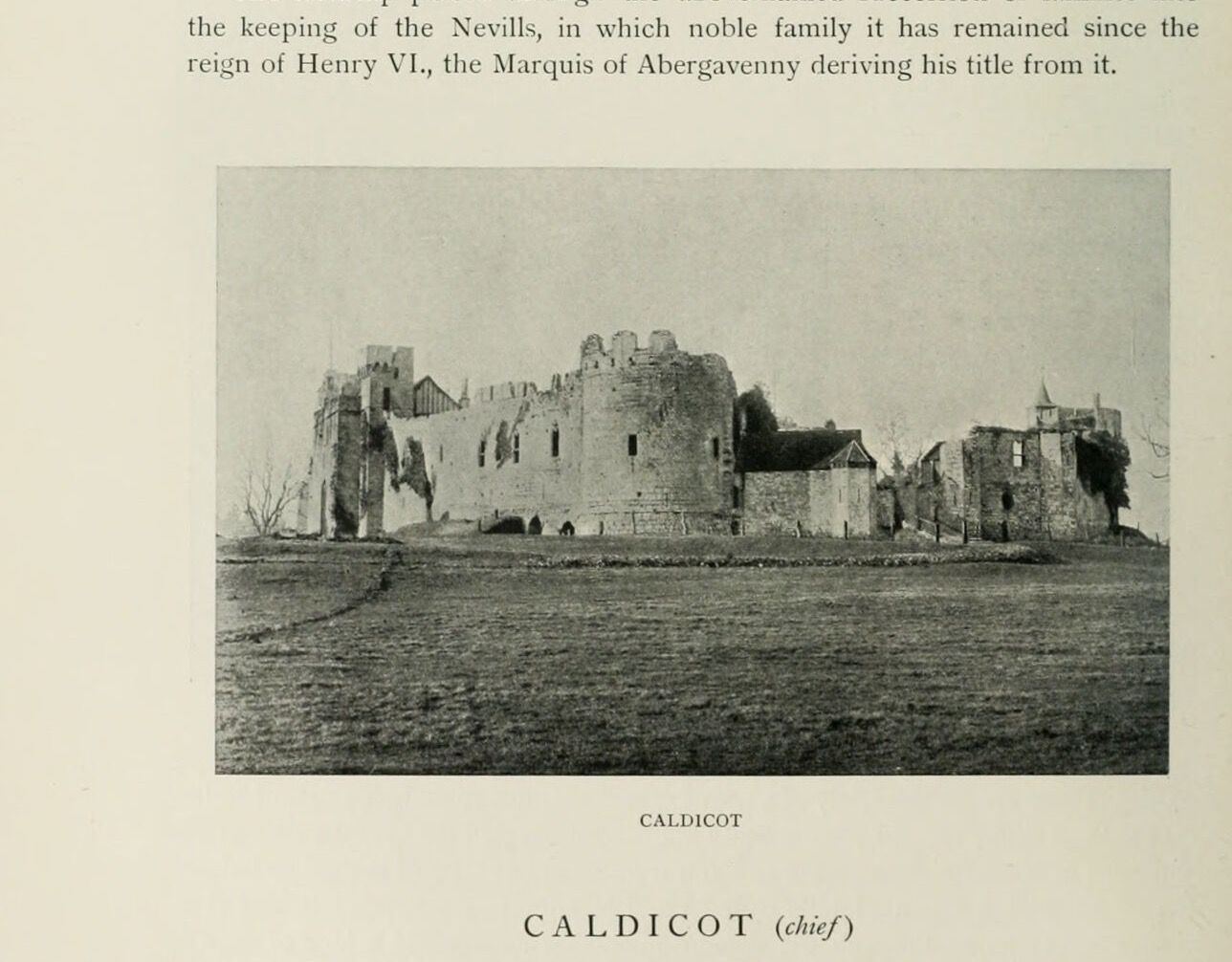
CALDICOT
1897 · J. D. Mackenzie, The Castles of England, vol. 2 (1897)
Public domain
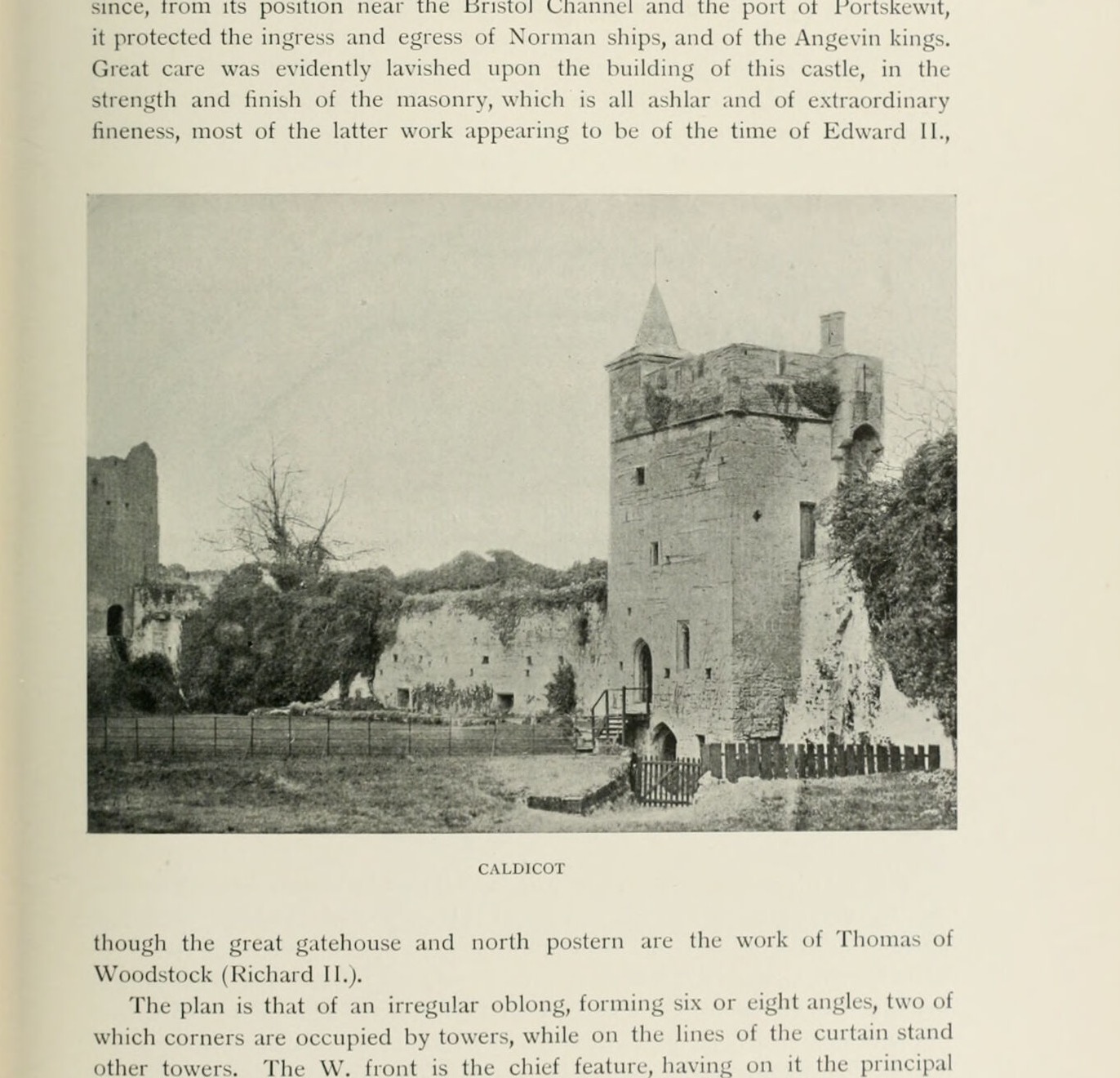
CALDICOT
1897 · J. D. Mackenzie, The Castles of England, vol. 2 (1897)
Public domain
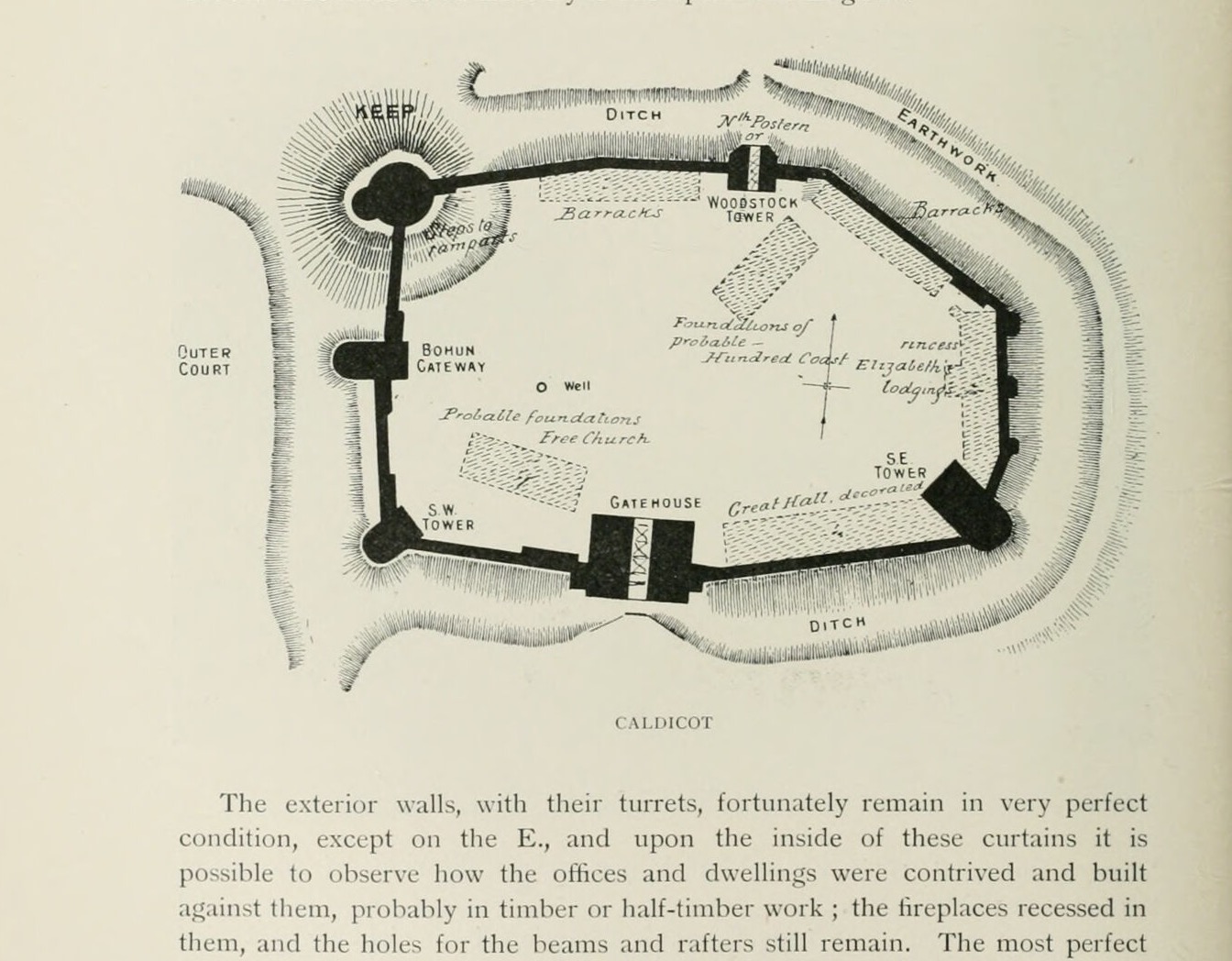
CALDICOT
1897 · J. D. Mackenzie, The Castles of England, vol. 2 (1897)
Public domain
Nearby