Wales · Partial ruin
Carreg Cennen Castle
Castell Carreg Cennen
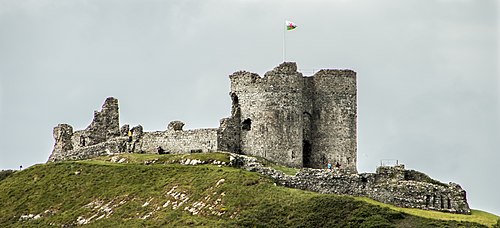
Carreg Cennen Castle (Castell Carreg Cennen) is a medieval castle perched on a high limestone outcrop above the River Cennen in Carmarthenshire, Wales. The surviving fabric forms a strongly walled, towered square inner ward with an outer ward, barbican and a prominent twin-towered gatehouse; the site is now in the care of Cadw and is visited from the nearby Castell Farm access route.
Its prime
1320
Today
Partial ruin
As it stood in 1320
What Carreg Cennen Castle looked like in its prime.
Perched on an isolated block of pale Carboniferous limestone, the castle crowns a steep precipice with sheer cliffs to the south. The plan is a strongly-walled, roughly square inner ward defended by six towers of differing shapes and heights and a prominent twin-towered gatehouse on the north side which is the highest element. Curtain walls are crenellated and built of roughly coursed local limestone; an outer ward and barbican lie to the north and east, and a yard and east-range of apartments occupy the inner court.
Its story
The story of Carreg Cennen Castle.
The Lord Rhys and the Spite of 1248
Human remains found in a cave inside the limestone crag date activity on the outcrop back into prehistory, and the site may also have carried an Iron Age hillfort. Roman coins of the first and second centuries have been recovered here, though it is unlikely the Romans held the place permanently. The first masonry castle was probably the work of The Lord Rhys (d. 1197); it stayed with the Deheubarth dynasty for the next fifty years, and whatever they built has been subsumed by later English work.
The earliest documented mention comes in 1248, when Brut y Tywysogion records that Matilda de Braose, mother of Rhys Fychan ap Rhys Mechyll, granted the castle to the Norman English to spite her son, but Rhys seized it before the English could take possession. For the next thirty years it changed hands repeatedly between Rhys and his uncle Maredudd, the two of them fighting for control of the kingdom of Deheubarth.
Edward I's Conquest, 1277–1283
In 1277, at the start of Edward I's conquest of Wales, the Welsh lords of the region sided with the king against Llywelyn ap Gruffudd and the castle was handed over to the English; documents show repairs were made afterwards. When a second phase of fighting opened in 1282 the local nobles switched sides again, joined the wider Welsh rising and took the castle back, but by the following year it was in English hands once more. In 1283 Edward granted it to the baron John Giffard (d. 1299), who had commanded the English troops at Cilmeri, where Llywelyn was killed.
What the Giffards Built
The castle that survives was probably Giffard's remodelling, the work likely finished under his son John (d. 1322). Reconstruction ran in three phases (inner ward and gatehouse first, then the barbican and outer ward), and similarities in the building suggest one followed the other quickly; the south curtain wall may retain masonry from the earlier Welsh castle. There are no royal accounts for any of it, and Edward chose not to visit during his tour of Wales in 1284, which implies the Giffards paid for the work themselves.
Rhys ap Maredudd took Carreg Cennen briefly during his rebellion against English rule in 1287, though he did not hold it for long. The Giffards kept the castle until 1322, after which it came to the Duchy of Lancaster; building records of 1369–70 show significant repairs. With Henry IV's accession in 1399 it passed to the Crown.
Glyndŵr at the Walls, 1403
In early July 1403 Owain Glyndŵr came against Carreg Cennen with 800 men. The siege ran for several months, with Owain himself present, and although his forces inflicted severe damage on the walls they failed to take the castle. It was defended by Sir John Scudamore of Herefordshire, who a few years later married Alys ferch Owain Glyndŵr, one of the besieger's own daughters. The damage was serious enough to demand major repair: more than £500 was spent on the castle between 1414 and 1421.
Mortimer's Cross and the 500 Men
By the mid-fifteenth century the castle's custodian was Gruffudd ap Nicolas, and Carreg Cennen became a Lancastrian stronghold during the Wars of the Roses; the gun port in the north-west tower, cut for muskets, was likely added then. The Yorkist victory at the Battle of Mortimer's Cross in 1461 forced Gruffudd's sons to surrender the place, and the Yorkists then set a team of 500 men to demolishing it, slighting the castle in 1462 so that it could not be used again.
Ownership passed afterwards to the Vaughan and Cawdor families, and from the eighteenth century the ruin began to draw artists, J. M. W. Turner painted it in 1798. The second Earl Cawdor began an extensive renovation in the nineteenth century, and in 1932 Carreg Cennen was given into the guardianship of the Office of Works. In the 1960s a mistake in the wording of Lord Cawdor's deeds included the castle as part of Castell Farm, and it passed to the Morris family of that farm, in whose family it has remained; Cadw maintains it.
Step inside
11 places to explore in 1320.
The record describes 11 distinct spots at Carreg Cennen Castle, including 6 interiors: gatehouse passage and upper chambers, great hall in the east range, kitchens and service range (east side) and more. Create your own photoreal reconstruction and explore every one, more scenes means more rooms, more angles, and more of the place to stand in.
Build Your Own Castle
Recreate Carreg Cennen Castle with AI to explore it.
The artist rebuilds it as it stood in 1320, a photoreal reconstruction that belongs to you alone. Pay with coins, no subscription needed.
Recreate this castle →Defend this castle →Whose castle
Clans who held Carreg Cennen Castle.
The families that held Carreg Cennen Castle for a decade or more across its history, follow a name to its clan.
Giffard
Granted to John Giffard in 1283; he and his son John (d. 1322) probably built and funded the present castle.
Ownership of the castle passed in its later history to the Vaughan family.
Cawdor
Held by the Cawdor family after the Vaughans, into the era when the ruin began attracting artists from the 18th century.