Clan Rising
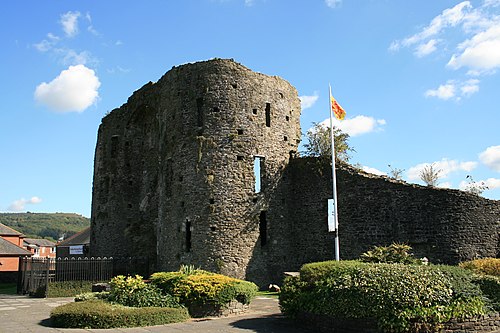
Castell Aberlleiniog today

Wales · Restored

Castell Aberlleiniog

Castell Aberlleiniog is a small motte-and-bailey castle on a steep hill near Llangoed on the Isle of Anglesey, Wales, built by the Normans in the late 11th century. The site later received stone defences and was partially destroyed in the mid-17th century; it has been restored and is open to the public.

Photograph via Wikimedia Commons

First raised

1080

Its prime

1600

Today

Restored

As it stood in 1600

What Castell Aberlleiniog looked like in its prime.

A compact stone motte-and-bailey fortress set atop a steep, tree-strewn hill beside the Menai Strait. The castle presents low, roughly coursed grey-brown rubble curtain walls with a narrow wall walk and parapet; round, squat towers occupy the corners and rise a storey or two above the parapet. The inner motte is broad with earthen ramparts, the bailey sits immediately adjacent, and the whole group reads as a tight, roughly circular stone enclosure above a grassy scarp.

Its story

The story of Castell Aberlleiniog.

Hugh d'Avranches, 1st Earl of Chester, built the motte-and-bailey of Castell Aberlleiniog between 1080 and 1099, probably in 1088, when he conquered Gwynedd, atop a very steep hill near Llangoed on Anglesey. It stands beside the Menai Strait opposite the Norman castle at Abergwyngregyn, a siting that shows how much visual communication mattered to the invaders, and about two miles from the later Beaumaris Castle.

Gruffudd ap Cynan besieged the castle in 1094 on his return from Ireland; the siege succeeded and 124 Norman defenders died. Gruffudd later drove Hugh out altogether, and Anglesey remained under Welsh control until Edward I arrived two hundred years later, whether the Welsh used Aberlleiniog is not known. The original Norman timber structure was at some point replaced in stone; partially destroyed in the mid-17th century, the site has been restored and is open to the public.

Step inside

8 places to explore in 1600.

The record describes 8 distinct spots at Castell Aberlleiniog, including 1 interior: keep interior / central court. Create your own photoreal reconstruction and explore every one, more scenes means more rooms, more angles, and more of the place to stand in.

Approach from the steep slope belowTop of the motte and rampartsNorthwest round tower (corner tower)Northeast round tower (corner tower)Parapet and wall-walk along the curtainInner bailey (courtyard)Keep interior / central courtView across the Menai Strait

Build Your Own Castle

Recreate Castell Aberlleiniog with AI to explore it.

The artist rebuilds it as it stood in 1600, a photoreal reconstruction that belongs to you alone. Pay with coins, no subscription needed.

Recreate this castle →Defend this castle →

Questions about Castell Aberlleiniog

What is the history of Castell Aberlleiniog?

Castell Aberlleiniog was built as a Norman motte-and-bailey fortress during the late 11th century. It occupied a steep hill beside the Menai Strait, opposite the Norman castle at Abergwyngregyn, giving the invaders a strategically placed position for visual communication. Its original timber structure was later replaced by stone defences.

What is inside Castell Aberlleiniog?

Inside Castell Aberlleiniog are the keep interior and the central court. The keep had broad ramparts fronted by a narrow wall rising to a parapet, while the adjacent bailey formed part of the fortified enclosure. The surviving remains also include the castle’s corner towers and wall-walk.

Who owns Castell Aberlleiniog now?

Castell Aberlleiniog is owned by Hugh d'Avranches, 1st Earl of Chester. It has heritage designations as a Grade II* listed building, a scheduled monument and a National Monument of Wales. The ownership reflects the person associated with its foundation rather than a present-day residential use.

Why was Castell Aberlleiniog built, and what was it used for?

Castell Aberlleiniog was built to serve as a Norman fortress on a steep hill beside the Menai Strait. Its position opposite the Norman castle at Abergwyngregyn supported visual communication between Norman strongholds during the conquest of Gwynedd. It was a motte-and-bailey castle, later strengthened with stone defences.

Where is Castell Aberlleiniog?

Castell Aberlleiniog is near Llangoed on the Isle of Anglesey, beside the Menai Strait. It stands on a very steep hill opposite the Norman castle at Abergwyngregyn, and is about two miles from Beaumaris Castle. Llangoed is the settlement in which the castle is located.

When was Castell Aberlleiniog built?

Castell Aberlleiniog was built in the late 11th century, between 1080 and 1099. It was probably erected in 1088, when Hugh d'Avranches conquered Gwynedd. The first structure was a Norman timber motte-and-bailey, later replaced by stone defences.

Was Castell Aberlleiniog ever attacked or besieged?

Castell Aberlleiniog was besieged by Gruffudd ap Cynan in 1094, after his return from Ireland. The siege succeeded, and 124 Norman defenders died in the battle. Gruffudd later drove Hugh d'Avranches out, after which Anglesey remained under Welsh control until Edward I arrived two hundred years later.

What did Castell Aberlleiniog look like in its prime?

In its prime, Castell Aberlleiniog was a compact stone motte-and-bailey fortress on a steep, tree-strewn hill. Low, roughly coursed grey-brown rubble curtain walls enclosed the site, with a narrow wall-walk and parapet. Squat round towers occupied the corners, while the broad motte and adjacent bailey formed a tight, roughly circular enclosure above a grassy scarp.

Is Castell Aberlleiniog still standing or is it a ruin?

Castell Aberlleiniog is still standing as a restored castle rather than an entirely demolished site. Its original Norman timber structure was replaced by stone before the mid-17th century, when the stone castle was partially destroyed. The site was restored from 2008, and the surviving remains include the keep’s ramparts, parapet and round towers.

Who built Castell Aberlleiniog?

Castell Aberlleiniog was commissioned by Hugh d'Avranches, 1st Earl of Chester. The supplied material does not identify a separate architect or designer. Hugh built the motte-and-bailey between 1080 and 1099, probably in 1088 during his conquest of Gwynedd.

Can you visit Castell Aberlleiniog?

Castell Aberlleiniog is open to the public. The restored site is a surviving motte-and-bailey castle with stone remains, including the keep, curtain walls and round towers. It was described as open to the public in 2016.
All castles of Wales · Castles of Europe · the best castles in Europe · explore the finished reconstructions.