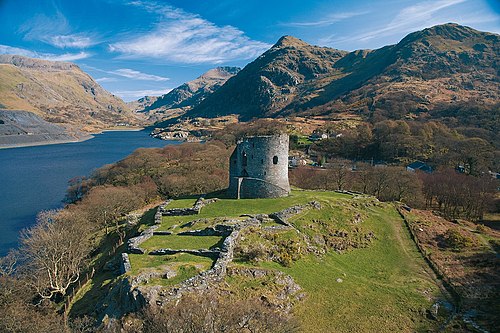
Wales · Partial ruin
Chepstow Castle
Castell Cas-gwent
Chepstow Castle is a Norman stone castle on a narrow ridge above the River Wye in Monmouthshire, Wales, founded soon after the Conquest and expanded through the 12th–13th centuries. Its plan shows multiple baileys with a large Great Tower, round towers on the landward side and a prominent gatehouse; many of the standing walls and towers survive as substantial masonry. The site is historically important as an early stone border stronghold in the Welsh Marches.
First raised
1067
Its prime
1284
Today
Partial ruin
Ranked among Europe’s castles
As it stood in 1284
What Chepstow Castle looked like in its prime.
A long, irregular silhouette of grey limestone curtain walls steps along a narrow ridge above the River Wye, punctuated by several round towers and a large cylindrical Great Tower at the riverward end with a crenellated parapet. The landward approach is dominated by a tall round Marten's Tower beside a pointed-arched gatehouse and heavy wooden gateway. Arrow-slit windows and larger domestic windows are set into thick walls; lower domestic ranges lie within the baileys and battlements run along the curtain walls.
Its story
The story of Chepstow Castle.
FitzOsbern's Stone Tower Above the Wye, 1067
William the Conqueror committed to a castle here at once, and the ground shows why: a narrow ridge above the limestone cliffs of the River Wye, commanding an important crossing and the route inland to Monmouth and Hereford. It would also help stop raids running along the Severn shore into Gloucestershire.
Work began under William FitzOsbern in 1067 or shortly afterwards, and the Great Tower was probably complete by about 1090, possibly as a show of strength by King William in his dealings with the Welsh king Rhys ap Tewdwr. It was built in stone from the first, unlike most castles raised in those years, and is the oldest surviving post-Roman stone fortification in Britain; much of its stone seems to have been quarried locally, with evidence that some blocks were re-used from the Roman ruins at Caerwent. The Normans called it Striguil, from the Welsh ystraigl, "river bend", and it was the southernmost of a chain of castles in the Welsh Marches. In the 12th century it was used in the conquest of Gwent, the first independent Welsh kingdom to be taken by the Normans.
Marshal's Gatehouse and Bigod's Tower, 1189–1300
William Marshal, Earl of Pembroke, began adding fortifications in the 1190s, drawing on warfare he had seen in France and on crusade: he built the present main gatehouse, strengthened the Middle Bailey with round towers and, before his death in 1219, may also have rebuilt the Upper Bailey defences. His sons William, Richard, Gilbert and Walter carried the enlargement of the Great Tower on to 1245.
In 1270 the castle was inherited by Roger Bigod, 5th Earl of Norfolk, a grandson of Marshal's eldest daughter Maud. Bigod raised a new range in the Lower Bailey to house his family, and built the town's Port Wall in about 1274–78. Edward I visited in 1284 at the end of his triumphal tour through Wales; soon afterwards Bigod put up the tower later known as Marten's Tower, which dominates the landward approach, and remodelled the Great Tower.
Twenty Men-at-Arms Against Glyndŵr, 1312–1403
From the 14th century the castle's defensive merit declined, and more sharply once the wars between England and Wales ended in the early 15th. Control passed in 1312 to Thomas de Brotherton, Earl of Norfolk, and later to his daughter Margaret. When Owain Glyndŵr rose in 1403 the place was garrisoned with twenty men-at-arms and sixty archers; his forces took Newport Castle but avoided Chepstow, probably deterred by its size, its limited strategic merit, its position and its garrison. Its four baileys were added in turn, but it has neither a strong keep nor a concentric layout.
From Great House to Front Line, 1468–1648
In 1468 the Earl of Norfolk granted the castle to William Herbert, Earl of Pembroke, in exchange for lands in the east of England, and in 1508 to Sir Charles Somerset, later Earl of Worcester, who remodelled the buildings extensively as private accommodation. After Henry VIII abolished the Marcher lords' autonomous powers through the Laws in Wales Acts of 1535 and 1542, the castle was increasingly fitted for occupation as a great house.
The Civil War put it back on the front line, between Royalist Monmouthshire and Parliamentarian Gloucestershire. Held for the King, it was besieged in 1645 and again in 1648, falling to Parliamentarian forces on 25 May 1648. Sir Nicholas Kemeys, who led the Royalist defence in the second war, refused to surrender after the castle's fall and was killed in combat; his memorial lies within the keep. It was then kept on as an artillery fort and barracks, and as a political prison: Bishop Jeremy Taylor was held here, and after the Restoration so was Henry Marten, one of the Commissioners who signed the death warrant of Charles I, imprisoned here before his own death in 1680.
Glass Works, the Wye Tour and the Lysaghts, 1682–1953
The castle came to the Duke of Beaufort in 1682. The garrison was disbanded in 1685 and the buildings partly dismantled, leased to tenants and left to decay; parts served as a farmyard and a glass factory. By the late 18th century the ruins had become a "Picturesque" feature of the Wye tour, the pleasure-boat trips down the river from Ross-on-Wye; Charles Heath of Monmouth published the first guidebook in 1793, and Turner painted it in 1794.
Steamship day trips from Bristol swelled the traffic by the 1840s, and the courtyard filled with horticultural shows, fêtes and, from the 1880s, historical pageants sanctioned by the Duke, who tried to sell the castle in 1899 and found no buyer. William Royse Lysaght bought it in 1914 and began conservation work; his family placed it in the care of the Ministry of Works in 1953, and Cadw has held it since 1984.
Step inside
9 places to explore in 1284.
The record describes 9 distinct spots at Chepstow Castle, including 3 interiors: great tower interior (keep), lower bailey domestic accommodation range, marten's tower interior and stair. Create your own photoreal reconstruction and explore every one, more scenes means more rooms, more angles, and more of the place to stand in.
Build Your Own Castle
Recreate Chepstow Castle with AI to explore it.
The artist rebuilds it as it stood in 1284, a photoreal reconstruction that belongs to you alone. Pay with coins, no subscription needed.
Recreate this castle →Defend this castle →Whose castle
Clans who held Chepstow Castle.
The families that held Chepstow Castle for a decade or more across its history, follow a name to its clan.
FitzOsbern
Construction began in 1067 under the Norman lord William FitzOsbern.
Marshal
Held and expanded by William Marshal, Earl of Pembroke, from the 1190s.
de Clare
Held by Richard de Clare, one of the most powerful Anglo-Norman magnates of medieval England.
Bigod
Inherited by Roger Bigod, 5th Earl of Norfolk, in 1270; he built a new range of accommodation in the Lower Bailey.
Granted to William Herbert, Earl of Pembroke, in 1468, in exchange for lands in the east of England.
Somerset
Passed to Sir Charles Somerset, later Earl of Worcester, in 1508, who remodelled it as private accommodation.
From the archive
Chepstow Castle on paper: the measured plan and period views.
The survey plan and photographs below are the ground truth this page's reconstructions are checked against, drawn and photographed while the castle was still a working garrison. Every image is public-domain or openly licensed, with its source named.
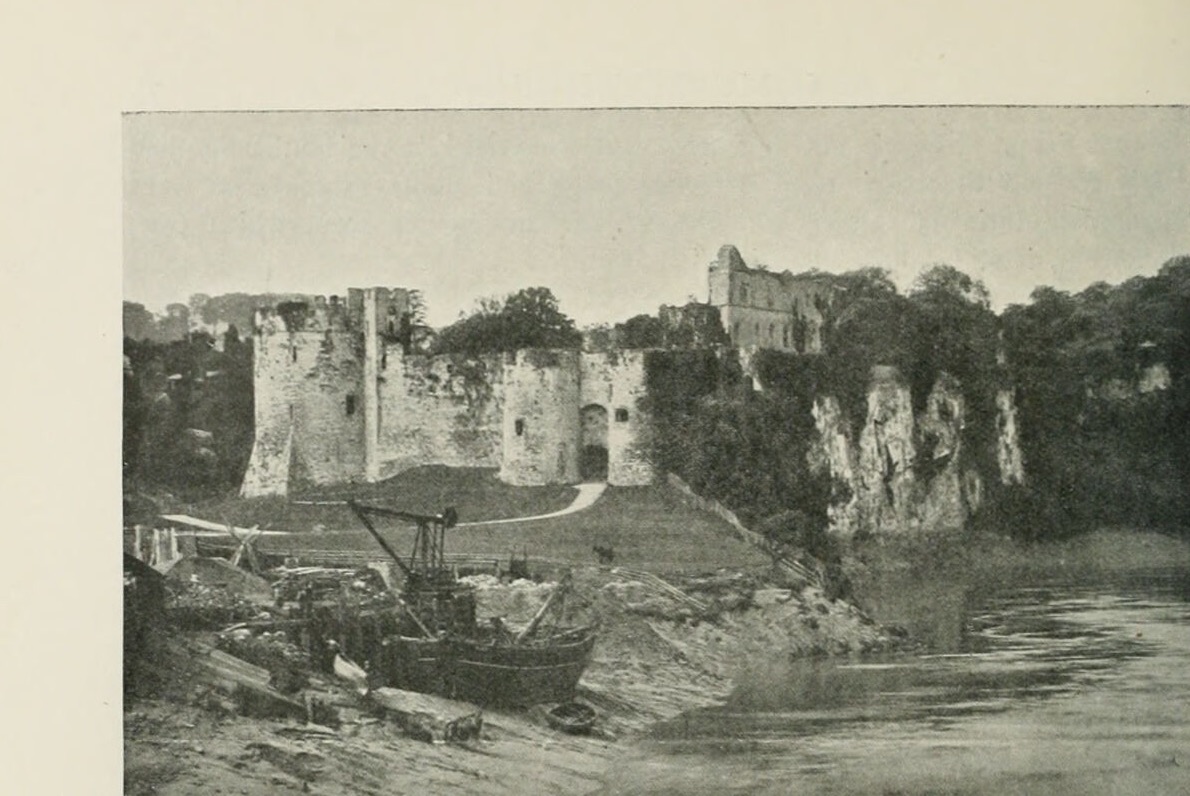
CHEPSTOW
1897 · J. D. Mackenzie, The Castles of England, vol. 2 (1897)
Public domain
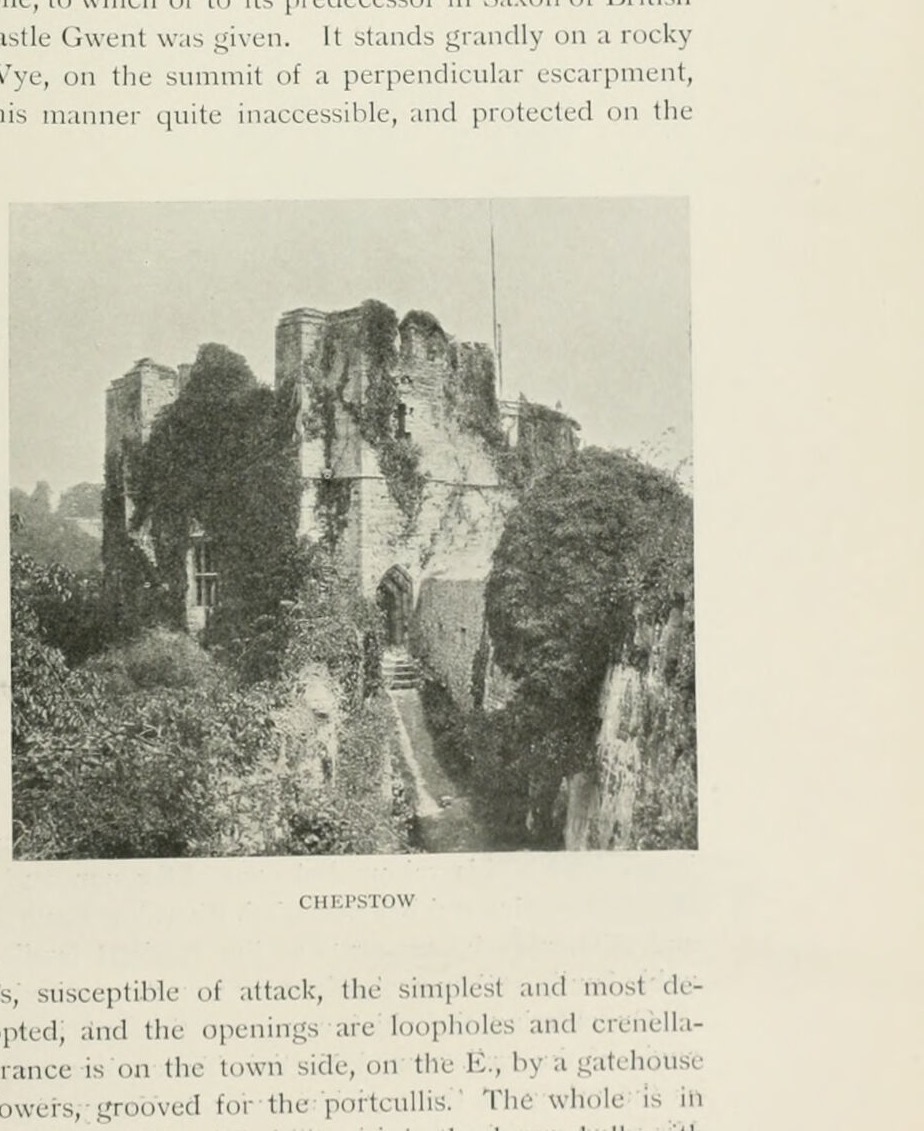
CHEPSTOW
1897 · J. D. Mackenzie, The Castles of England, vol. 2 (1897)
Public domain
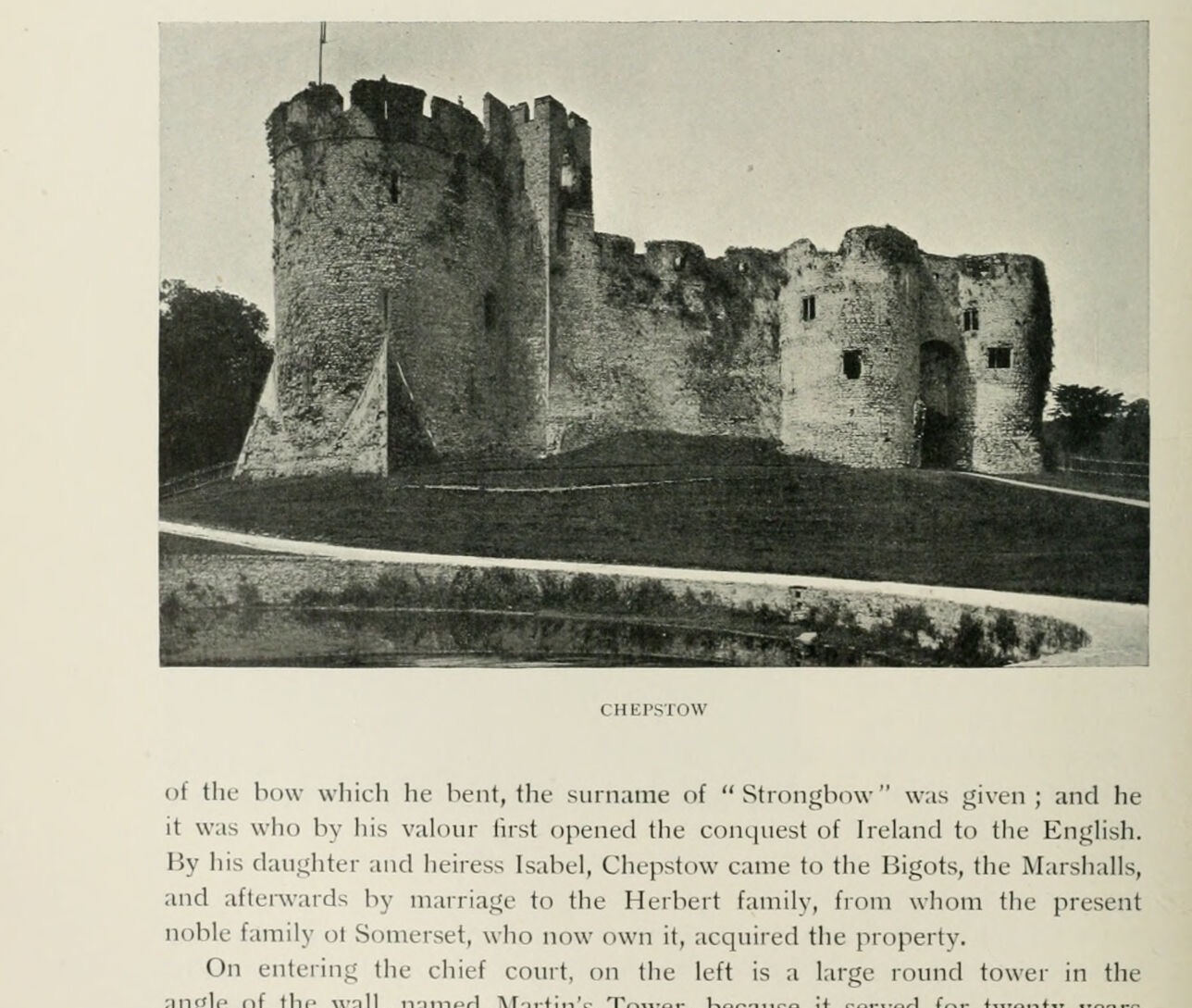
CHEPSTOW
1897 · J. D. Mackenzie, The Castles of England, vol. 2 (1897)
Public domain
Nearby