Wales · Ruin
Laugharne Castle
Castell Talacharn
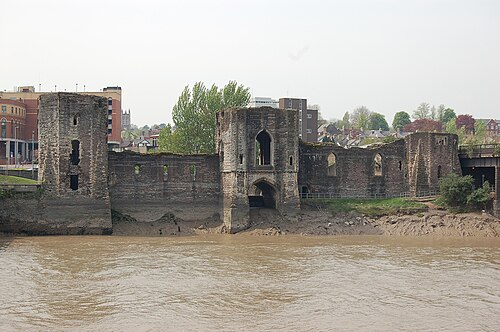
Laugharne Castle is a medieval castle and later Tudor fortified manor on the estuary of the River Tâf in Laugharne, Carmarthenshire, Wales. The site began in the early 12th century, was rebuilt and altered across the medieval period, and was remodelled into a Tudor mansion in the 16th century before being slighted in the 17th century.
Its prime
1590
Today
Ruin
As it stood in 1590
What Laugharne Castle looked like in its prime.
A low-lying castle of red sandstone sited on the estuary bank, defined by long curtain walls with mock battlements and two prominent round towers: a north-west tower with a domed roof and a three-storey round tower with a projecting circular stair. A substantial Tudor accommodation block adjoins the south side of the curtain wall, with pitched roofs and a cobbled courtyard behind. Repairs show contrasting greenish stone patches; the castle sits beside tidal marshland with a small stone approach bridge.
Its story
The story of Laugharne Castle.
Courtemain, Rhys ap Gruffudd and Llywelyn the Great, 1116–1215
The castle on the Tâf estuary was established by 1116 as the castle of Robert Courtemain, who is recorded entrusting its keeping to a Welshman, Bleddyn ap Cedifor. In 1171–1172 Laugharne was the meeting place of Henry II and Rhys ap Gruffudd of Deheubarth, who agreed a treaty of peace here. When Henry died in 1189 Rhys seized Laugharne along with St Clears and Llansteffan, and the castle may have been burnt at that point. The Normans rebuilt it, and in 1215 Llywelyn the Great took it during his campaign across south Wales.
The de Brians and the Stone Rebuilding, 1247–c.1350
By 1247 Laugharne had been granted to the de Brian family, and in 1257 Llywelyn ap Gruffudd captured Guy de Brian at the castle and destroyed it. The two robust round towers belong to the rebuilding of the late thirteenth century, as do surviving stretches of curtain wall. The north-west tower served as a keep and guarded the entry gate through the curtain to its south; the other, of three storeys, has partly collapsed. A new hall was raised against the south of the curtain wall, with a further round tower at the south-west corner of the inner ward, a stronger gatehouse, and the outer ward's defences rebuilt in stone.
In the mid-fourteenth century the curtain at the south-west corner of the inner ward was heightened, and the round tower and inner gatehouse with it, work easy to pick out, because the greenish stone used for it differs sharply from the red sandstone of the rest of the building.
Where Glyndŵr's Rising Stalled, 1403–1415
It was at Laugharne in 1403 that Owain Glyndŵr's rebellion stalled. He was tricked by an ambush and lost 700 men, and when a local soothsayer then warned him to leave the district or be taken, he withdrew. The rising afterwards petered out under the weight of greater English numbers, and by 1415 Glyndŵr had disappeared.
Perrott's Tudor Mansion and the Siege of 1644
In 1584 Queen Elizabeth I granted Laugharne to Sir John Perrott, rumoured to have been an illegitimate son of Henry VIII, who converted the fortification into a substantial Tudor mansion with a more comfortable accommodation block and mock battlements along the curtain walls. Excavation has recovered the Tudor cobbled courtyard and a pitched stone kitchen floor.
In 1644 the castle was taken by Royalists and then attacked by the Parliamentary forces of Major-General Rowland Laugharne. The siege lasted a week (Richard Avent dates it from 28 October to 3 November), and much of the castle was damaged by cannon fire before the Royalist garrison surrendered. It was slighted afterwards to prevent any further use.
Castle House, the Gazebo and Cadw's Care
About 1730 the new Castle House was built close by and the castle left as a romantic ruin; around the start of the nineteenth century the outer ward was laid out as formal gardens. Richard Hughes leased Castle House in the 1930s and 1940s and wrote his novel In Hazard (1938) working in the garden gazebo overlooking the river; Dylan Thomas stayed with Hughes and worked in the same gazebo on Portrait of the Artist as a Young Dog (1940).
The castle is a scheduled ancient monument and was designated a Grade I listed building on 30 November 1966, the citation calling it among the most substantial castle remains in Wales; the park is registered Grade II on the Cadw/ICOMOS Register of Parks and Gardens of Special Historic Interest in Wales. Laugharne is in the care of Cadw and open to the public from spring to autumn, with wheelchair access.
Step inside
10 places to explore in 1590.
The record describes 10 distinct spots at Laugharne Castle, including 4 interiors: north-west tower (keep) interior, three-storey round tower and spiral stair, south hall against the curtain wall and more. Create your own photoreal reconstruction and explore every one, more scenes means more rooms, more angles, and more of the place to stand in.
Build Your Own Castle
Recreate Laugharne Castle with AI to explore it.
The artist rebuilds it as it stood in 1590, a photoreal reconstruction that belongs to you alone. Pay with coins, no subscription needed.
Recreate this castle →Defend this castle →Whose castle
Clans who held Laugharne Castle.
The families that held Laugharne Castle for a decade or more across its history, follow a name to its clan.
de Brian
Granted to the De Brian family by 1247.
Perrott
Granted to Sir John Perrott by Elizabeth I in 1584; he remade the castle as a Tudor mansion.