Wales · Ruin
Montgomery Castle
Castell Trefaldwyn
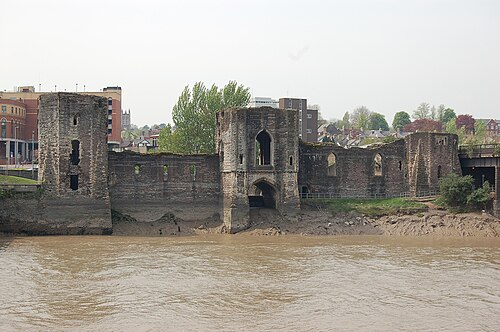
Montgomery Castle is a medieval stone castle on a rocky outcrop overlooking the town of Montgomery in Powys, Mid Wales. Built in the early 13th century and expanded with middle and outer wards, it was besieged and altered over centuries and was deliberately slighted in 1649; today only ruined masonry remains visible above the town.
First raised
1223
Its prime
1267
Today
Ruin
As it stood in 1267
What Montgomery Castle looked like in its prime.
Set on a prominent rocky outcrop above the town, the castle in its prime presents a compact concentric profile: an inner ward (donjon) of continuous grey rubble curtain wall encircling apartments, a prominent gatehouse, and two stout D-shaped towers flanking the inner defenses, with additional middle and outer wards stepping down the rock. Walls are stone throughout with crenellated parapets, accessible curtain-walks, and roofed tower houses rising above the curtain line, all intact and enclosing a central courtyard.
Its story
The story of Montgomery Castle.
Roger de Montgomery's Motte and Baldwin's Town, 1071–1214
The first castle here was an earthwork, the motte and bailey now known as Hen Domen, raised at the order of Roger de Montgomery, Earl of Shrewsbury, sometime between 1071 and 1074. Prince Cadwgan ap Bleddyn and his brothers captured it in 1093. After the rebellion of Roger's son Robert of Bellême in 1102 the castle was given to Baldwin de Boulers, whose name survives in the Welsh name for the place, Trefaldwyn, Baldwin's town. The de Boulers, later known as Bowdler, held it until 1214, when Prince Llywelyn ab Iorwerth of the Royal House of Aberffraw destroyed it.
Hubert de Burgh Builds in Stone, 1223–1233
Rebuilding in stone began in the late summer of 1223, on the sixteenth birthday of Henry III, a mile to the south-east of the original site. The architect was Hubert de Burgh, who also rebuilt Skenfrith, Grosmont and White Castle in the Welsh Marches. From 1223 until 1228 masons worked solidly on the entire inner ward (the donjon, as it was then known) on a great rock above the later town: a gatehouse, two D-shaped towers, and apartments crowded around the curtain wall. Llywelyn ab Iorwerth attacked without success in 1228, after which the middle and outer wards were added; a further attack in 1233 damaged the well tower, which had to be repaired and re-roofed.
Charter, Treaty and the Killing of Llywelyn, 1227–1282
Montgomery was granted a royal charter in 1227, making it the oldest borough in Wales. In 1267 it hosted the negotiations for the Treaty of Montgomery, at which Henry III granted Llywelyn ap Gruffudd the title Prince of Wales. In December 1282 the castle garrison formed part of the army that defeated and killed Llywelyn at the Battle of Orewin Bridge.
Glyndŵr's Fires and the Battle of Montgomery, 1402–1645
The walled town was attacked by the forces of Owain Glyndŵr in 1402 and sacked and burned. The local forces successfully defended the castle, but the town remained a ruin until the early 17th century.
When the First English Civil War began in August 1642, Mid Wales was largely Royalist and the elderly Lord Herbert of Cherbury held the castle for Charles I. In September 1644 he surrendered to Parliamentarian troops commanded by Sir Thomas Myddelton and Thomas Mytton, and on 18 September a Royalist attempt to retake the castle was repulsed, the biggest battle of the war in Wales and a major victory for Parliament. The new Parliamentarian governor, Sir John Pryce, a Royalist defector, switched sides again in May 1645.
Slighted by Parliament, 1649 Onwards
Much of Wales rose again in the Second English Civil War of 1648, and in June 1649 Parliament demolished the castle walls, despite the opposition of the 2nd Lord Herbert, who had succeeded his father the year before. The same policy was followed throughout England and Wales to prevent castles being used again, reducing the number and cost of garrisons required. Herbert was the last to use Montgomery as a residence, and was buried in the town in 1655.
The ruined masonry above Montgomery is owned and operated by Cadw. It is a scheduled monument and a National Monument of Wales, and has been listed Grade I since July 1950. The Old Bell Museum in the town keeps permanent exhibitions on Hen Domen and the Norman stone castle and their archaeological excavations, with scale models of both.
Step inside
9 places to explore in 1267.
The record describes 9 distinct spots at Montgomery Castle, including 2 interiors: inner ward courtyard and apartments, well tower. Create your own photoreal reconstruction and explore every one, more scenes means more rooms, more angles, and more of the place to stand in.
Build Your Own Castle
Recreate Montgomery Castle with AI to explore it.
The artist rebuilds it as it stood in 1267, a photoreal reconstruction that belongs to you alone. Pay with coins, no subscription needed.
Recreate this castle →Defend this castle →Whose castle
Clans who held Montgomery Castle.
The families that held Montgomery Castle for a decade or more across its history, follow a name to its clan.
Bowdler
The de Boulers, later known as Bowdler, held the original motte-and-bailey castle (Hen Domen) until 1214, when Llywelyn ab Iorwerth destroyed it.
Held for Charles I by the elderly Lord Herbert of Cherbury from 1642; his son the 2nd Lord Herbert unsuccessfully opposed the slighting of the walls in 1649.
Nearby