Clan Rising
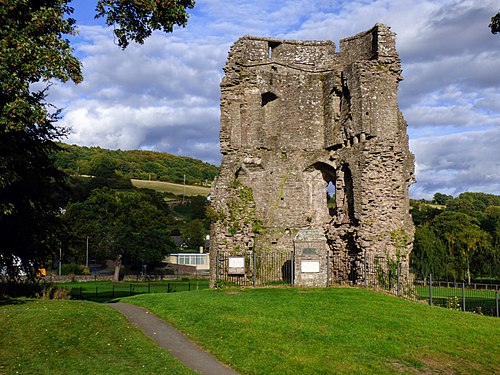
Narberth Castle today

Wales · Ruin

Narberth Castle

Castell Arberth

Narberth Castle is a ruined Norman fortress in Narberth, Pembrokeshire, dating to the 13th century and built by the Perrot family. The site is associated in Welsh tradition with the Mabinogi and today survives as low stone wall fragments and cellar vaulting above rolling Pembrokeshire countryside.

Photograph via Wikimedia Commons

Its prime

1280

Today

Ruin

As it stood in 1280

What Narberth Castle looked like in its prime.

A low, fragmented Norman stone castle of grey-brown rubble masonry set on a terrace above rolling green fields; surviving fabric consists of single- and double-storey wall stumps, a prominent square tower stump with a large rectangular window opening, and gaps where curtain walls once ran. The ground inside is an open earthen courtyard; below parts of the ruins the barrel-vaulted kitchen cellars remain intact, their rounded stone ceilings visible at ground level.

Its story

The story of Narberth Castle.

Narberth Castle in Pembrokeshire forms part of the Landsker Line. A chronicle in the Cotton library records Gruffydd ap Rhys attacking and destroying a "castle of Arberth" in 1116, but that probably refers to nearby Sentence Castle, the stone castle at Narberth was not built until over a century later. The current ruins are undoubtedly Norman, dating from the 13th century and built by Andrew Perrot.

Welsh tradition associates the site with the Mabinogi. What survives today is low fragments of stone wall and cellar vaulting above the town; in the early 20th century the annual town fair ended with a procession into the castle, with dancing and music.

Step inside

6 places to explore in 1280.

The record describes 6 distinct spots at Narberth Castle, including 1 interior: barrel-vaulted kitchen cellars. Create your own photoreal reconstruction and explore every one, more scenes means more rooms, more angles, and more of the place to stand in.

Exterior approach from townInner courtyard (ward)Tower window (looking through)Barrel-vaulted kitchen cellarsCurtain walls and wall-walkNorth-side burial area

Build Your Own Castle

Recreate Narberth Castle with AI to explore it.

The artist rebuilds it as it stood in 1280, a photoreal reconstruction that belongs to you alone. Pay with coins, no subscription needed.

Recreate this castle →Defend this castle →

Whose castle

Clans who held Narberth Castle.

The families that held Narberth Castle for a decade or more across its history, follow a name to its clan.

  • Perrot

    The 13th-century stone castle was built by Andrew Perrot; a fortress of the Perrot family.

Questions about Narberth Castle

What is the history of Narberth Castle?

Narberth Castle was built as a Norman fortress in the 13th century by Andrew Perrot. It forms part of the Landsker Line and is associated in Welsh tradition with the Mabinogi. The castle never changed hands during the Glyndŵr Rising from 1400 to 1415, but it was slighted after Oliver Cromwell took it during the English Civil War.

What is inside Narberth Castle?

Inside Narberth Castle, the surviving features include an open earthen courtyard and barrel-vaulted kitchen cellars. The cellars remain intact, with rounded stone ceilings visible at ground level. No upper-storey rooms survive, while the remaining walls are mostly single- and double-storey fragments.

Why was Narberth Castle built, and what was it used for?

Narberth Castle was built as a Norman fortress in the 13th century. It formed part of the Landsker Line, a frontier zone, and served a defensive purpose rather than surviving as a palace or domestic residence. Later, parts of the castle were used as building material for surrounding houses, leaving the fortress in ruins.

Where is Narberth Castle?

Narberth Castle is in Narberth, Pembrokeshire. It stands above the town on a terrace overlooking rolling Pembrokeshire countryside and forms part of the Landsker Line. Narberth is the nearest named settlement and the location given for the castle.

When was Narberth Castle built?

Narberth Castle was built in the 13th century. Its first-raised year is not recorded, while the site’s prime year is given as 1280. A chronicle mentions a castle of Arberth being destroyed in 1116, but that probably referred to nearby Sentence Castle rather than the stone castle at Narberth.

Was Narberth Castle ever attacked or besieged?

Narberth Castle was attacked in 1116 and during the English Civil War. The 1116 attack by Gruffydd ap Rhys probably concerned nearby Sentence Castle, not the stone castle at Narberth. Oliver Cromwell later took Narberth Castle, after which it was slighted; it also held throughout the Glyndŵr Rising from 1400 to 1415.

Which family or clan held Narberth Castle?

Narberth Castle was built by the Perrot family, with Andrew Perrot named as its builder. The 13th-century stone castle is described as a fortress of the Perrot family. No later family or clan holding is given in the supplied material.

What did Narberth Castle look like in its prime?

In its prime, Narberth Castle was a Norman stone fortress with grey-brown rubble masonry on a terrace above rolling green fields. Its silhouette included single- and double-storey wall stumps, a prominent square tower stump with a large rectangular window opening, and curtain walls. The courtyard was open, with barrel-vaulted cellars beneath parts of the ruins.

Is Narberth Castle still standing or is it a ruin?

Narberth Castle is a ruin. Low fragments of stone wall survive, including single- and double-storey wall stumps, a square tower stump and gaps in the former curtain walls. The barrel-vaulted kitchen cellars remain intact, but no upper-storey rooms survive; surrounding houses have also taken building material from the castle.

Is Narberth Castle real, or is it only a legend?

The stone castle at Narberth is a real documented Norman ruin, but its identification with the castle in the Mabinogi is contested. Welsh tradition places Rhiannon’s imprisonment there, while at least two other nearby earthworks have also been proposed. The 13th-century stone castle itself was built by Andrew Perrot.
All castles of Wales · Castles of Europe · the best castles in Europe · explore the finished reconstructions.