Clan Rising
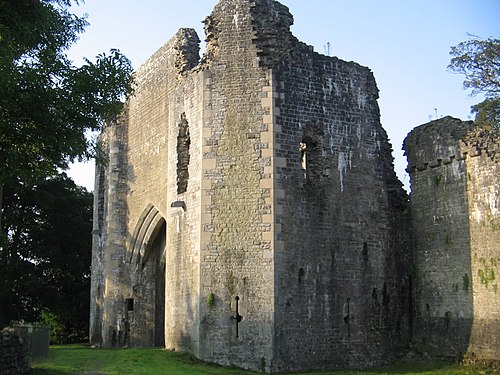
Painscastle Castle today

Wales · Ruin

Painscastle Castle

Castell Paun

Painscastle is a medieval castle site in the village of Painscastle, Powys, Wales. The site was originally held by Pain fitzJohn, refortified several times in the 12th–13th centuries and rebuilt in stone in the 13th century. Today little survives above ground beyond massive earthworks and ditches that mark the rectangular footprint of the former castle.

Photograph via Wikimedia Commons

Its prime

1276

Today

Ruin

As it stood in 1276

What Painscastle Castle looked like in its prime.

Sited on a raised, grass-covered defensive platform above a small village, the castle occupied a clearly rectangular footprint defined by broad earthen banks and a surrounding ditch. In its prime the enclosure was lined by a continuous stone curtain wall rising from the earthworks, with a formal entrance on the approach side and enclosed open courtyard within. The ensemble sat amid open pasture and lanes, visible as a compact fortified rectangle above the surrounding fields.

Its story

The story of Painscastle Castle.

The first castle at Painscastle appears to have been built by Pain fitzJohn, whose name the village carries. The site, between Builth and Hay-on-Wye near the English border, changed hands repeatedly: it remained in Welsh hands until about 1195, when William de Braose, 4th Lord of Bramber, captured the area and refortified the castle, his formidable wife Maud held it against the Welsh for several months.

In 1196 Rhys ap Gruffudd of Deheubarth defeated the Marcher lords in battle at Radnor, eight miles to the north, and besieged Painscastle, though terms were agreed before it fell. King John later held the lands; the Welsh de Braose ally Iorwerth Clud occupied the castle in 1215, submitted to John in 1216 and was granted the Lordship of Elfael until his death in 1222.

Ralph Tosny claimed the castle in 1233 and his family held it until Llywelyn ap Gruffudd took it from Roger Tosny in 1265; rebuilt in stone in the 13th century, it later passed to the Beauchamp Earls of Warwick. Little now survives above ground beyond the massive earthworks and ditches that mark the castle's rectangular footprint.

Step inside

6 places to explore in 1276.

The record describes 6 distinct spots at Painscastle Castle, including the full exterior approach. Create your own photoreal reconstruction and explore every one, more scenes means more rooms, more angles, and more of the place to stand in.

Approach from the village roadBase of the earthwork rampart and ditchSummit of the raised platform (site of keep)Inner courtyard enclosed by curtain wallsAlong the curtain wallPanoramic view from surrounding fields

Build Your Own Castle

Recreate Painscastle Castle with AI to explore it.

The artist rebuilds it as it stood in 1276, a photoreal reconstruction that belongs to you alone. Pay with coins, no subscription needed.

Recreate this castle →Defend this castle →

Whose castle

Clans who held Painscastle Castle.

The families that held Painscastle Castle for a decade or more across its history, follow a name to its clan.

  • de Braose

    William de Braose refortified Painscastle about 1195; his wife Maud held it against the Welsh.

  • Tosny

    Held by the Tosny family from 1233 until Llywelyn ap Gruffudd took it from Roger Tosny in 1265.

  • Beauchamp

    Later passed to the Beauchamp Earls of Warwick.

Nearby

Landmarks within reach of Painscastle Castle.

Questions about Painscastle Castle

What is the history of Painscastle Castle?

Painscastle Castle began as a medieval stronghold, apparently built by Pain fitzJohn. It remained in Welsh hands until about 1195, when William de Braose refortified it. The castle was rebuilt in stone in the 13th century, later taken by Llywelyn ap Gruffudd in 1265, recovered and rebuilt in 1276, and eventually passed to the Beauchamp Earls of Warwick.

What is inside Painscastle Castle?

Inside Painscastle Castle, the surviving layout includes an inner courtyard enclosed by curtain walls and the summit of the raised platform, where the keep stood. Alongside these spaces, the site preserves the base of the earthwork rampart and ditch. Little survives above ground beyond the massive earthworks and ditches.

Why was Painscastle Castle built, and what was it used for?

Painscastle Castle was built as a defensive stronghold on a frontier site. It was refortified and rebuilt in stone during conflicts involving Welsh rulers, the Marcher lords and the English crown. Its military purpose continued when it was refortified again during the Welsh rebellion led by Owain Glyndŵr in 1401.

Where is Painscastle Castle?

Painscastle Castle is in the village of Painscastle, in Powys, between Builth and Hay-on-Wye. It lies approximately 3 miles from the Wales-England border. The site stands above the village on a raised defensive platform amid surrounding fields and pasture.

When was Painscastle Castle built?

Painscastle Castle was built in several phases from the 12th to the 13th centuries, but its first construction date is not recorded. The site was refortified several times, and it was rebuilt in stone in the 13th century. A later rebuilding took place in 1276.

Was Painscastle Castle ever attacked or besieged?

Painscastle Castle was besieged by Rhys ap Gruffudd in 1196, but it did not fall because terms were agreed. Gwenwynwyn ab Owain besieged it in 1198 and was heavily defeated by an English army led by Geoffrey fitz Peter. The castle was later attacked and destroyed by the Welsh after Iorwerth Clud's occupation.

Which family or clan held Painscastle Castle?

Painscastle Castle was held by the de Braose, Tosny and Beauchamp families at different times. William de Braose refortified it about 1195, while his wife Maud held it against the Welsh. The Tosny family held it from 1233 until Llywelyn ap Gruffudd took it from Roger Tosny in 1265; it later passed to the Beauchamp Earls of Warwick.

What did Painscastle Castle look like in its prime?

In its prime, Painscastle Castle was a compact fortified rectangle on a raised, grass-covered platform. Broad earthen banks and a surrounding ditch defined the footprint, while a continuous stone curtain wall enclosed an open courtyard. The castle had a formal entrance on the approach side and stood above open pasture and lanes.

Is Painscastle Castle still standing or is it a ruin?

Painscastle Castle is now a ruin, with little surviving above ground. Massive earthworks and ditches still mark the rectangular footprint of the former castle. The raised platform, rampart, ditch, inner courtyard area and curtain-wall line remain identifiable as parts of the site.
All castles of Wales · Castles of Europe · the best castles in Europe · explore the finished reconstructions.