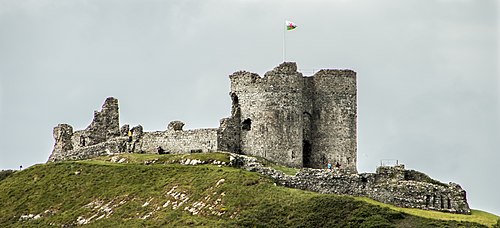
Wales · Partial ruin
Ruthin Castle
Castell Rhuthun
Ruthin Castle is a medieval fortification in North Wales originally built in the late 13th century by Dafydd ap Gruffydd. It was a marcher stronghold that was slighted after the Civil War; substantial sections of the curtain walls survive and have been incorporated into a hotel. The ruins stand on a red sandstone ridge overlooking the Vale of Clwyd.
Its prime
1300
Today
Partial ruin
As it stood in 1300
What Ruthin Castle looked like in its prime.
A high curtain of roughly coursed grey stone with distinctive red-sandstone dressings around major openings sits on a red sandstone ridge above a grassy slope. A rounded tower fragment projects from one corner and a large pointed arched gateway with red-sandstone voussoirs opens into the interior; corbelled stone courses sit above the arch. The wall face shows punched window openings and a continuous defensive skyline in its original complete state.
Its story
The story of Ruthin Castle.
Dafydd ap Gruffydd's Castle, 1277
Ruthin Castle stands on a red sandstone ridge above the Vale of Clwyd, on a site first used as an Iron Age fort. In 1277 Edward I granted the land to Dafydd ap Gruffydd, brother of Prince Llywelyn ap Gruffudd, in gratitude for his help during the invasion of North Wales, and the castle was built in the late thirteenth century that followed. It is unclear whether Dafydd built on an existing fortification or established the castle from nothing; it was originally given the Welsh name Castell Coch yn yr Gwernfor, the Red Castle in the Great Marsh.
The Greys of Ruthin and the Rebellion of Owain Glyndŵr
The castle became the seat of a branch of the de Grey family, who held the title Barons Grey de Ruthyn and headed the marcher lordship of Dyffryn Clwyd from it. Among them was Reginald Grey, 3rd Baron Grey de Ruthyn, the man who could be said to have sparked the rebellion of Owain Glyndŵr.
Richard Gwyn's Imprisonment, 1579–1584
Between 1579 and 1580 the castle was used to imprison and torture the Welsh poet and recusant schoolmaster Richard Gwyn, who was hanged, drawn and quartered at Wrexham on 15 October 1584. Gwyn was canonised in 1970 by Pope Paul VI as one of the Forty Martyrs of England and Wales.
The Eleven-Week Siege and Slighting, 1646
By the outbreak of the English Civil War the castle was in disrepair, and hurried work was needed to make it defensible. It withstood an eleven-week siege by parliamentary troops in 1646, surrendering only after the besiegers announced they intended to mine beneath the walls. Oliver Cromwell's forces later dismantled and demolished the castle in the organised de-fortification known as slighting; the surviving sections of the ancient walls now form part of the Ruthin Castle Hotel.
From Private Hospital to Hotel, 1923–1969
In 1923 the castle became Britain's first private hospital for the investigation and treatment of obscure internal diseases, closing around 1950. Since the 1960s its remains have formed part of a hotel, whose guests have included Prince Charles, who stayed the night before his investiture as Prince of Wales at Caernarfon Castle in 1969.
Step inside
5 places to explore in 1300.
The record describes 5 distinct spots at Ruthin Castle, including 1 interior: inner courtyard (seen through gateway). Create your own photoreal reconstruction and explore every one, more scenes means more rooms, more angles, and more of the place to stand in.
Build Your Own Castle
Recreate Ruthin Castle with AI to explore it.
The artist rebuilds it as it stood in 1300, a photoreal reconstruction that belongs to you alone. Pay with coins, no subscription needed.
Recreate this castle →Defend this castle →Whose castle
Clans who held Ruthin Castle.
The families that held Ruthin Castle for a decade or more across its history, follow a name to its clan.
Base of the de Grey Barons Grey de Ruthyn and the head of their marcher lordship of Dyffryn Clwyd.
Nearby