Brady
also O'Brady, Ó Brádaigh, MacBrady, Mac Brádaigh
The spirited ones of Breifne, lords in Cavan.
- Origin
- Ulster, Ireland
- Famous bearer
- Tom Brady (b. 1977), American football quarterback
- Register
- Irish family
The Brady arms and country

Coat of armsBrady (of Hazelbrook) EscutcheonBorne by the Hazelbrook line, one branch of the name rather than all of it.Robin S. Taylor · CC BY-SA 4.0
_Escutcheon.png)
- Coat of arms: Granted to an individual and inherited down that one documented line. These are the arms of particular families of the name, not of everyone who shares the surname.
CoreHistoric reach
The seat of Brady
Seat vacantChief
No one leads the Brady community yet. When the movement opens, you can stand for its leadership, or help elect whoever does.
Current mission
No shared goal set yet. Once Brady has leadership, it sets the public focus: a restoration, a gathering, a real-world project that helps its own.
The Brady clan is being rebuilt. Join the waiting list for the movement today, and you help decide who leads it and what it does.
Help rebuild the Brady clan →What does the Brady name mean?
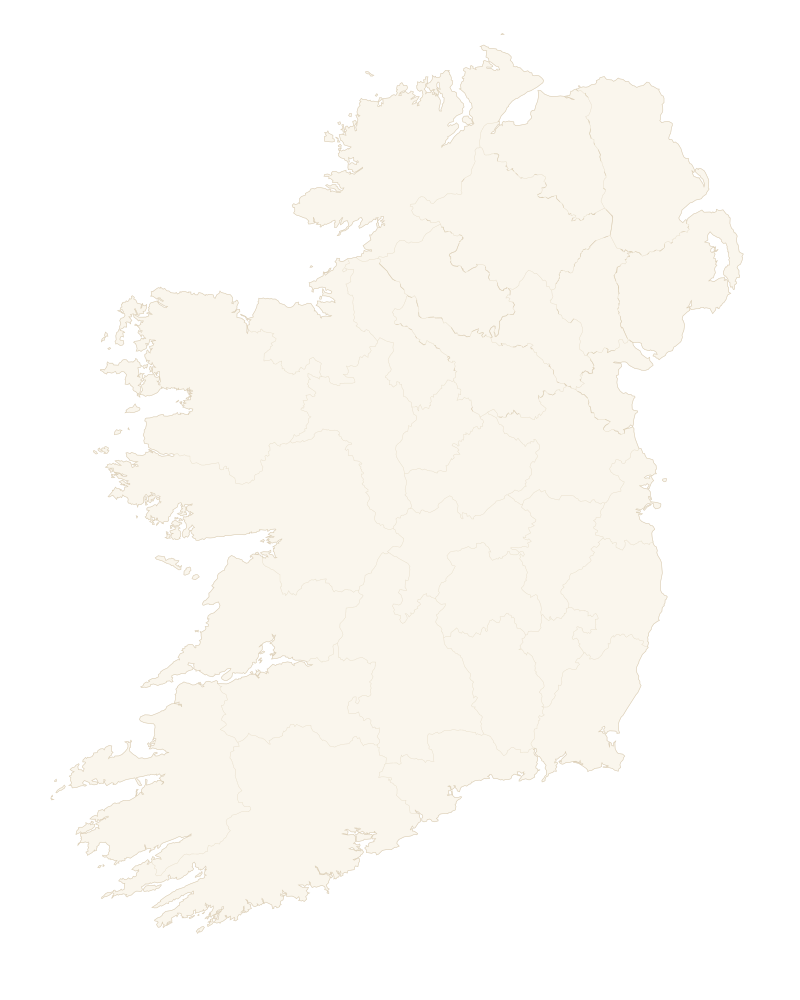
From Ó Brádaigh and Mac Brádaigh, 'descendant (or son) of Brádach', a personal name perhaps meaning 'spirited' or 'large-chested'. The Brádaigh were a Breifne family, chiefs in the country around Stradone in modern County Cavan, where they grew to be one of the dominant septs of the south Ulster–north Leinster borderland.
The history of Brady
Bradach the spirited, and a pedigree that runs back to Brion
The name is Ó Brádaigh or Mac Brádaigh: descendant, or son, of Brádach, a personal name read as "spirited" and "broad", and glossed in the family's own record as perhaps "large-chested". Both prefixes belong to the same stock: Ó marks a descendant, Mac a son. What the name never was is a trade or a place. It fossilises one man, Brádach, and the Breifne country that filled up with his descendants.
The Mac Brádaigh pedigree preserved in the Irish genealogies is unusually explicit about where that man sits. It runs Tighearnán mac Gallbrath mac Domhnall mac Bradaigh (Brádach marked a quo, the ancestor the surname comes from) then back through Niall, Maolmordha (a quo Muintir Maoilmhordha), Cearnachán and Blathmac to Brion, from whom the Uí Briúin take their name, and to Eochaid Mugmedon. The Uí Briúin were the Connachta stock that also produced the O'Rourkes and the O'Reillys, and it was under the O'Reillys, in the lordship of East Breifne, that the Ó Brádaigh rose.
Chiefs of Cúil Bhríghde, entered in the Annals of the Four Masters
The Mac Brádaigh were a strong sept of Breifne, in what is now County Cavan, and their chiefs of Cúil Bhríghde are named in the Annals of Ireland, among them the compilation known as the Annals of the Four Masters. The earliest of them recorded as head of the family is Tighearán Mac Brádaigh, Chief of the Name, who died in 1256. A chief in that world was not a landlord: under Brehon law the leaders of Irish clans were appointed by their kinsmen as custodians of the clan and its property, and the office passed by tanistry, election from among the agnatic cousins descended from a shared grandfather or great-grandfather, rather than from father to son.
A separate reckoning of the chiefly families of Oriel (the Airgíalla, who controlled what are now Tyrone, Armagh, Fermanagh and Monaghan) counts the MacBradys among them, alongside the Maguires, the MacMahons, the O'Boylans and the O'Cassidys. The two placements are less a contradiction than a map: the family's weight sat in Cavan, but the name carried across the south Ulster border country into Monaghan, Meath and Longford, and the Oriel list is where that reach shows on paper.
Five Bradys in the see of Kilmore, and one in Ardagh
Gilbert Mac Brádaigh held the bishopric of Ardagh from 1396 to 1400. After him the family took the see of Kilmore, and kept coming back to it for the better part of two centuries: Nicol Mac Brádaigh, bishop of Kilmore, died in 1421; Aindrias Mac Brádaigh, bishop of Kilmore, died in 1445; Tomás Mac Brádaigh, bishop of Kilmore, died in 1511.
Sean Mac Brádaigh, who died in 1559, and Richard Mac Brádaigh, who died in 1607, carried the family's hold on Kilmore through the Reformation century and out the far side of it. Richard appears in the wider record of the surname stripped of his Irish form, simply as Richard Brady, Irish prelate, died 1607. Five men of one name in a single see is not accident: it is the machinery of a Gaelic lordship, in which church office ran in the same kindreds that supplied the chiefs.
Ó, Mac, and the O'Grady who came out as a Brady
In Irish the surname flexes with the person carrying it. A man is Ó Brádaigh or Mac Brádaigh; his daughter is Ní Bhrádaigh or Nic Bhrádaigh; a woman who takes her husband's name becomes Bean Uí Bhrádaigh, or in Ulster simply Ní Bhrádaigh. English record-keeping had no use for any of it. Anglicisation stripped the prefix and froze one spelling, so that Ó Brádaigh and Mac Brádaigh alike came out of the clerk's pen as Brady, O'Brady and MacBrady surviving only as minority forms. The genealogical fact the prefix carried, descendant or son, was thrown away in a single stroke.
The flattening had a second cost, and the family's own notes flag it. A wholly separate family, the Ó Grádaigh of north-east Thomond, normally anglicise as O'Grady, but some of them used Brady instead, and the two names have nothing to do with each other. The best-known case is Aodh Mac Brádaigh, better known as Hugh Brady, Church of Ireland Bishop of Meath, who died in 1584: he is recorded as coming from the O'Grady family, not from the Breifne line. A Brady tracing a pedigree has to establish which name was anglicised, not merely which spelling was kept.
Bards, scribes and a scaffold in the penal century
Fedlim Mac Brádaigh, the bard of Armagh, was active around 1710, still working a poet's office generations after English common law, the county and the sheriff had replaced the Irish country and the clan chief. Phillip Mac Brádaigh, who died in 1719, was at once a Protestant cleric and a Gaelic poet, a pairing that describes eighteenth-century Ireland more economically than commentary could. Fiachra Mac Brádaigh, poet and scribe, born about 1690 and dead about 1760, worked the other half of that trade, copying manuscripts by hand for a language whose patrons had gone down with the Gaelic aristocracy.
Michael Mac Brádaigh belongs to the same seventy years and ends them badly: a Jacobite, executed in 1746. Set the four side by side (a bard, a Protestant clergyman writing verse in Irish, a scribe, and a Jacobite put to death) and the family's eighteenth century stops being a blank between the lordship and the emigrant ship.
A field marshal in Austria, a Marine at Chapultepec
Thomas Mac Brádaigh (1752–1827) reached the rank of field marshal in the service of Austria. The road he took was an old one: the senior Gaelic chiefs of Ulster had left in 1607 to recruit support in Spain, and the Continent went on absorbing Irish careers long after the Flight of the Earls. Thomas A. Mac Brádaigh (1813–47) took the newer road west, and is recorded with the United States Marine Corps at the Battle of Chapultepec.
The soldiering did not stop there. Samuel Brady (1756–1795) served as an American military officer; Brookner Brady (1905–1977) was an American pentathlete and colonel; Eugene R. Brady (1928–2011) an American naval aviator, and Roger A. Brady (born 1946) an American general. Herman Brady (1919–2011) was a Chilean military officer, and Tanya Brady (1973–2022) a British army captain.
The nineteenth century: a bench, a naturalist and a camera
Maziere Brady (1796–1871) sat as an Irish judge and Denis Caulfield Brady (1804–1886) as a British politician, while Jasper Ewing Brady (1797–1871) held office as an American politician: one surname arguing law and politics on both sides of the Atlantic in a single generation. Antonio Brady (1811–1881) took another line entirely, as an English naturalist.
The best-known Brady of the century worked with a camera: Mathew Brady (1823–1896), the Irish-American photographer. Alongside him stand Mary Brady (1821–1864), an American nurse, and Genevieve Garvan Brady (1880–1938), an American philanthropist. The turn of the century then gave the name two women and two very different lives: Alice Brady (1892–1939), the American actress, and Alice Brady (1898–1914), the Irish labour activist.
Cavan's third name, and where it travelled
In 1890 Brady had the third highest number of births registered in County Cavan, and the name is still strongly represented there and in adjacent County Meath. Part of that density is descent and part of it is politics: an Irish fine took in not only the chief and his patrilineal relatives but unrelated clients, who assumed the name of the leading lineage as a show of allegiance while remaining ineligible, they and their descendants alike, ever to be elected chief. A dominant Breifne sept therefore produced Bradys faster than biology alone would have managed.
From there the name went wherever the Irish went. By 2014 Brady ranked No. 411 in the U.S. Census Bureau's listing of the most common American surnames. Australia has E. J. Brady (1869–1952), journalist, writer and poet, and Alfred Barton Brady (1856–1932), architect; New Zealand, Anne-Marie Brady (born 1966), political researcher, and Gavin Brady (born 1973), sailor; Canada, the ice-hockey player Neil Brady and the politician Bobbi Ann Brady; Britain, Graham Brady in politics, Karren Brady in sport and Fern Brady in comedy. At home the name still turns up where it always did, on Gaelic football teamsheets: Ciarán, Killian, Ollie, Phil and Ger Brady among them.
Castles that share the Brady name
The same name on the map, look one up, see what it looked like in its prime, and recreate it to explore.

All castles in Ireland → · Strongest castles in Ireland → · Castles of Europe
Play As Your Clan
Hold a real castle against whatever you choose to send at it, take a ship out in her own service years, or stand at the shoulder of someone the record remembers. The chronicler sets the scene; the deeds are yours.
Notable bearers of the Brady name
- Tom Brady (b. 1977), American football quarterback
- Liam Brady (b. 1956), footballer
- Paul Brady (b. 1947), singer-songwriter