Reilly
also O'Reilly, Riley, Ó Raghallaigh
Kings of East Bréifne, and the family that gave English the phrase 'the Reilly money'.
- Origin
- Ulster, Ireland
- Motto
- Fortitudine et prudentia
- Famous bearer
- Hugh O'Reilly (c.1581–1653), Archbishop of Armagh, Confederation of Kilkenny
- Register
- Irish family
Where the Reilly name comes from
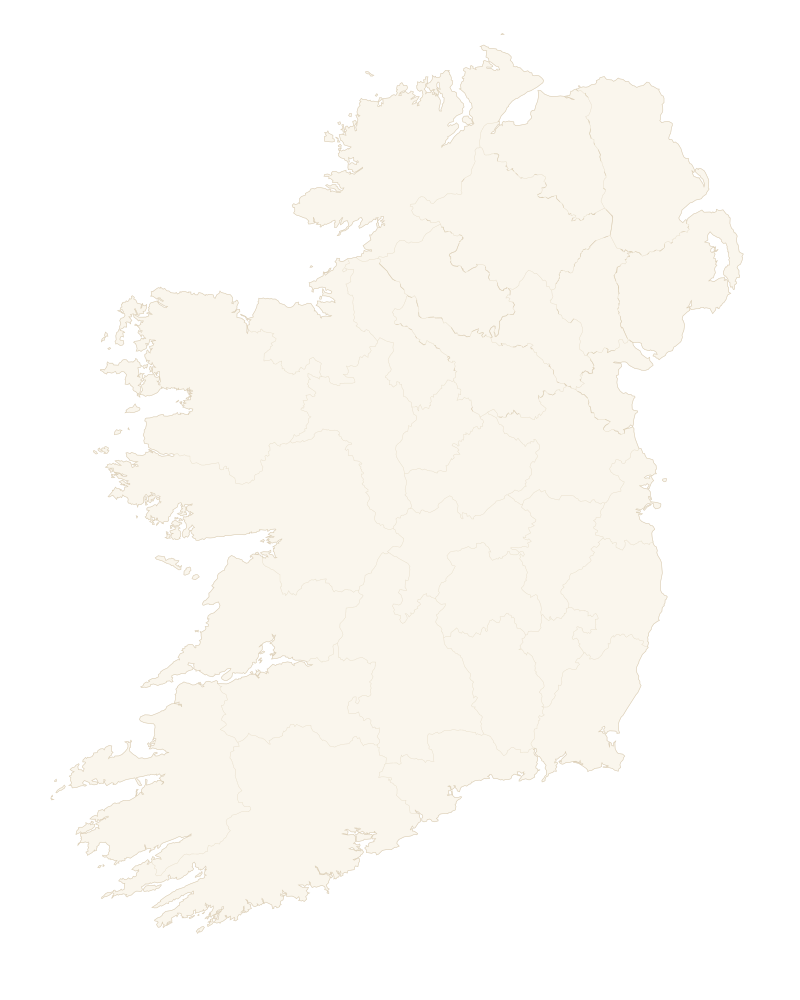
CoreHistoric reach
The seat of Reilly
Seat vacantChief
No one leads the Reilly community yet. When the movement opens, you can stand for its leadership, or help elect whoever does.
Current mission
No shared goal set yet. Once Reilly has leadership, it sets the public focus: a restoration, a gathering, a real-world project that helps its own.
The Reilly clan is being rebuilt. Join the waiting list for the movement today, and you help decide who leads it and what it does.
Help rebuild the Reilly clan →Motto
Fortitudine et prudentia
“By fortitude and prudence”
What does the Reilly name mean?
From Ó Raghallaigh, descendant of Raghallach. Raghallach was an early-tenth-century chief of East Bréifne, killed at the battle of Clontarf in 1014 fighting alongside Brian Boru. His descendants took the surname in the eleventh century and ruled the kingdom of East Bréifne, modern county Cavan with parts of Longford, Meath and Westmeath, until the early seventeenth century. The English form Reilly (with or without the apostrophe-O) is dominant today; Riley is a parallel American spelling of the same name.
The history of Reilly
Descendant of Raghallach
The name is a genealogical sentence in two words. In Irish it is Ó Raghallaigh, written properly with the accented Ó, and the Ó means descendant: the descendants of Raghallach, an early-tenth-century chief of East Bréifne who was killed at the battle of Clontarf in 1014 fighting alongside Brian Boru. His people took the dead chief's name as a fixed inheritance in the eleventh century, which put them among the earliest surname-bearing families anywhere in Europe. It was in the century of declining Uí Néill dominance, after Brian Boru took the high kingship from them in 1002, that surnames first began to be used in Ireland at all.
The kindred belonged to the Uí Briúin and their chiefly grouping the Síol Muireadaigh, which carried the O'Reillys alongside the O'Connors, the O'Rourkes, the MacGoverns and the O'Sheridans. What the name bought them was a claim: the kingdom of East Bréifne, modern Cavan with parts of Longford, Meath and Westmeath, held from the eleventh century to the early seventeenth.
The island fortress in Lough Oughter
The stone that proves the lordship sits on an island in Lough Oughter. The castle there had belonged to the O'Rourkes in the latter part of the twelfth century and appears to have passed early in the thirteenth to the Anglo-Norman de Lacy family. In 1233 the O'Reillys took possession, finished the building the others had begun, and kept it for centuries against two enemies at once: the O'Rourkes outside the family and rival branches within it.
It served as a prison as readily as a residence. In the 1360s a Philip O'Reilly was held in it with, in the chronicler's words, "no allowance save a sheaf of oats for day and night and a cup of water, so that he was compelled to drink his own urine". The drum-shaped keep and its thick masonry still stand in the water as a ruin, kept as a national monument.
How a chief was made, and how that ended
Behind the seat at Tullymongan above Cavan town and the silver the family struck in the 1480s lay a system of law, not a crown. Under Brehon law an Irish chief was appointed by his kinsmen as custodian of the clan, responsible for maintaining and protecting it and its property, and the succession ran by tanistry: on a chief's death the next was elected from among the agnatic cousins descended from a shared patrilineal grandfather or great-grandfather. A taoiseach of a clan of this rank held the status of royalty, and the system remained the basis of Irish society into the seventeenth century.
From 1541 the Dublin administration set about dismantling it. Gaelic chiefs were offered new titles, granted new coats of arms in 1552, and brought under the policy of surrender and regrant, which replaced election among cousins with European primogeniture. The early seventeenth century finished the work: the Tudor re-conquest destroyed the old Gaelic aristocracy, the senior Ulster chiefs left for Spain in 1607 and ended their lives in Rome, and English authority in Dublin disarmed the native lordships across the whole island for the first time.
Breffni Castle and the plantation that took it
Near Belturbet stood a castle known from the fourteenth century as Breffni Castle, inhabited by the O'Reillys of Breffni. They lost it in the Plantation of Ulster, when the Saunderson family acquired the site, and Cloughoughter went the same way after the confiscations that followed the 1610 plantation, granted to Captain Hugh Culme.
What followed at Belturbet was other people's war fought over O'Reilly ground. Robert Sanderson, who fought for William of Orange, inherited the place from his father in 1676; James II's troops burned the castle in 1689, and months later 400 of James's soldiers were ambushed nearby, many of them drowning in the Finn River. The castellated house raised on the site in 1840 was the birthplace of Colonel Edward James Saunderson, a founder of the Ulster Unionist Party.
Philip O'Reilly takes the castle back, 1641
The family did not accept the loss quietly. In 1641 another Philip O'Reilly, MP for Cavan and a leading figure in the Irish Rebellion of that year, seized Cloughoughter and held the island for twelve years. Commonwealth forces under Sir Theophilus Jones came to besiege it in March 1653, and the castle the family had completed in 1233 fell out of their hands for good.
The same decade produced the family's churchmen. Hugh O'Reilly held the Catholic archbishopric of Armagh from 1628 until his death in 1653, the years of the Confederation of Kilkenny, and Edmund O'Reilly (1606-1669) held the same see afterwards, an archbishop of the Restoration era. The Cromwellian confiscation of 1652 and the Williamite confiscation of 1691 removed what political ground the line still had.
The house at Ballinlough, and the year the name changed
One branch kept its roof. Ballinlough, a seventeenth-century country house near Clonmellon in County Westmeath, stands on a wooded hill above two of the Westmeath lakes and was the O'Reilly home from that century onward. Around 1790 Sir Hugh O'Reilly added a new wing, probably to designs by the amateur architect Thomas Wogan Browne, who was also responsible for Malahide Castle, the home of Sir Hugh's sister Margaret. The principal rooms may have the tallest windows in any private house of the period.
In 1812 the family changed their name from O'Reilly to Nugent, a surname brought to Ireland by the Normans, and under it they remain among the very few Irish Catholic families of the seventeenth century still living in their original home. It is still the house of Nicholas and Alice Nugent, and the demesne has been leased each year since 2010 to the Body and Soul festival.
The Dowth schoolmaster's son who escaped Western Australia
John Boyle O'Reilly was born on 28 June 1844 at the schoolmaster's cottage at Dowth on the Boyne in County Meath, third son of the master of Dowth National School. He was apprenticed at eleven to a Drogheda printer, went at fifteen to the Preston Guardian in England, and at nineteen, in 1863, enlisted in the British 10th Hussars at Dublin on the instruction of the Irish Republican Brotherhood organiser James Stephens, one of the sleeper agents planted in the Irish garrisons for a rising to come.
Constabulary infiltration broke the conspiracy in 1866. Arrested at Island Bridge Barracks at twenty-one, court-martialled for treasonable conspiracy and sentenced to death, he had the sentence commuted to twenty years' penal servitude and was transported to Western Australia aboard the Hougoumont in 1867. From convict road-work at the Bunbury camp he escaped in February 1869 to the American whaler Gazelle, which landed him at New Bedford, Massachusetts, that November.
He took a junior post on the Boston Pilot in 1870 and was its editor by 1876, building the Catholic Irish-American weekly to a national circulation of about a hundred and forty thousand and making himself the dominant voice of Irish-Catholic America in the 1880s. In 1876 he planned, with the Clan na Gael leadership, the Catalpa rescue: a whaling vessel bought by Clan na Gael sailed to Western Australia and on 17 April took off the six remaining Fenian prisoners who had got out of the Fremantle Convict Establishment, landing them at New York that August. He published Songs of the Southern Seas (1873) and Statues in the Block (1881), and died at Hull, Massachusetts on 10 August 1890, aged forty-six.
Cavan names, and the Ó that fell away
Anglicisation treated the prefix as optional. Where it survived, Ó and Ui were written O'; where clerks and emigration offices found it inconvenient, it was simply removed, and the same hand that turned Ó Raghallaigh into Reilly turned Ó Ceallaigh into Kelly. Riley is a further anglicised spelling that was not found originally in Ireland; the Indiana poet James Whitcomb Riley (1849-1916) carried it, and the actor John C. Reilly, born in 1965, carries the English form that is dominant today.
The lordship went; the name did not. Reilly stands among the ten most frequently found surnames in Ireland, and although its bearers are everywhere, they remain thickest on the ground of the old kingdom, with Cavan by a distance the densest O'Reilly county on the island.
Champions of the Reilly name
The bearers whose lives are inseparable from this surname. Each has their own page, biography, achievements, geography, connection to the family.
Castles the Reilly held
Strongholds this name held for a decade or more, look one up, or rebuild it to explore.
- Cloughoughter Castle
The O'Reilly clan took possession in 1233, completed the castle and retained it for centuries; Philip O'Reilly held it again, 1641–53.
- Ballinlough Castle
Home of the O'Reillys from the seventeenth century; Sir Hugh O'Reilly added a new wing around 1790.
- Castle Saunderson
The O'Reillys of Breffni held the original castle, known as Breffni Castle, from the 14th century until the Plantation of Ulster.
The castles of the homeland
The great strongholds of the homeland, look one up, see what it looked like in its prime, and recreate it to explore.
 Ashford Castle, County MayoRestored · prime 1880
 Manderley CastleRestored · prime 1840
 Dublin CastleRestored · prime 1790
All castles in Ireland → · Strongest castles in Ireland → · Castles of Europe
Play As Your Clan
Hold a real castle against whatever you choose to send at it, take a ship out in her own service years, or stand at the shoulder of someone the record remembers. The chronicler sets the scene; the deeds are yours.
Notable bearers of the Reilly name
- Hugh O'Reilly (c.1581–1653), Archbishop of Armagh, Confederation of Kilkenny
- Edmund O'Reilly (1606–1669), Archbishop of Armagh, Restoration-era
- John C. Reilly (b. 1965), actor
- James Whitcomb Riley (1849–1916), American poet, Indiana-Riley line