Lange
also Lang, Langer
'The tall one', the German Long.
- Origin
- German
- Register
- German family
The seat of Lange
Seat vacantChief
No one leads the Lange community yet. When the movement opens, you can stand for its leadership, or help elect whoever does.
Current mission
No shared goal set yet. Once Lange has leadership, it sets the public focus: a restoration, a gathering, a real-world project that helps its own.
The Lange clan is being rebuilt. Join the waiting list for the movement today, and you help decide who leads it and what it does.
Help rebuild the Lange clan →What does the Lange name mean?
Descriptive, Middle High German lanc, long or tall, for the tall man. The north inflects it Lange, the south keeps the bare Lang. Cognate of English Long.
The history of Lange
The word three languages reached for at once
Lange is Middle High German lanc, long or tall, hung on a man because he stood above the others in the room. The northern mouth adds the -e; the south keeps the bare Lang. Both sit in the smallest of the four classes German surnames fall into, the bodily attributes, alongside Klein for the small man, Groß for the big one, Krause for curly hair and Schwarzkopf for a black head. Nothing in it records a farm, a trade or a father. It records a body, seen once, by a neighbour who needed to say which man he meant.
The observation was so obvious that no language had to borrow it from another. Lang, Lange, Laing and Long are the same judgement made separately in German, Scots and English. The 2016 University of the West of England study of 45,602 surnames of Britain and Ireland put Brown, Short and Thin in this same class, names describing the first man to carry them, and Richard Coates, who led it, attached the warning every Lange should keep: Short may itself have begun as an ironic nickname for a tall man. A byname is a joke as often as a measurement.
Twelfth in Germany, and no kindred behind it
Counted with Lang, the name is carried by 0.1925 per cent of Germany, twelfth on the national list, between Bauer at 0.21 and Wolf at 0.1918. The eleven names above it are the point. Schmidt, Müller, Meyer, Schulz, Schneider, Hoffmann, Becker, Fischer, Weber, Wagner, Bauer: a smithy, a mill, a stewardship, a constable's staff, a pair of shears, a farm. Lange is the first name in Germany that describes a man's body rather than his work.
That is also why it is everywhere and concentrated nowhere. German surnames hardened into heritable form gradually through the late Middle Ages and were largely fixed by about 1600, when central demographic records began holding them still. The earliest to stick were the Hofnamen, the estate names, which is how Ulrich Zwingli, born 1484, inherited a surname from his father without inheriting the estate it named. A trade name needs a trade and an estate name needs an estate. A tall man needs neither. Any village could coin a Lange in any generation, and thousands did, which is the plain reason most people called Lange today descend from no single kindred and hold no common seat.
When a Lange daughter was written down differently
Into the eighteenth century a German woman was often not spelled the way her brother was. Registers of baptism, marriage and burial carried female forms of the surname: in the south a suffixed -in, so that Peter Huber's sister enters the book as Anna Huberin; in West Low German an ending in -sch or -sche, making Ms Schmidt into de Smidtsche, the Smithian; elsewhere a bare genitive s, so that Herr Bäcker's daughter was written Bäckers. In the northern parishes where the -e form belongs, the women of a Lange household could sit under a shape of the name a modern searcher would walk past.
Paperwork ended it. As the German states brought in official registration of legal names across the eighteenth and nineteenth centuries, the female variants were abolished and spelling was fixed to the recorded form instead of drifting from clerk to clerk. Before that a single family could surface as Lang, Lange or Langer in consecutive generations. After it, the north's Lange and the south's Lang were two surnames rather than two accents, and a vowel of dialect became a permanent fact of a passport.
Three Ludwigs and two Juliuses
The surest proof that Lange is a description and not a lineage is what happens when anyone tries to index it. Nineteenth-century German scholarship alone yields three men called Ludwig Lange, each with his own dates and his own field: the architect and landscape designer (1808–1868), the philologist and archaeologist (1825–1885), and the physicist (1863–1936). Three disciplines, three entries, one name, no line drawn between them.
The doubling runs everywhere. Julius Lange the German landscape painter (1817–1878) sits a generation from Julius Lange the Danish art historian (1838–1896), two men in one corner of the art world. Chess has Max Lange (1832–1899) and Wilfried Lange (1910–1993). Photography has Oscar V. Lange (1853–1913) and Dorothea Lange (1895–1965), both American. This is the signature of a nickname surname: not one family spreading, but the same plain word landing again and again on unconnected people.
The pulpit, the lecture room and the campaign
The learned Langes arrive early and keep arriving. Johann Joachim Lange (1670–1744) worked as a theologian and philosopher; Samuel Gotthold Lange (1711–1781) wrote as a poet a generation after him; Johann Peter Lange (1802–1884) was a theologian again, a century downstream of the first Johann and joined to him by nothing but the word. Friedrich Albert Lange (1828–1875) was a German philosopher.
Helene Lange (1848–1930) spent her life as an activist in Germany, and Luise Lange (1891–1978) worked there as a physicist, the two spanning the century in which German women moved into public and scientific life.
Mozart's brother-in-law and the man who drew 2001
Joseph Lange (1751–1831) was an actor and painter in Vienna and brother-in-law to Mozart, which is as near as the surname comes to standing in a famous room.
Its strangest turn belongs to Harry Lange (1930–2008), a German illustrator and production designer on 2001: A Space Odyssey. A word coined in some village to tell one tall man from his neighbours ended up on the drawing board of a film about spaceflight.
Danish mushrooms, a Norwegian Nobel and a Swede who signed herself Lang
Denmark kept the name in the natural sciences for over a century. Johan Lange (1818–1898) was a Danish botanist; Jakob Emanuel Lange (1864–1941) a Danish mycologist; Morten Lange (1919–2003) a Danish mycologist and politician, a second specialist in fungi under the same surname a generation on. When Frederik I of Denmark-Norway ordered noble families in 1526 to fix their surnames, many reached into their coats of arms and invented one: Rosenkrantz from a wreath of roses, Gyldenstierne from a gold star on the shield. The Langes needed no invention. They already had a word.
Norway produced Christian Lous Lange (1869–1938), a politician and Nobel Prize winner, and Even Lange, born 1946, an economic historian. Sweden has Algot Lange (1884 – after 1941), an explorer whose death the record cannot date; Henrik Lange (1908–2000), a lieutenant general; and Dagmar Lange (1914–1991), a crime novelist who published as Maria Lang. Her pen name is the surname's whole argument in four letters: she dropped the northern -e and printed the southern form.
Long-ee, and a name plain enough to hide behind
Emigration scattered it hard: the American actress Jessica Lange, born 1949, the Dutch HIV researcher Joep Lange (1954–2014), the Polish economist and diplomat Oskar R. Lange (1904–1965). Argentina holds the tightest cluster: Norah Lange (1905–1972) wrote there, and its sailing produced Santiago Lange, born 1961, Yago Lange, born 1988, and Klaus Lange, born 1995, the German forename still standing on the youngest of them.
The furthest the word travelled from its own sound was New Zealand, where David Lange (1942–2005) served as Prime Minister and the surname was said long-ee, a pronunciation a German speaker producing [ˈlaŋə] would not have recognised as the same name. Six letters, and no agreement anywhere on how to say them.
It also proved plain enough to hide behind. Michael Crichton published fiction as John Lange; the American novelist John Warren Wadleigh spent a working life as Oliver Lange; John Frederick Lange Jr., born 1931, went the other way and abandoned a real Lange for the invented John Norman. A surname meaning only the tall one makes an excellent disguise, because it points at nobody in particular.
The castles of the homeland
The great strongholds of the homeland, look one up, see what it looked like in its prime, and recreate it to explore.
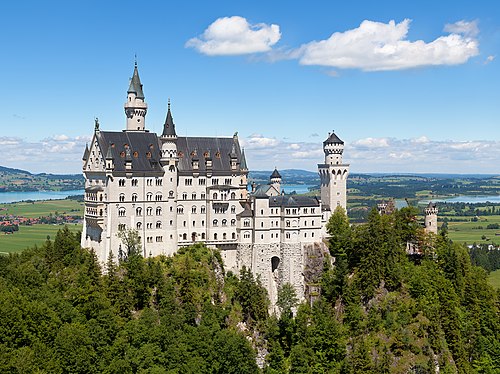 Neuschwanstein CastleStill standing · prime 1886
 Hohenzollern CastleRestored · prime 1867
 Eltz CastleStill standing · prime 1615
All castles in Germany → · Strongest castles in Germany → · Castles of Europe
Play As Your Clan
Hold a real castle against whatever you choose to send at it, take a ship out in her own service years, or stand at the shoulder of someone the record remembers. The chronicler sets the scene; the deeds are yours.