Parry
also ap Harry
Son of Harry, the Welsh ap-Harry compressed into a single syllable.
- Origin
- Powys, Wales
- Famous bearer
- Sir William Edward Parry (1790-1855), Royal Navy Arctic explorer; latitude record 1827
- Register
- Welsh family
The Parry arms and country

Coat of armsArmorial Bearings of the PARRY family of Vowchurch, HerefordshireBorne by the Vowchurch line, one branch of the name rather than all of it.Rs-nourse · CC BY-SA 4.0

- Coat of arms: Granted to an individual and inherited down that one documented line. These are the arms of particular families of the name, not of everyone who shares the surname.
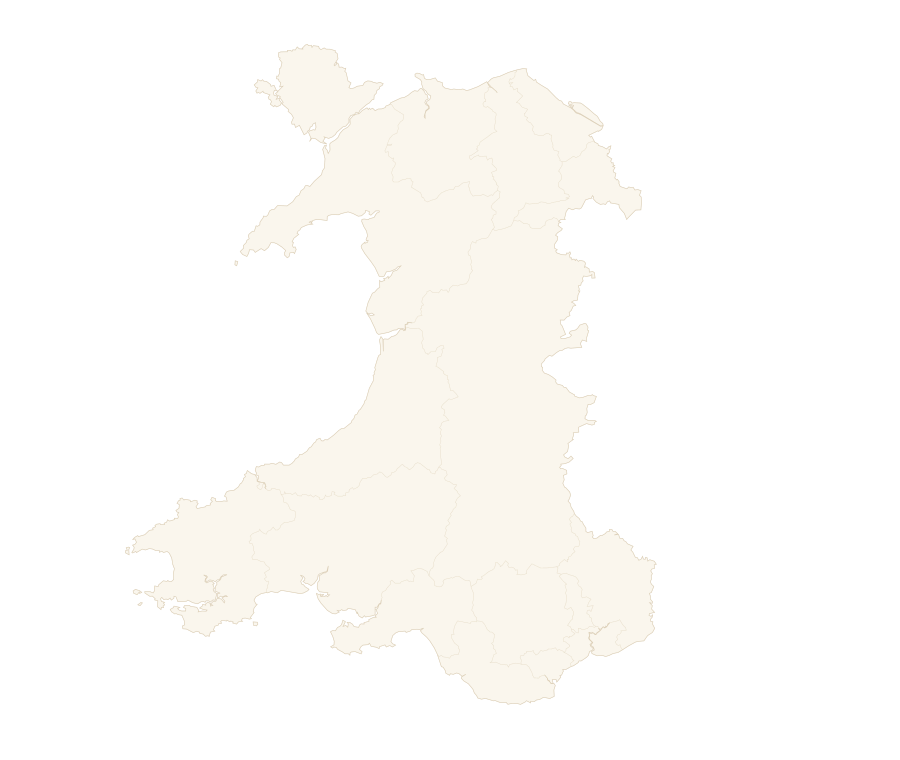
CoreHistoric reach
The seat of Parry
Seat vacantChief
No one leads the Parry community yet. When the movement opens, you can stand for its leadership, or help elect whoever does.
Current mission
No shared goal set yet. Once Parry has leadership, it sets the public focus: a restoration, a gathering, a real-world project that helps its own.
The Parry clan is being rebuilt. Join the waiting list for the movement today, and you help decide who leads it and what it does.
Help rebuild the Parry clan →What does the Parry name mean?
Welsh patronymic, ap Harry (son of Harry, the standard Welsh-and-English diminutive of Henry). The patronymic ap Harry compressed to Parry in the same Tudor surname-compression that produced Powell from ap Hywel, Pritchard from ap Richard and Bowen from ap Owen. The Welsh form Henri / Harri carried the personal name across the medieval Welsh marcher gentry, and the patronymic Parry is densest in mid- and north Wales, particularly Denbighshire, Flintshire and Powys where the late-medieval surname-fixation took the ap-form into standard hereditary use.
The history of Parry
Son of Harry, squeezed into a single syllable
In 1292, 48 per cent of Welsh names were patronymics, and in some parishes more than 70 per cent. A man was not a Parry; he was ap Harry: his baptismal name, then ap or ab for 'son of', then his father's name. Harry was the Welsh-and-English diminutive of Henry, carried into Wales as Henri and Harri by the marcher gentry who took the Norman-French form into use from the twelfth century onwards. Every generation rebuilt the name from scratch. Thomas's son Evan answered to Evan ap Thomas, his son John to John ab Evan, his son Rees to Rees ap John. Nothing was inherited.
The names could run much further back than one father. Llewelyn ap Dafydd ab Ieuan ap Gruffudd ap Meredydd is no unusual specimen: extended patronymics reached perhaps a seventh generation and amounted to a spoken genealogy of the male line. The Encyclopaedia of Wales surmises the habit grew out of Welsh law itself, under which it was essential to know how a person descended from a given ancestor. When ap Harry hardened into one hereditary word, the ap did not disappear so much as collapse into the front of it, leaving the P that still opens Parry.
The reign that stopped the name changing
Welsh law decayed through the later Middle Ages and the patronymic decayed with it. Fixed surnames were adopted in Wales from the fifteenth century onwards, and in the reign of Henry VIII they became hereditary among the Welsh gentry; unification under Henry in 1536 carried the English pattern across the country. Town families, the wealthy and the districts nearest English influence gave up the old system first, while rural parishes kept patronymic naming into the early nineteenth century.
The compression produced a cluster of surnames at once, each a swallowed ap: Powell from ap Hywel, Price and Pryce from ap Rhys, Pugh from ap Hugh, Pritchard from ap Richard, Bowen from ab Owen, Probert from ap Robert, Probyn from ap Robin, Penry from ap Henry, and Parry from ap Harry. Elsewhere the ap was dropped and an English s added to the father's name instead, which is how Jones, Roberts and Edwards became the commonest surnames in Wales. Parry belongs to the smaller group that kept the fossil of the preposition.
Two Parrys in one village need not be cousins
The stock of Welsh surnames is small, and it shrank further after the Reformation cut the variety of baptismal names parents chose from. A handful of first names, run through the patronymic machine and frozen, supplied a whole country. The standard account states the consequence flatly: Welsh communities have families bearing the same surname who are not related, and it cannot be assumed that two people named Jones, even in one village, inherited it from a common ancestor.
That warning applies to Parry exactly as it applies to Jones. Any parish holding more than one man called Harry in the fifteenth century could throw off several unrelated lines of Parrys. The pressure shows up in the nineteenth century, when Welsh families began prefixing the name of a house, a parish or the mother's surname to tell themselves apart, giving double surnames such as Cynddylan Jones and later hyphenated forms like Griffith-Jones. It is why a Parry working through a Denbighshire parish register finds many candidates and few certainties.
Denbighshire, Flintshire and the ground the name holds
Parry is densest in mid- and north Wales, above all in Denbighshire, Flintshire and Powys, the country where the late-medieval fixing of surnames took the ap-form into hereditary use rather than discarding it. The name sits historically across Wrexham, Gwynedd, Ceredigion and Carmarthenshire too: along the north-eastern march and down the Welsh-speaking west, rather than in the industrial south.
Welsh Parrys held Welsh office: Albert Parry (1874-1950) was Anglican Dean of St David's from 1940 to 1949, at the cathedral of the saint whose day Wales still keeps on 1 March. The name has stayed Welsh on the field as well, through the footballer Maurice Parry (1877-1935) and, in the modern game, Mark Parry (born 1970) and Paul Parry (born 1980).
82 degrees 45 minutes north
Sir William Edward Parry (1790-1855), born at Bath, rose to Rear-Admiral in the Royal Navy and made three Arctic voyages between 1819 and 1825 in search of the Northwest Passage. In 1827 he reached 82 degrees 45 minutes north, a record latitude no one bettered for the next forty-nine years. He was the leading senior Royal Navy Arctic explorer of the early nineteenth century.
The name recurs on people who went out and looked at things. Charles Christopher Parry (1823-1890) worked as an American botanist and mountaineer; Frederic John Sidney Parry (1810-1885) was an English entomologist; Bruce Parry (born 1969) has made his career as a British television presenter and adventurer. None of them need be kin, which is rather the point: the surname was fixed on many unrelated households at once, and each went its own way.
Jerusalem, Myfanwy, and the Parrys who wrote music
Sir Hubert Parry (1848-1918), born at Bournemouth, set William Blake's Jerusalem to music in March 1916, and the result became the English anthem sung at hymn-singings, at rugby and cricket grounds and on the Last Night of the Proms. He had already written the coronation anthem I Was Glad in 1902, and he held the directorship of the Royal College of Music from 1894 to 1918. The 1916 setting is told in full as one of this catalogue's legends.
Joseph Parry (1841-1903), the Welsh composer, wrote Myfanwy (1875) and Aberystwyth (1879). The thread runs on with Wilfred Parry (1908-1979), a pianist and accompanist who taught at Trinity College, London, Ben Parry (born 1965), composer, conductor and singer, and Dick Parry (1942-2026), an English saxophonist.
The name that left Wales
Welsh surnames travelled with Welsh people, and travelled far. An analysis commissioned by the Welsh Government found 718,000 people in Wales, nearly 35 per cent of the population, carrying a family name of Welsh origin, against 5.3 per cent in the rest of the United Kingdom, 4.7 per cent in New Zealand, 4.1 per cent in Australia and 3.8 per cent in the United States; across those countries 16.3 million people bear one. During the Industrial Revolution thousands moved into England, to Liverpool and Ashton-in-Makerfield among other places, which is why English, Scottish and Irish families carry Welsh names today.
The longer voyages were more deliberate. Contract miners went to the coalfields of Pas-de-Calais; the ship Albion left Cardigan for New Brunswick in 1819 with twenty-seven Cardiganshire families aboard, many of them farmers; Thomas Benbow Phillips of Tregaron founded a settlement of about a hundred Welsh people in Rio Grande do Sul in 1852. Jackson County, Ohio was known as Little Wales, and Malad City in Idaho, begun as a Welsh Mormon settlement, claims more Welsh descent per head than anywhere outside Wales.
The name is found well beyond Wales. Bill Parry (1878-1952) sat as a New Zealand politician and H. G. Parry writes and teaches there now; Diane Parry (born 2002) plays tennis for France; American classical scholarship carries the name twice, in Milman Parry (1902-1935), a scholar of epic poetry, and Adam Parry (1928-1971).
Parrys of the last hundred years
Harold Parry (1896-1917) was an English poet of the First World War. Thomas Gambier Parry (1816-1888) was a British artist and art collector; Cecil Parry (1866-1901) an English cricketer; Bill Parry (1934-2006) a British mathematician. In sport and broadcasting the name became almost a fixture: Rick Parry (born 1955) was chief executive of Liverpool Football Club and headed the FA Premier League, Alan Parry (born about 1947) commentates on football and athletics, and Mike Parry (born 1954) is an English journalist and broadcaster.
Philip Pullman borrowed it for His Dark Materials, where Will Parry stands at the centre of the story beside a father hidden under another name who turns out to be Colonel John Parry. That spread is what a fixed Welsh patronymic does once loose in the world: it stops meaning 'son of Harry' and comes to mean nothing but a family.
Historic Places, Rebuilt
Explore the streets and seats the Parry name knew, rebuilt with AI as they stood in history.
Historic Places, Rebuilt · New
Edward I's walled bastide and mighty castle in North Wales, a generation after the conquest, the banded towers still rising.
Historic Places, Rebuilt · New
Owain Glyndŵr's mountain fortress and court at the high tide of Welsh independence, the English siege lines gathering below.
The castles of the homeland
The great strongholds of the homeland, look one up, see what it looked like in its prime, and recreate it to explore.
 Caernarfon CastleRestored · prime 1330
 Conwy CastleRuin · prime 1287
 Pembroke CastleRestored · prime 1280
All castles in Wales → · Strongest castles in Wales → · Castles of Europe
Play As Your Clan
Hold a real castle against whatever you choose to send at it, take a ship out in her own service years, or stand at the shoulder of someone the record remembers. The chronicler sets the scene; the deeds are yours.
Notable bearers of the Parry name
- Sir William Edward Parry (1790-1855), Royal Navy Arctic explorer; latitude record 1827
- Sir Hubert Parry (1848-1918), composer of Jerusalem (1916) and I Was Glad (1902); director of the Royal College of Music 1894-1918
- Joseph Parry (1841-1903), Welsh composer; Aberystwyth (1879) and Myfanwy (1875)
Stories of Parry
Frequently asked
What does the surname Parry mean?
Where does the Parry family come from?
Where did the Parry family historically hold territory?
Is Parry Welsh or English?
How old is the Parry surname?
What is the Parry family known for?
Is there a Parry family crest or coat of arms?
Who is the most famous Parry?
Who are some famous Parrys?
What stories are told about the Parry family?
What is the story of Parry sets Blake's Jerusalem to music?
Is ap Harry the same family as Parry?
Where is the Parry surname found today?
What does the Clan Rising page for the Parry family cover?
Who is the head of the Parry family today?
Neighbouring clans
- EvansSon of John, by the Welsh road, the cousin name of Jones.
- LewisLlywelyn anglicised, a princely name carried into common use across the Marches and the south.
- OwenThe princely name, Owain in Welsh, the surname of the last revolt and the first Tudor.
- EdwardsSon of Edward, densest along the eastern marches where the name first crossed.