Quine
Son of Conn, Manx on the island, scattered through the diaspora.
- Origin
- Isle of Man, Islands & Dependencies
- Register
- Manx family
Where the Quine name comes from
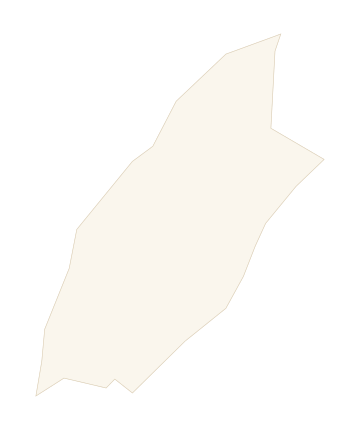
The seat of Quine
Seat vacantChief
No one leads the Quine community yet. When the movement opens, you can stand for its leadership, or help elect whoever does.
Current mission
No shared goal set yet. Once Quine has leadership, it sets the public focus: a restoration, a gathering, a real-world project that helps its own.
The Quine clan is being rebuilt. Join the waiting list for the movement today, and you help decide who leads it and what it does.
Help rebuild the Quine clan →What does the Quine name mean?
From the Gaelic Mac Cuinn, 'son of Conn', reduced in the Manx manner to Quine.
The history of Quine
Mac Cuinn, and the parishes that kept it
Quine is Mac Cuinn, son of Conn, and it is said kwine. On Man the unstressed Mac fell out of use between the early sixteenth century and the seventeenth, leaving its final consonant welded to the front of the father's name, which is why so many island surnames now open with C, K or Q.
There is no seat in this story and no charter, only addresses: a miller's household at Foxdale, a family at Kirk St Ann (now Santon) that sailed for Chicago in 1853, a farm called Ballacrebbin in Andreas. From those the name went into a vicarage, a medical school and a Harvard chair.
The Foxdale miller's third son goes up to Merton
John Quine (1857-1940) was the third son of William Quine, a Foxdale miller, and his wife Christian, born a Callister. He was put to Latin and the classics early, and when the family moved to Ballasalla he went to King William's College close by. In 1877 he won an open scholarship in mathematics to Merton College, Oxford, and was elected Postmaster there, the senior undergraduate scholar of the house.
He graduated in 1881 with the mathematics degree and the classics habit, having spent his Oxford years on Greek, Latin and divinity as well, and took holy orders. Oxford expected the Church in England or the British Museum to have him; he went home instead, by then a convinced Manx nationalist: curate of Kirk Michael in 1881, domestic chaplain to Bishop Rowley Hill in 1883, and from July that year headmaster of Douglas Grammar School, where the art master was Archibald Knox and Quine is credited with turning him towards Celtic art.
The Captain of the Parish, and a letter from T. E. Brown
In 1895 Quine left the school for the vicarage of Lonan and the chaplaincy of All Saints, Laxey, and held both until he died. Two years later Heinemann published his novel The Captain of the Parish, and it did well with critics and public alike. Heinemann was Hall Caine's publisher too, and Caine's island novels had already made him the Manx national novelist; Mona Douglas, writing in the 1960s, called Quine's book a classic of its genre and said it was accounted by many the best Manx novel ever written.
Every section of it is headed by a quotation from T. E. Brown, the Manx national poet, and Brown wrote to Quine on 26 April 1897 to say what he made of it: "With The Captain of the Parish I am supremely contented, I can die happy." He wrote a comedy as well, Kitty's Affair, published in 1909 in the Anglo-Manx dialect and stocked with smugglers, farmers and maids, and the Isle of Man volume of the Cambridge County Geographies in 1911.
Roman surveyors on the Manx hills
Quine was twice president of the Isle of Man Natural History and Antiquarian Society, and his antiquarian work was as inventive as his fiction. In a paper of 1917 he argued that the cronks, taken until then for burial mounds or fortifications, were artificial mounds raised by Roman engineers for triangulating the island, set at regular distances of Roman miles and aligned so that the lines between them made parallelograms and triangles on the Ordnance Map. He read Manx place-names as corruptions of Latin names from Roman emperors and goddesses, and thought besides that Saint Patrick had been born on Man. The evidence was thin and the academic establishment never took it seriously; Mona Douglas defended the scholarship anyway, writing that there was hardly a branch of these subjects on which he had not written papers of profound scholarship.
The solid legacy is a building. Lonan Old Church was falling down and Quine rescued it; it stands today as a listed building of recognised national importance. He was chaplain to the House of Keys from 1906 to 1924 and Canon of St German's from 1909, never owned a car, knew little Manx Gaelic and kept his diaries in fluent French. Knox cut the slate headstone over him, and did not live to finish it.
Kirk St Ann to a Chicago drug store counter
William Edward Quine (1847-1922) was born at Kirk St Ann, now Santon, on 9 February 1847 and taken to Chicago by his parents in 1853. He read medicine on his own while clerking in a drug store, and only afterwards, in 1866, matriculated at the Northwestern University College of Medicine; the school thought enough of him that when he graduated in 1869 it made him professor of materia medica and therapeutics. In 1883 he left for the new College of Physicians and Surgeons, was its dean from 1892 to 1913, argued the case for merging it into the University of Illinois, and stayed on the staff for life.
What the Manx doctor did with the money is the part worth keeping. In 1912 he founded the library of the University of Illinois College of Medicine at Urbana, which carries his name; in memory of a daughter who died in childhood he founded the Ruth Quine Deaconess at Normal, Illinois; a devout Methodist, he gave his own house to the Chicago Missionary and Church Extension Society as a community house for the city's African-American Methodists. His wife had been a missionary in China, so he built a hundred-bed hospital for women at Zhenjiang and named it after her, then endowed four girls' schools across China carrying her name too.
Akron, Prague, and the last ship out of Danzig
Willard Van Orman Quine (1908-2000) grew up in Akron, Ohio, son of Cloyd Robert Quine, who founded the Akron Equipment Company and made tire molds, and Harriet Ellis Van Orman, a teacher. He took a mathematics degree at Oberlin in 1930 and a Harvard doctorate in philosophy in 1932 under Alfred North Whitehead, then spent 1932-33 in Europe on a Sheldon Fellowship, meeting the Polish logicians Alfred Tarski, Jan Lukasiewicz and Stanislaw Lesniewski, and the Vienna Circle. Prague and Rudolf Carnap made a philosopher of him.
In 1939 he arranged Tarski's invitation to the Unity of Science Congress at Cambridge that September, and Tarski, who was Jewish, sailed on the last ship out of Danzig before Germany invaded Poland; he survived the war and worked another forty-four years in the United States. Quine spent the war lecturing on logic in Brazil, in Portuguese, and then in United States Navy intelligence deciphering German submarine signals, finishing as a lieutenant commander.
He held the Edgar Pierce Chair of Philosophy at Harvard from 1956 to 1978 and is reckoned one of the most influential philosophers of the twentieth century. "On What There Is" (1948) gave philosophy his dictum that to be is to be the value of a variable; "Two Dogmas of Empiricism" (1951) took apart the analytic-synthetic distinction; Word and Object (1960) introduced the indeterminacy of translation. He also built the set theory called New Foundations.
Detroit, Columbia Pictures, and the name in the credits
Richard Quine (1920-1989) was born in Detroit to an actor father and raised in Los Angeles from the age of six: a child radio star, then vaudeville, then the stage, with a film debut in Cavalcade in 1933. My Sister Eileen on Broadway brought a contract at MGM, and the war put him in the Coast Guard as a lieutenant. When his acting career stalled afterwards he changed jobs, talking Harry Cohn into letting him and William Asher direct Leather Gloves for Columbia in 1948; it worked, and in July 1951 he signed a seven-year directing contract with the studio.
Pushover in 1954 made a star of Kim Novak. Then came Bell, Book and Candle (1958), The World of Suzie Wong (1960), Paris When It Sizzles (1964) and How to Murder Your Wife (1965), several through his own Quine Productions, and three episodes of Columbo before his last feature, The Prisoner of Zenda, in 1979. Don Quine, born at Fennville, Michigan in 1938, played Stacey Grainger through fifty-five episodes of The Virginian, then ran the Professional Karate Association, whose Kick of the 80's held an ESPN slot for close to a decade.
Ballacrebbin to the Keys
Richard Edgar Quine was born on 16 August 1934 at Ballacrebbin in Andreas, a farmer's son, and moved from farm to farm until he was eleven. He served in the Hong Kong Police Force, then came home to island politics: elected to the House of Keys in 1986, sitting for Ayre until 2004, leader of the Alliance for Progressive Government, and deputy Speaker from 2002 to 2004. Between John Quine reading prayers to the Keys from 1906 and Edgar Quine sitting in them eighty years later, the chamber has heard the name from both sides of the rail.
Play As Your Clan
Hold a real castle against whatever you choose to send at it, take a ship out in her own service years, or stand at the shoulder of someone the record remembers. The chronicler sets the scene; the deeds are yours.