Wells
By the springs, the southern-English locative that named the War of the Worlds.
- Origin
- South East, England
- Famous bearer
- H.G. Wells (1866-1946), British novelist; The Time Machine (1895), The War of the Worlds (1898), The Outline of History (1920)
- Register
- English family
The Wells arms and country

Coat of armsArmorial Bearings of the WELLS of HerefordBorne by the Hereford line, one branch of the name rather than all of it.Rs-nourse · CC BY-SA 4.0 
Coat of armsArmorial Bearings of the WELLS family of HerefordBorne by the Hereford line, one branch of the name rather than all of it.Rs-nourse · CC BY-SA 4.0


- Coat of arms: Granted to an individual and inherited down that one documented line. These are the arms of particular families of the name, not of everyone who shares the surname.
CoreHistoric reach
The seat of Wells
Seat vacantChief
No one leads the Wells community yet. When the movement opens, you can stand for its leadership, or help elect whoever does.
Current mission
No shared goal set yet. Once Wells has leadership, it sets the public focus: a restoration, a gathering, a real-world project that helps its own.
The Wells clan is being rebuilt. Join the waiting list for the movement today, and you help decide who leads it and what it does.
Help rebuild the Wells clan →What does the Wells name mean?
Locative, dweller by the springs or wells (Old English wella, a spring of water). The Wells surname is locative on the many English springs-and-wells parishes (the Wells Somerset cathedral-city being the most-famous Wells locative), and crystallised as a hereditary surname across the late-medieval surname-fixation period. The Wells surname is distributed across the southern-English counties with a particular concentration in the Wessex-and-Home-Counties medieval-water-source parish-belt.
The history of Wells
The spring, the city, and two ways into one name
The word underneath the surname is Old English wella, a spring of water. A man known as the one at the wells carried a label anyone in his village could check by walking to it. What separates Wells from England's other ground-taken surnames is that the same word also became a place in its own right, most famously the Somerset cathedral city of Wells, one of a scatter of springs-and-wells parishes the name sits on. Once the spelling settled, a surname taken from a named town and a surname taken from a feature at the end of a lane looked identical on the page, and nobody could say afterwards which of the two a given family had.
The specific sort attaches to people who have moved: a man is not called Wells while he is still in Wells, he is called it once he is somewhere else and needs a name that says where he came from. The generic sort, the household by the spring, needed no journey at all. Both were hereditary by the time the English surname finished hardening, and the result is the modern spread of the name: Kent, Surrey and London, and the belt running from Hampshire through Dorset and Wiltshire into Somerset.
Atlas House, Bromley, 1866
Herbert George Wells was born on 21 September 1866 at Atlas House, 162 High Street, Bromley, in Kent, the fourth and last child of Joseph Wells and Sarah Neal. Joseph had been a domestic gardener and was by then a shopkeeper selling china and sporting goods from stock that was old and worn out, in a poor location; what money came into the house came mostly from his other trade, professional cricket for the county of Kent. Sarah had been a domestic servant. The family called the boy Bertie. In 1874 an accident left him bedridden with a broken leg, and his father carried him books from the local library.
In 1877 Joseph fractured his femur, which ended the cricket and with it the household's main income, and the sons were placed as apprentices. From 1880 to 1883 Wells worked a thirteen-hour day at Hyde's Drapery Emporium in Southsea and slept in a dormitory with the other apprentices, an experience he later turned into Kipps and The History of Mr Polly. His mother had gone back into service as a lady's maid at Uppark in West Sussex, on the condition that she keep no living space there for husband or children; the house had a magnificent library, and in it the failed draper read Plato's Republic, Thomas More's Utopia and Defoe. Midhurst Grammar School took him on as a pupil-teacher in 1883, remembering the Latin and science of an earlier short stay, and from there he won a scholarship to study biology under Thomas Henry Huxley at the Normal School of Science in South Kensington, where his guinea a week left him, by his own account, constantly hungry.
Eighteen months in Maybury Road
In the school magazine he helped found, The Science School Journal, Wells printed a story called The Chronic Argonauts; it was the first version of The Time Machine. In 1891 he married his cousin Isabel Mary Wells, and the couple agreed to separate in 1894. In May 1895 he moved with Amy Catherine Robbins, whom he called Jane, into a rented house in Maybury Road in the centre of Woking, Surrey. They were there just under eighteen months, the most productive stretch of his working life: in that house he planned and wrote The War of the Worlds and The Time Machine, completed The Island of Doctor Moreau, and wrote and published The Wonderful Visit and The Wheels of Chance.
The four scientific romances of 1895 to 1898, The Time Machine, The Island of Doctor Moreau, The Invisible Man and The War of the Worlds, laid down the pattern the genre still runs on. His method was one extraordinary assumption to a book and ordinary detail everywhere else, the rule his readers came to call Wells's law: "As soon as the magic trick has been done the whole business of the fantasy writer is to keep everything else human and real." Joseph Conrad hailed him in 1898 as "O Realist of the Fantastic!". The phrase time machine was his coinage and is now simply the English for the thing.
Some of the guesses landed hard. The World Set Free, published in 1914, describes bombs it calls atomic, built on accelerated radioactive decay, which go on exploding for days after they fall. The physicist Leo Szilard read it in 1932, and when he carried the idea of a nuclear chain reaction to the Admiralty in 1934 he signed the patent away to keep it quiet, writing afterwards that he knew what it would mean "because I had read H. G. Wells".
Moscow, and three inches at the line
Allan Wipper Wells was born in Edinburgh on 3 May 1952, went to Fernieside Primary and Liberton High, and left school at fifteen for an engineering apprenticeship. He began as a jumper rather than a sprinter and was Scottish indoor long jump champion in 1974, turning to the sprints only in 1976. In 1978 he set a British 100 metres record of 10.29 at Gateshead ahead of Don Quarrie and James Sanford, and at the Commonwealth Games in Edmonton took gold in the 200 metres, silver in the 100 and gold in the relay. The following year in Turin he won the European Cup 200 metres, beating the new world record holder Pietro Mennea on Italian ground.
He had never used starting blocks; a rule change forced him into them for the 1980 Olympics in Moscow. Chronic back pain struck shortly before the games and cost him his training, so between four treatment sessions a day he rested instead. He qualified for the 100 metres final in a British record 10.11, then took the final with a lean so extreme that his head and shoulder crossed three inches (76 mm) ahead of Silvio Leonard's chest; both men were given the same time of 10.25. At 28 years and 83 days he was the oldest Olympic 100 metres champion to that date. He added silver in the 200 in another British record, 20.21, two hundredths of a second behind Mennea.
Because Moscow was a boycotted games, some held the gold cheap. Less than a fortnight later Wells entered the ASV Weltklasse meeting at Koblenz against the best American sprinters of the year and won in 10.19, ahead of Stanley Floyd, Mel Lattany, Carl Lewis and Harvey Glance. Lattany crossed the line and went straight to him: "For what it's worth, Allan, You're the Olympic champion and you would have been Olympic champion no matter who you ran against in Moscow." In 1981 he beat Carl Lewis again to win the 100 metres at the IAAF World Cup in Rome. In Brisbane in 1982 he took the Commonwealth 100 and 200 double, sharing the 200 title in a rare dead heat with Mike McFarlane of England, and in 1983 he beat Mennea once more in London for a third European Cup title. He finished with eighteen medals from major championships, an MBE in the 1982 Birthday Honours, and a place in the Scottish Sports Hall of Fame beside Eric Liddell and Wyndham Halswelle.
The back injuries kept returning, and he kept running. At thirty-two he reached the 100 metres semi-finals at the Los Angeles Olympics of 1984. Left out of the 1986 Commonwealth Games in his own city after missing the Scottish trials, he went to Gateshead that August and beat Ben Johnson and Atlee Mahorn, the reigning Commonwealth champions at 100 and 200 metres, and beat Linford Christie at Crystal Palace before the year was out. He was the first sprinter seen in the Lycra shorts that are now standard, which earned him the nickname Wilson of the Wizard. One of his last wins was the 100 and 200 double at the Inverness Highland Games in 1987. He and his wife Margot, herself a Scottish sprint and hurdles champion, settled in Surrey; he coached the British bobsleigh team and the Bank of Scotland sprint squad, worked as a systems engineer, carried the first leg of the Queen's Baton relay out of Buckingham Palace in October 2013, and took an honorary doctorate from Edinburgh Napier University alongside Margot in 2014.
Hyde Park Township, 1870, and the grass on Rush Creek
Thomas E. Wells (1855-1910) crossed to the United States with his father John and his younger brother Samuel and settled in Hyde Park Township, Illinois, in 1870. He dropped out of school at fifteen and began work in Chicago. In 1873 he went to the Chicago Board of Trade, was made a partner of the firm in 1876 alongside Robert Stuart, and by the late 1870s sat as a director of Stuart's new company, Quaker Oats, a post he held until his death and to which he later added the vice presidency. The company was selling sixteen million dollars a year of wheat cereals, farina, hominy, cornmeal, baby food and animal feed; by 1918 the figure was a hundred and twenty-three million.
A defaulting debtor once settled with him in cattle, several thousand head of them, and cattle need grass. In 1890 he bought ten thousand acres of the Nebraska panhandle from the Union Pacific Railroad and called it Rush Creek Ranch; by his death it had grown to 155,864 acres, and the family still owns and works it; they are among the largest landowning families in Nebraska. In 1904 he came back to England and acquired Orchard Farm in the Cotswolds, which remains the family's ancestral house, and in 1906 he inherited the Wells baronetcy from his first cousin Sir Arthur Spencer Wells, son of Sir Thomas Spencer Wells. The boy who had crossed the Atlantic in 1870 and left school at fifteen ended his life an English baronet.
Green Beach 1, 19 February 1945
Greeley Wells, of the same family, served in the United States Marine Corps against Japan in the Pacific. He began basic training at Marine Corps Base Camp Pendleton and went on to Camp Tarawa in Hawaii, and on 19 February 1945 he landed on the southeast side of Iwo Jima with the 2nd Battalion, 28th Marines, on Green Beach 1, the landing beach nearest Mount Suribachi at the southern end of the island. He came ashore under what the record calls intense mortar, sniper and machine gun fire, and was shot in the arm.
He took part in the raising of both American flags on Iwo Jima, the first and the second. He came through the war, served as mayor of Harding Township in 1963, and afterwards as the township's police commissioner.
Eight thousand two hundred and fifty dollars for the Riverside
In January 1934 two of Thomas E. Wells's sons, Preston A. Wells Sr. and Thomas E. Wells Jr., bought the Riverside Hotel in Fort Lauderdale from the Fort Lauderdale Bank and Trust Company for $8,250 in cash. It was a three-storey building of thirty rooms, put up by George E. Miller in 1925. The brothers formed the Las Olas Company to hold it, and the company has owned the hotel ever since. Dick Wells took control of Las Olas in 1974, by which time it held many large properties across Broward County; in January 1979 Governor Bob Graham appointed him to the Florida Tax Commission, and in 2007 the city named him posthumously an Honored Founder of Fort Lauderdale. By 1993 the family held close to sixty per cent of the land on Las Olas Boulevard.
In 1974 Thomas E. Wells III founded the First American Bank in Chicago, which now runs sixty-one locations and holds assets above six billion dollars, with Thomas E. Wells IV as chairman and chief executive. The surname is on two medical departments in Florida as well: the University of Florida's Department of Neurology carries the name of Lillian Shedd Wells, and its Center for Brain Tumor Therapy that of Preston A. Wells Jr.
Wells, Welles, and a studio in San Antonio
On 28 October 1940, H. G. Wells sat for a radio interview on KTSA in San Antonio, Texas, alongside Orson Welles, who two years earlier had performed the famous radio adaptation of The War of the Worlds. Wells admitted he had been surprised by the sensation that followed the broadcast, and acknowledged his debt to Welles for the sales it brought one of his more obscure titles. The two surnames are not one name: Welles belongs to a separate line and is bracketed with Wells only by the ear.
Wells died on 13 August 1946 at 13 Hanover Terrace, overlooking Regent's Park, and his ashes went into the English Channel at Old Harry Rocks on the Dorset coast. The name carried on down his own line: his elder son George Philip Wells, called Gip, co-wrote The Science of Life with his father and Julian Huxley in 1930, and the younger, Frank Richard Wells, was grandfather to the film director Simon Wells. It travelled in other directions as well. Sir John Wells (1925-2018), born in Sussex, rose to senior command in the Royal Marines, and the springs-and-wells parishes that handed the surname out had promised no one anything of the kind.
Historic Places, Rebuilt
Explore the streets and seats the Wells name knew, rebuilt with AI as they stood in history.
The castles of the homeland
The great strongholds of the homeland, look one up, see what it looked like in its prime, and recreate it to explore.
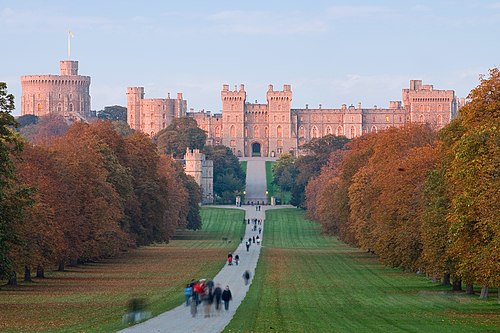 Windsor CastleRestored · prime 1820
 Tower of LondonRestored · prime 1285
 Bamburgh CastleRestored · prime 1904
All castles in England → · Strongest castles in England → · Castles of Europe
Play As Your Clan
Hold a real castle against whatever you choose to send at it, take a ship out in her own service years, or stand at the shoulder of someone the record remembers. The chronicler sets the scene; the deeds are yours.
Notable bearers of the Wells name
- H.G. Wells (1866-1946), British novelist; The Time Machine (1895), The War of the Worlds (1898), The Outline of History (1920)
- Allan Wells (b. 1952), Scottish sprinter; Olympic 100-metre gold medallist 1980
- Orson Welles (1915-1985), American actor-director; the spelling variant Welles is a different surname-line, but is occasionally bracketed with Wells