Stadium · England · Still standing
City Ground
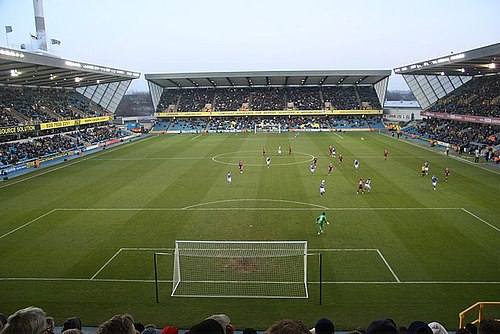
The City Ground is Nottingham Forest Football Club's riverside football stadium in West Bridgford, Nottinghamshire, on the banks of the River Trent. The ground comprises four main stands around a rectangular pitch and has long been Forest's home since 1898.
Its prime
1995
Today
Still standing
As it stood in 1995
What City Ground looked like in its prime.
Rectangular riverside football stadium with four enclosed stands around a lush rectangular grass pitch; a wide pale concrete main façade faces the car park while the opposite executive stand is two-tiered with red seating and the word 'FOREST' spelled in white seats. Other sides show covered terraces with red-painted steel supports and visible floodlight pylons at the corners. The stadium sits tightly amid terraced streets on three sides and the River Trent on the fourth.
Its story
The story of City Ground.
Six Homes Before the Trent, 1865-1898
Nottingham Forest were founded in 1865, behind only Notts County of 1862 and Stoke of 1863 among the world's oldest league clubs, and did not reach the City Ground - their seventh home - until thirty-three years later. For their first fourteen years they played most of their matches on the Forest Recreation Ground, from which the club took its name. That was common land, so the club could not exploit its matches commercially; with no gate money, revenue came mainly from the players' membership fees. When Forest first entered the FA Cup in 1878-79 and reached the semi-finals, they could not play home ties at all, because the competition's rules required that spectators be charged admission. In 1879 they left The Forest for the Castle Ground in The Meadows, taken over after Notts Castle Football Club disbanded and its players joined Forest, which let them charge admission in time for the 1879-80 cup campaign. From 1880 most important games were played at Trent Bridge Cricket Ground, then the most advanced enclosed sports venue in Nottingham.
In 1883 Forest were abruptly replaced as Trent Bridge tenants by Notts County, a move possibly connected with County's appointment of the assistant secretary of Nottinghamshire County Cricket Club to their own newly created post of paid Club Secretary. Forest only learned of it in early August, leaving almost no time to find a ground, and the Parkside Ground at Lenton, where they first played on 22 September, drew criticism in the press for its distance from the town, its slope and its uneven surface. A move three years later to the nearby Gregory Ground was much better received in the press, but Lenton's distance from the centre of Nottingham saw attendances continue to fall, and in 1890 the club moved to the Town Ground in The Meadows, close to its roots and its first proper football stadium.
In July 1897 the Town Ground was briefly renamed the City Ground to mark Nottingham's grant of city status, but the newly formed city council planned to build on the site and terminated Forest's lease, offering instead a site on the south bank of the Trent half a mile away. That land had been granted to the Mayor and Burgesses of Nottingham by Edward VI in a royal charter dated 21 February 1551, on the intention that rents from the agricultural ground would pay for the upkeep of the adjacent Trent Bridge. The council granted a twenty-one-year lease, the members approved the move at the annual meeting in December 1897, and the £3,000 needed was sought from members, supporters and businessmen through "New Ground Scheme" bonds at £5 each, which raised over £2,000. Many of those bonds were never redeemed, their holders in effect making a donation towards the ground.
Bardill's Turf, Elliptical Goalposts and the 1947 Flood, 1898-1947
Forest first played on the new ground a week before their FA Cup final victory in April 1898, and the reserve team played there on the afternoon of the final itself, but the official opening waited for the first match of the following season, a Division One fixture against Blackburn Rovers on 3 September 1898 watched by 15,000. The pitch was reckoned among the finest in the country, "a velvet carpet of lush turf", and it was the work of the club committee-member William Bardill, a nurseryman and landscape gardener whose family firm still trades in Stapleford. Bardill excavated the playing area to a depth of two feet, laid a bed of clinker for drainage, and topped it with high-quality turf brought up the river by barge from Radcliffe-on-Trent.
The first-round FA Cup tie against Aston Villa in 1898 drew 32,070, the first time a football match in Nottingham had taken gate receipts of over £1,000. The ground was judged "one of the best in the country" and was chosen for the FA Cup semi-final of 1899, recognition the club's annual meeting called "beneficial to the club and the city". Four FA Cup semi-finals were played there between 1899 and 1905, and a full international between England and Wales in 1909. Through the 1900s Notts County regularly used the City Ground for their own home matches when cricket took precedence at Trent Bridge. The City Ground and Meadow Lane, County's own ground, sit three hundred yards apart on opposite banks of the Trent, the closest professional football stadiums in England and the second-closest in the United Kingdom, after Tannadice Park and Dens Park.
In 1922 the Nottingham firm Standard Goals presented the club with a new set of goals, making the City Ground the first football ground to have elliptically shaped goalposts in place of the usual round or square ones. The shape became commonplace, but the FA's ruling in 1938 that the eight-yard width of a goal be measured from the inside of the posts meant the City Ground's goals had been two inches too narrow for the preceding sixteen years. In 1935 the club turned down the chance to buy the ground from Nottingham Corporation for £7,000. During the Second World War the ground staged boxing, horse gymkhanas and visits from zoos to entertain off-duty servicemen, and the pitch was badly damaged by bombing on the night of 8-9 May 1941, with repairs costing £75 9s 11d. In March 1947 the Trent burst its banks and flooded the ground; Forest played some home fixtures at Meadow Lane, many archives and official records were damaged, floodwater reached the crossbars and swans were seen swimming the length of the pitch.
The Busby Babes, the Floodlights and the Fire, 1950-1968
Promotion in 1950 prompted plans to redevelop the ground, drawn up in detail by the local architects Reginald Cooper and Partners in 1951. The Trent End was extended and covered in 1954, though a second tier of seats planned for that end was never built. A new East Stand opened on 12 October 1957 at a cost of £40,000, with benches seating up to 2,500 behind the terrace; with improvements to the Colwick Road Terrace it took capacity to 48,000, of which 6,500 were seats, for the club's first season in the First Division since 1925. The visitors that day were Manchester United's "Busby Babes", four months before eight of them died in the Munich air disaster, and the match set a record attendance of 47,804.
Forest had pioneered floodlit football, staging a game lit by Wells lights at the Gregory Ground in March 1889, but the City Ground was the second-from-last top division ground to install permanent floodlights. They were first used on 11 September 1961 against Gillingham in the League Cup, from four 120 ft pylons, one in each corner. The ground's all-time record attendance of 49,946 was set in October 1967, when Forest beat Manchester United 3-1 in the First Division, five months after finishing second to United in the league. England's under-23s played Italy there in December 1967.
The Main Stand was re-roofed, extended and refurbished between 1962 and 1965, with offices, changing rooms, kit stores, medical suites and press rooms added behind it. On 24 August 1968, during a First Division game against Leeds United, fire broke out near the dressing rooms and spread rapidly through the largely wooden structure. A crowd of 31,126 was in the ground and none of them was hurt; the only reported injuries were to a television crew on the gantry, who had to scramble down it because the access ladder was stored in the boiler room. Many of the club's records, trophies and memorabilia were lost. The roof survived, which allowed the club to rebuild the base of the stand beneath it in concrete and steel, and as a result of the fire Forest played six "home" matches at Meadow Lane, losing every one, before returning to use the changing rooms at Trent Bridge while the work went on.
Clough's Stand, Hillsborough and the All-Seater Rebuild, 1980-1996
The Executive Stand opened in August 1980, built for £2.5 million drawn largely from the proceeds of the years in which Forest won consecutive League Cups, the League title and consecutive European Cups under Brian Clough. It held 10,000 and spelled "FOREST" in white seats against the red of the upper tier - the first stand in football known to have used coloured seats that way. It was renamed the Brian Clough Stand after his retirement and re-opened by Clough himself after refurbishment in the mid-1990s. Its opening gave the ground a capacity of 35,567 including 15,009 seats, a figure that held broadly steady until terrace capacities were cut after the Hillsborough disaster of 1989.
Forest were the opposing team in the FA Cup semi-final against Liverpool at Hillsborough, Sheffield, on 15 April 1989, in which 97 Liverpool supporters were fatally injured in a human crush on the Leppings Lane terrace. The Taylor Report that followed required every club in the top two divisions of English football to have an all-seater stadium by August 1994, and further redevelopment and refurbishment at the City Ground followed. In 1991 Nottingham City Council proposed a 45,000-capacity stadium costing £44m on the site of Wilford Power Station a mile to the west, to be shared with Notts County. County were keen; the plan was abandoned after Clough declared "over my dead body" and threatened to resign if it was approved.
Forest's own scheme began with the Trent End, but was held up by a dispute with the council over the strip of land, between eight and fifteen metres deep, behind that stand. The club had taken a fifty-year lease on the eleven acres of the City Ground in 1964 at £750 a year; the council now demanded £150,000 a year for the 1,121 square yard "ransom strip", drawing accusations that it was trying to force the club into the Wilford scheme. A rent of £22,000 a year was agreed, but the delay meant Forest turned first to the other end of the ground. The Bridgford Stand was rebuilt in 1992-93 for £4.6m, of which £1.9m came as a grant from the Football Trust; work began in April 1992 and the finished stand held 7,710, with the lower tier of 5,131 given to away supporters. The Trent End followed between 1994 and 1996, in time for the European Championship: the last day of standing there was 8 May 1994, when 27,010 saw Forest celebrate promotion back to the Premier League, and the replacement held 7,338 and took the ground to 30,576 all-seated. The City Ground was one of the venues when England hosted UEFA Euro 1996.
Relegations, Abandoned Relocations and the 52,500 Ambition, 1999-2025
Forest were relegated from the Premier League three times between 1993 and 1999, going straight back up after the first two; it took twenty-three years from the relegation of 1999 before they returned in 2022, and in that time the club spent three seasons in League One. The ground kept a wider fixture list through the lean years. Leicester Tigers beat Llanelli Scarlets 13-12 there in a Heineken Cup semi-final on 28 April 2002, and lost 19-16 to Racing 92 in a European Rugby Champions Cup semi-final on 24 April 2016. The Women's FA Cup final was played at the City Ground in two successive years: in 2007 Arsenal met Charlton Athletic before 24,529, far beyond the competition's previous best of 13,824 at Selhurst Park in 2001, and in 2008 that record fell again when 24,582 saw Arsenal beat Leeds United 4-1. R.E.M. gave the ground's first concert, before an audience of 20,000, and Take That played on 25 and 26 May 2024, the first concerts there since 2005, with more than 50,000 attending across the two nights.
From 2007 the club repeatedly tried to leave. That year it announced a stadium of up to 50,000 at Clifton, arguing that expanding the City Ground would cost too much and that £45m-£50m of public and private funding could deliver a new ground by 2014; residents opposed it, supporters criticised it as a distraction from relegation to League One, and the developers decided against proceeding. A 50,000-seat "super stadium" costing £100m at Holme Pierrepont followed in 2008 as part of England's bid for the 2018 World Cup, the club arguing that the main stand at the City Ground could be developed to a capacity of 37,000 but that access problems would always disqualify the venue from World Cup and other international matches; it needed a new bridge over the Trent and heavy engineering against the floodplain, and was dropped in the expectation of local opposition. In 2009 Nottingham City Council, which owned the land under the ground, ruled out further development there, and in September a 45,000-seat World Cup stadium was proposed near the A52 at Gamston. Nottinghamshire County Council withdrew its support shortly before the bid was submitted, complaining that redeveloping the City Ground had not been properly considered and objecting to 4,000 homes on green belt, and the failure of England's World Cup bid in 2010 threw the plans into doubt.
After the 2012 takeover the new owner Fawaz Al-Hasawi announced long-term plans to build elsewhere while making refurbishment the immediate priority, and in October 2015 the Main Stand was renamed for Brian Clough's assistant manager Peter Taylor. Problems with the safety certificate cut capacity to 24,357 for the 2016-17 season, and by the Hasawis' sale of the club in 2017 the Nottingham Post described a ground that had "started to fall into a state of decay" and was "tired, dishevelled, sad and like nobody really cared any more". Work under the new owner Evangelos Marinakis followed that summer, and in 2019 the club secured a 250-year extension of its lease from the city council and announced a plan by the Newark practice Benoy to lift capacity from 30,455 to about 38,000. The COVID-19 pandemic put that work on hold; Rushcliffe Borough Council's planning committee resolved to grant permission on 28 July 2022, but full permission never followed, because the parties could not agree section 106 terms. A row with the city council over rent in February 2024 brought the plans into question again, the club stating that it could revive plans to move unless an agreement was reached, and in May 2024 it was reported that Marinakis wanted Forest to leave for a purpose-built stadium at Toton, nearly six miles from the city centre. In July 2024 the council agreed to sell the land under the stadium to the club, and in September Marinakis confirmed he intended to keep Forest at the City Ground. On 4 November 2025, at a launch attended by the club chairperson Nicholas Randall and the East Midlands Mayor Claire Ward, Forest announced an expansion to more than 52,500 - the Peter Taylor Stand to 15,000, the Trent End up by 5,000 and the Brian Clough Stand by 7,500 - and submitted the application to Rushcliffe on 16 December 2025, hoping to begin enabling works in the summer of 2026. Also in 2025 Marinakis proposed renaming the Bridgford Stand the John Robertson Stand, after John Robertson, who died on Christmas Day that year. Nottingham Forest own and operate the ground, whose capacity stands at 31,212; the freehold of the site had still to be bought, subject to the club obtaining its permissions.
Step inside
10 places to explore in 1995.
The record describes 10 distinct spots at City Ground, including 7 interiors: pitch, centre-line, executive (brian clough) stand seating tiers, main stand gantry and rear offices and more. Create your own photoreal reconstruction and explore every one, more scenes means more photos, more angles and more of the immersive experience.
Build Your Own Castle
Recreate City Ground with AI to explore it.
Rebuilds stop at 1945, so the artist raises this site as it stood in 1930, not today's building, as a photoreal reconstruction that belongs to you alone. Pay with coins, no subscription needed.
Recreate Stadium to Explore →Nearby