England · Restored
Nottingham Castle
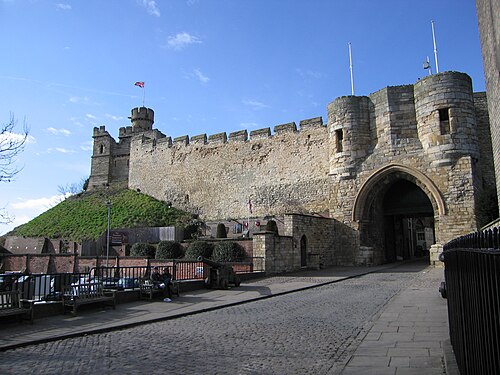
Nottingham Castle occupies Castle Rock, a natural sandstone promontory above the city of Nottingham. The site began as a Norman motte-and-bailey and was a major medieval royal fortress; little of the original keep survives but the medieval gatehouse and sections of curtain wall remain. The later Ducal Mansion (1670s) stood on the site and was converted into a museum; the whole site now appears as a restored heritage complex.
First raised
1067
Its prime
1476
Today
Restored
As it stood in 1476
What Nottingham Castle looked like in its prime.
A stone gatehouse with two large round drum towers flanking a central arched gateway, set into a length of curtain wall of pale ashlar with lower bands of older red-brown masonry; curtain walls and ramparts extend along a steep sandstone promontory (Castle Rock) with sheer cliffs to the south and west. In prime form the site comprises an upper bailey at the highest point, a middle bailey with royal lodgings and a large outer bailey to the east, all linked by defended walls and stairways.
Its story
The story of Nottingham Castle.
William's Motte on Castle Rock, 1068
Two years after Hastings, in 1068, William the Conqueror ordered a motte-and-bailey castle raised on the natural promontory of Castle Rock, whose cliffs fall 130 feet (40 m) to the south and west. The first work was timber. Under Henry II it was replaced by a far more defensible stone castle of complex design, comprising in the end an upper bailey at the summit of the rock, a middle bailey to the north holding the main royal apartments, and a large outer bailey to the east.
It stood near a crossing of the River Trent, and close to the royal hunting ground at Tideswell (the "Kings Larder" of the Royal Forest of the Peak), and to the royal forests of Barnsdale and Sherwood. The castle kept its own deer park immediately west, still called The Park.
Richard the Lionheart's Siege Engines, March 1194
While Richard I was away on the Third Crusade, Nottingham was occupied by supporters of his brother John, among them the Sheriff of Nottingham. In March 1194 the returned king besieged it, having first built siege machines of the kind used on crusade, with Ranulph de Blondeville, 4th Earl of Chester, and David of Scotland, 8th Earl of Huntingdon, at his side. The garrison surrendered after only a few days.
The castle belongs to the legends of Robin Hood as well, which make it the scene of the final showdown between the sheriff and the outlaw, a story told about the place, not a record of it.
Mortimer Taken Through the Rock, 19 October 1330
Roger Mortimer, 1st Earl of March, and Isabella of France governed as regents through the minority of Edward III, having murdered his father Edward II at Berkeley Castle. Shortly before his eighteenth birthday the young king moved against them at Nottingham. On the night of 19 October 1330 a party led by Sir William Montagu was guided by William Eland, castellan and overseer of Mortimer's own castle, into a secret tunnel through the rock that came up at a normally locked door, unlocked that night either by Edward himself or by a trusted servant.
Montagu's men killed Mortimer's guards and overpowered the earl. He was bound, gagged, led back out through the tunnel and arrested, and Isabella with him. Mortimer went to the Tower of London and was hanged a month later; Isabella was forced into retirement at Castle Rising. Edward's personal reign began that night, and the long passage down the rock is still called Mortimer's Hole.
Parliaments, Prisoners and the Razing of 1651
Edward III held parliaments here and kept King David II of Scotland prisoner in 1346; in 1365 he added a tower on the west side of the Middle Bailey and a prison under the High Tower. In 1376 Peter de la Mare, Speaker of the House of Commons, was confined for having "taken unwarrantable liberties with the name of Alice Perrers, mistress of the king". Richard II held state councils in the castle in 1387 and 1392.
From 1403 to 1437 it was the main residence of Joan of Navarre, Henry IV's queen, after which maintenance was reduced. The Wars of the Roses returned it to military use: Edward IV proclaimed himself king at Nottingham and in 1476 ordered a new tower and royal apartments, which John Leland in 1540 called "a right sumptuous piece of stone work". A survey of 1525 had already found much "dekay and ruyne", the roof of the Great Hall fallen in. In 1536 the Earl of Rutland answered the Pilgrimage of Grace with a new drawbridge and a garrison raised from a few dozen men to a few hundred.
By 1600 the castle had ceased to be a royal residence, and artillery was making it obsolete. In August 1642 Charles I chose Nottingham as the rallying point for his armies, but soon after he left the rock was made defensible and held for Parliament. Commanded by John Hutchinson, the garrison repulsed several Royalist attacks and were the last to hold the place. In 1651 it was razed to prevent its being used again.
The Ducal Mansion and the Reform Bill Riot of 1831
After the restoration of Charles II, William Cavendish, 1st Duke of Newcastle, began an Italianate mansion on the rock in the 1670s, completed by his son the 2nd Duke. The mason was Samuel Marsh of Lincoln, whose designs are thought to owe much to Rubens's engravings in Palazzi di Genova.
The Industrial Revolution left Nottingham with a reputation for the worst slums in the British Empire outside India, and in 1831 residents of those slums rioted against the 4th Duke of Newcastle's opposition to the Reform Bill and burned the mansion down. It stood a derelict shell until Thomas Chambers Hine restored it in 1875, and the Prince of Wales, later Edward VII, opened it in 1878 as Nottingham Castle Museum, the first municipal art gallery in the United Kingdom outside London.
Step inside
10 places to explore in 1476.
The record describes 10 distinct spots at Nottingham Castle, including 4 interiors: under the gatehouse arch, great hall in the middle bailey, prison beneath the high tower and more. Create your own photoreal reconstruction and explore every one, more scenes means more rooms, more angles, and more of the place to stand in.
Build Your Own Castle
Recreate Nottingham Castle with AI to explore it.
The artist rebuilds it as it stood in 1476, a photoreal reconstruction that belongs to you alone. Pay with coins, no subscription needed.
Recreate this castle →Defend this castle →Nearby