Clan Rising
Halshany Castle today

Belarus · Ruin

Halshany Castle

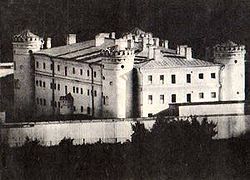
Halshany (Holszany) Castle is the ruined early‑17th‑century residence of the Sapieha magnate family in Halshany, Belarus. Built about 1610, it was a large red‑brick private château whose surviving fragments include vaulted arcades, curtain walls and a tall rectangular tower now partially collapsed.

Photograph via Wikimedia Commons

Its prime

1610

Today

Ruin

As it stood in 1610

What Halshany Castle looked like in its prime.

A compact red‑brick château clustered around an open inner courtyard, with curtain walls pierced by a sequence of broad semicircular vaulted arches and arcades. A taller rectangular tower rises above the surrounding ranges, its faces of brick punctured by narrow vertical openings. The roofs and towers would have been complete with tiled roofs and raised parapets; the complex sits low in parkland among trees, with lawns and paths around the enclosed yard.

Its story

The story of Halshany Castle.

Halshany Castle was built about 1610 by Paweł Stefan Sapieha, replacing an older castle of the Holszanski princely family, of whom the Sapiehas were descendants and heirs. The seat of one of the largest land estates in the Grand Duchy of Lithuania, the red-brick residence once rivalled Mir Castle as the most elegant private château in the Grand Duchy.

The castle was devastated and looted twice by invading Swedish troops, during the Deluge and again in the Great Northern War in 1704, and the financially pressed Sapiehas never fully restored it. In the 18th century it passed, diminished by creditors, to the Żaba family and then to the Korsaks, who sold it in the last quarter of the 19th century to a Russian landlord, Gorbanyov; he had the towers pulled down in 1880.

The nickname "Black Castle", despite the red brick, properly belongs to a fictional building in a book by Uladzimir Karatkievich, loosely based on Halshany. Government-funded restoration of the northern tower began in 2018, and an annual tournament is held beneath the walls each summer.

Step inside

7 places to explore in 1610.

The record describes 7 distinct spots at Halshany Castle, including 1 interior: north tower interior. Create your own photoreal reconstruction and explore every one, more scenes means more rooms, more angles, and more of the place to stand in.

Exterior approach from the southwestVaulted arcades at the courtyard edgeInner courtyardNorth tower exteriorNorth tower interiorWalk along the curtain wallAdjacent grounds where tournaments were held

Build Your Own Castle

Recreate Halshany Castle with AI to explore it.

The artist rebuilds it as it stood in 1610, a photoreal reconstruction that belongs to you alone. Pay with coins, no subscription needed.

Recreate this castle →Defend this castle →

Whose castle

Clans who held Halshany Castle.

The families that held Halshany Castle for a decade or more across its history, follow a name to its clan.

  • Holszanski

    The Holszanski princely family held the earlier castle on the site until their Sapieha heirs rebuilt it about 1610.

  • Sapieha

    Seat of the Sapieha magnates from its building about 1610 until the 18th century.

  • Żaba

    Held by the Żaba family in the 18th century, the estate diminished by creditors.

  • Korsak

    Held by the Korsak family until sold in the last quarter of the 19th century.

Questions about Halshany Castle

What is the history of Halshany Castle?

Halshany Castle was built about 1610 as a residence for Paweł Stefan Sapieha, replacing an older castle of the Holszanski princely family. It was the seat of one of the largest land estates in the Grand Duchy of Lithuania. Swedish troops devastated and looted it during the Deluge and again in the Great Northern War in 1704, after which the financially pressed Sapiehas never fully restored it.

What is inside Halshany Castle?

Inside Halshany Castle, the documented remains include a large square hall with four columns supporting cross vaults, large cellars and richly decorated former interiors. Walls were decorated with paintings, while tiled stoves, stucco on ceilings and fireplaces, and ceramic terracotta and glazed floor tiles provided decoration. The castle also had heating, water-supply and sewage systems.

Why was Halshany Castle built, and what was it used for?

Halshany Castle was built as a residence and the seat of the Sapieha family’s large land estate. It was a private château rather than only a military fortress, although its towers retained a defensive role and earthworks and water-filled ditches surrounded it. Its layout included living quarters, household spaces, arcaded galleries and large cellars.

Where is Halshany Castle?

Halshany Castle is in Halshany, in Hrodna Voblast, Belarus. It stands near the settlement of Halshany, in the administrative area of Haĺšanski sieĺsaviet. The castle and its surrounding grounds form a ruined palace-and-park complex.

When was Halshany Castle built?

Halshany Castle was built about 1610, in the early 17th century. The stone castle was raised in the first half of the 17th century, replacing an older castle of the Holszanski princely family. The site’s earlier wooden castle was known from chronicles as far back as the 13th century.

Was Halshany Castle ever attacked or besieged?

Halshany Castle was attacked and looted twice by invading Swedish troops. The first assault took place during the Deluge, and the second occurred during the Great Northern War in 1704. The castle was devastated on both occasions and was not fully restored afterwards.

Which family or clan held Halshany Castle?

Halshany Castle was held first by the Holszanski princely family, whose Sapieha heirs rebuilt it about 1610. The Sapieha magnates held it from its building until the 18th century. It then passed to the Żaba family, followed by the Korsak family, who sold it in the last quarter of the 19th century.

What did Halshany Castle look like in its prime?

Halshany Castle was a compact red-brick château arranged around an open inner courtyard. Its curtain walls were pierced by broad semicircular vaulted arches and arcades, while a taller rectangular tower rose above the surrounding ranges. Tiled roofs and raised parapets completed the former silhouette, and narrow vertical openings punctuated the tower’s brick faces.

Is Halshany Castle still standing, or is it a ruin?

Halshany Castle is a ruin, with surviving fragments including vaulted arcades, curtain walls and a partly collapsed rectangular tower. Its towers were pulled down in 1880, and later remains of living quarters were dismantled after the Second World War. Government-funded restoration of the northern tower began in 2018, including work on its walls and openings.
All castles of Belarus · Castles of Europe · the best castles in Europe · explore the finished reconstructions.