Clan Rising
Sloup Castle today

Czechia · Partial ruin

Sloup Castle

Sloup Castle is a rock castle carved into a freestanding 35-metre sandstone pillar above the surrounding plain near Sloup v Čechách. The complex combines rock-hewn chambers, terraces and masonry infill on the outcrop and was later adapted by hermits who carved a chapel and cells into the stone. Today the carved spaces, well and terraced walkways remain visible amid the ruined plateau.

Photograph via Wikimedia Commons

First raised

1324

Its prime

1750

Today

Partial ruin

As it stood in 1750

What Sloup Castle looked like in its prime.

A single, freestanding 35-metre-high pillar of pale warm sandstone rising from flat countryside, its summit a level plateau whose edges were carved to imitate curtain walls with narrow loopholes and masonry filling some gullies; rock-cut terraces step down the southern slope; multiple chambers and passages are hewn directly into the stone face, including a sunken well and recessed prayer niches; a small rock chapel and hermit cells are cut into a sheltered side, and rough terraced walkways link the openings.

Its story

The story of Sloup Castle.

Sloup is a rock castle cut into a freestanding 35-metre sandstone pillar rising above the plain at Sloup v Čechách in northern Bohemia. It was established by the Ronovec family beside the salt trade route running from Meissen to Česká Lípa, and is first mentioned in records dating from 1324, when it was owned by Čeněk of Ojvína.

The outcrop was later adapted by hermits, who carved a chapel and cells directly into the stone alongside the castle's rock-hewn chambers, terraces and masonry infill. After the hermitage ceased to exist, the owners, the Kinsky family, turned the complex into a romantic tourist attraction.

The carved chambers, the well and the terraced walkways remain visible amid the ruined plateau. Sloup is now a favoured place for outings, and candlelit concerts and historical jousting matches are occasionally held on the rock.

Step inside

10 places to explore in 1750.

The record describes 10 distinct spots at Sloup Castle, including 5 interiors: rock-cut entrance and passage, chapel carved into the rock, hermit cell and more. Create your own photoreal reconstruction and explore every one, more scenes means more rooms, more angles, and more of the place to stand in.

Approach from the surrounding plainPlateau rim with carved loopholesSouthern terraced slopesRock-cut entrance and passageChapel carved into the rockHermit cellSunken dungeon and prisoner carvingsRock-cut wellTerraced walkways along the rock faceView across the surrounding trenches

Build Your Own Castle

Recreate Sloup Castle with AI to explore it.

The artist rebuilds it as it stood in 1750, a photoreal reconstruction that belongs to you alone. Pay with coins, no subscription needed.

Recreate this castle →

Castle Siege

Play Castle Siege at Sloup Castle.

A strategy game played on Sloup Castle’s real ground plan: the same surveyed walls shown in the archive below. Post your finite garrison on the battlements between assaults, then hold out as rams, siege towers, trebuchets and sappers arrive in ever-worse waves.

Sign in free to see the garrison muster. One castle costs 150 Clan Coins and is yours forever.

Sign in to take command →

See every castle’s leaderboard →

Whose castle

Clans who held Sloup Castle.

The families that held Sloup Castle for a decade or more across its history, follow a name to its clan.

  • Ronovec

    Established the rock castle beside the Meissen–Česká Lípa salt road; first recorded 1324.

  • Kinsky

    Owners after the hermitage era, who opened the rock as a romantic attraction.

From the archive

Sloup Castle on paper: the measured plan and period views.

The survey plan and photographs below are the ground truth this page's reconstructions are checked against, drawn and photographed while the castle was still a working garrison. Every image is public-domain or openly licensed, with its source named.
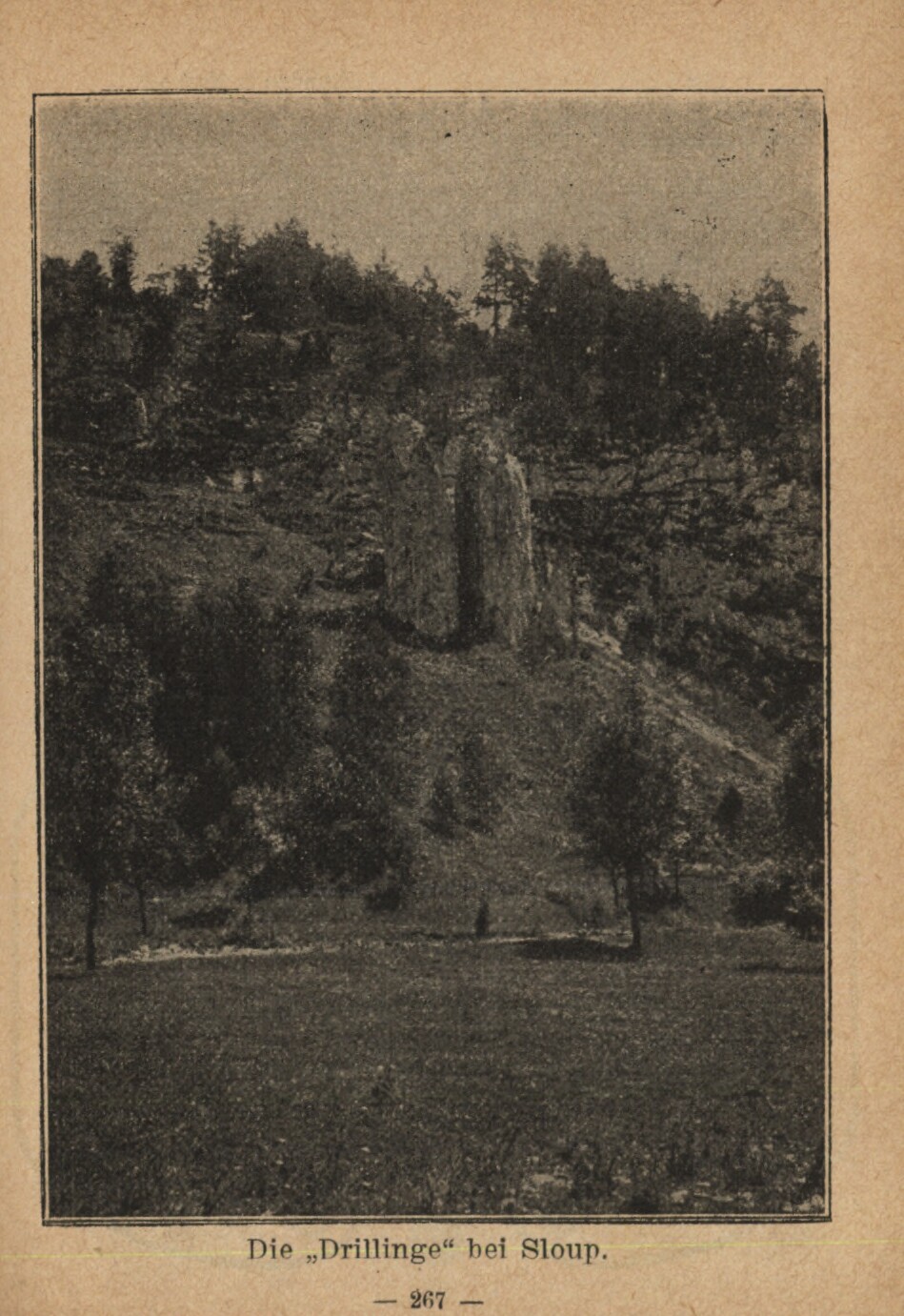
Die „Drillinge“ bei Sloup., Sloup Castle

Die „Drillinge“ bei Sloup.

1906 · W. Burkart's Führer durch Brünn und Umgebung: mit 151 Illustr., 1 Stadtplan, 1 Theatersitz

Public domain (Moravian Library)

Questions about Sloup Castle

What is the history of Sloup Castle?

Sloup Castle was established in the 14th century beside the salt trade route from Meissen to Česká Lípa. The Ronovec family founded it, and it was first mentioned in records dating from 1324. It was besieged during the 15th century, burned in 1447 and again by Swedish forces in 1639. From 1670 to 1785, hermits occupied the ruined castle and carved new spaces into the rock.

What is inside Sloup Castle?

Inside Sloup Castle are rock-cut chambers and passages, a sunken well, a dungeon with prisoner carvings, hermit cells and a chapel carved into the rock. The complex also contains an ambulatory, terraces, three artificial caves and a cross-vaulted corridor. The underground chapel dates from 1693, while many of the visible spaces are later Baroque additions.

Who owns Sloup Castle now?

Sloup Castle is owned by Sloup v Čechách. It is also designated a cultural monument of the Czech Republic. The supplied information does not identify a separate current private owner.

Why was Sloup Castle built, and what was it used for?

Sloup Castle was built as a fortified rock castle beside the Meissen–Česká Lípa salt trade route. Its freestanding sandstone outcrop, carved loopholes, masonry-filled gullies and surrounding trenches helped make it difficult to attack. After the medieval castle became a ruin, hermits used the rock for their cells, chapel and other needs, and the Kinsky family later made it a romantic attraction.

Where is Sloup Castle?

Sloup Castle is in Sloup v Čechách, in the Liberec Region of northern Bohemia. It stands at the south-western edge of the municipality, on a freestanding sandstone pillar above the surrounding plain. The nearby recognised places mentioned in the description include Česká Lípa, Nový Bor and Janov.

When was Sloup Castle built?

Sloup Castle was first raised in 1324, placing its construction in the 14th century. The castle was probably built at the beginning of that century, and its first documented owner was Čeněk of Ojvína. The outcrop was later altered by hermits between 1670 and 1785, including the creation of a rock chapel and new rooms.

Was Sloup Castle ever attacked or besieged?

Sloup Castle was besieged twice during the 15th century. A siege in 1445–45 ended after three months when starving troops capitulated, and the castle was burned by the end of 1447. The material also records an earlier siege in 1444, which did not capture the castle, followed by another Lužice expedition the next year.

Which family or clan held Sloup Castle?

Sloup Castle was established by the Ronovec family and was first recorded in 1324. After the hermitage era, the Kinsky family owned the complex and turned the rock into a romantic attraction. These are the two families specifically associated with its establishment and later ownership in the supplied family history.

What did Sloup Castle look like in its prime?

Sloup Castle is a freestanding 35-metre-high pillar of pale warm sandstone rising from flat countryside. Its level summit was shaped with carved loopholes resembling curtain walls, while masonry filled some gullies. Rock-cut terraces and walkways descend the southern slope, linking chambers, passages, prayer niches, a well, chapel and hermit cells cut into the stone.

Is Sloup Castle still standing or is it a ruin?

Sloup Castle is a partial ruin. Little of the original structure survives on the elevated plateau, because many of its buildings were wooden, but rock-cut rooms, the dungeon, well, hermitage, passage and terraced walkways remain visible. The site also preserves later Baroque features, including hermit cells, a chapel, terraces and other rock-cut structures.

Can you visit Sloup Castle?

Sloup Castle can be visited as a public visitor site. The castle complex is presented as an attraction with accessible rock-cut spaces, terraces and walkways, and the surrounding area has marked walking routes. Its surviving remains are protected as a cultural monument of the Czech Republic.
All castles of Czechia · Castles of Europe · the best castles in Europe · explore the finished reconstructions.