Clan Rising
Švihov Castle today

Czechia · Restored

Švihov Castle

Vodní hrad Švihov

Švihov Castle is a late Gothic water castle in Švihov in the Plzeň Region of the Czech Republic. Built and rebuilt by the Rýzmberk of Skála family with major works by Benedikt Rejt, it is known for its moat system with massive horseshoe-shaped bastions, a tall entrance tower and a chapel built atop a bastion. The site today is conserved and open to the public.

Photograph via Wikimedia Commons

First raised

1500

Its prime

1520

Today

Restored

As it stood in 1520

What Švihov Castle looked like in its prime.

Long low curtain walls of pale rubble stone with a darker battered base surround an elongated rectangular complex set within water moats and ponds. The silhouette includes a cone-roofed round corner tower at the left, a tall square five-level entrance tower near the centre with a pointed cap, and a chapel block at the right with arched windows and a small roof spire. Red clay tile roofs cover the palaces and service ranges; four large bastions project into the moats.

Its story

The story of Švihov Castle.

Švihov Castle is a late Gothic water castle in the Plzeň Region, built by the Rýzmberk of Skála noble family, with major works by the master builder Benedikt Rejt. Two water moats ringed it, the inner where the courtyard now lies, fed at need from three nearby ponds, behind ramparts studded with four bastions: the Red, the White, the Green and the Gold, whose remains were rediscovered in 1951.

The complex consists of two residential palaces, a five-level entrance tower and a chapel built on top of a bastion by Půta von Schwihau between 1480 and 1489, its entrance hall net-vaulted with ribs converging on a single painted keystone. Valuable 16th-century wall paintings survive in the Red Bastion, the chapel and other rooms.

The Kavka of Říčany family later took control of the castle, but after some fifty years their poor management forced them to sell it to the Czernin family. The castle is conserved and open to the public today: the armoury, the kitchen with mainly 18th-century furnishings, the feast hall, chapel, bed chambers and the Great Hall with its wooden cassette ceiling brought from Dobrovice Castle.

Step inside

12 places to explore in 1520.

The record describes 12 distinct spots at Švihov Castle, including 7 interiors: chapel nave and vault, the red bastion (interior), the great hall with wooden cassette ceiling and more. Create your own photoreal reconstruction and explore every one, more scenes means more rooms, more angles, and more of the place to stand in.

Exterior approach across the outer moatFive-level entrance tower (gatehouse)Inner courtyard (former inner moat)Chapel exterior on the bastionChapel nave and vaultThe Red Bastion (interior)The Great Hall with wooden cassette ceilingFeast HallCastle kitchenArmoryBed chambersOuter rampart, bastions and surrounding ponds

Build Your Own Castle

Recreate Švihov Castle with AI to explore it.

The artist rebuilds it as it stood in 1520, a photoreal reconstruction that belongs to you alone. Pay with coins, no subscription needed.

Recreate this castle →

Castle Siege

Play Castle Siege at Švihov Castle.

A strategy game played on Švihov Castle’s real ground plan: the same surveyed walls shown in the archive below. Post your finite garrison on the battlements between assaults, then hold out as rams, siege towers, trebuchets and sappers arrive in ever-worse waves.

Sign in free to see the garrison muster. One castle costs 150 Clan Coins and is yours forever.

Sign in to take command →

See every castle’s leaderboard →

Whose castle

Clans who held Švihov Castle.

The families that held Švihov Castle for a decade or more across its history, follow a name to its clan.

  • Rýzmberk

    The Rýzmberk of Skála family built the castle and shaped its late Gothic form.

  • Kavka

    The Kavka of Říčany family held Švihov for some fifty years before poor management forced its sale.

  • Czernin

    Bought from the Kavkas of Říčany, who were forced to sell after fifty years of poor management.

From the archive

Švihov Castle on paper: the measured plan and period views.

The survey plan and photographs below are the ground truth this page's reconstructions are checked against, drawn and photographed while the castle was still a working garrison. Every image is public-domain or openly licensed, with its source named.
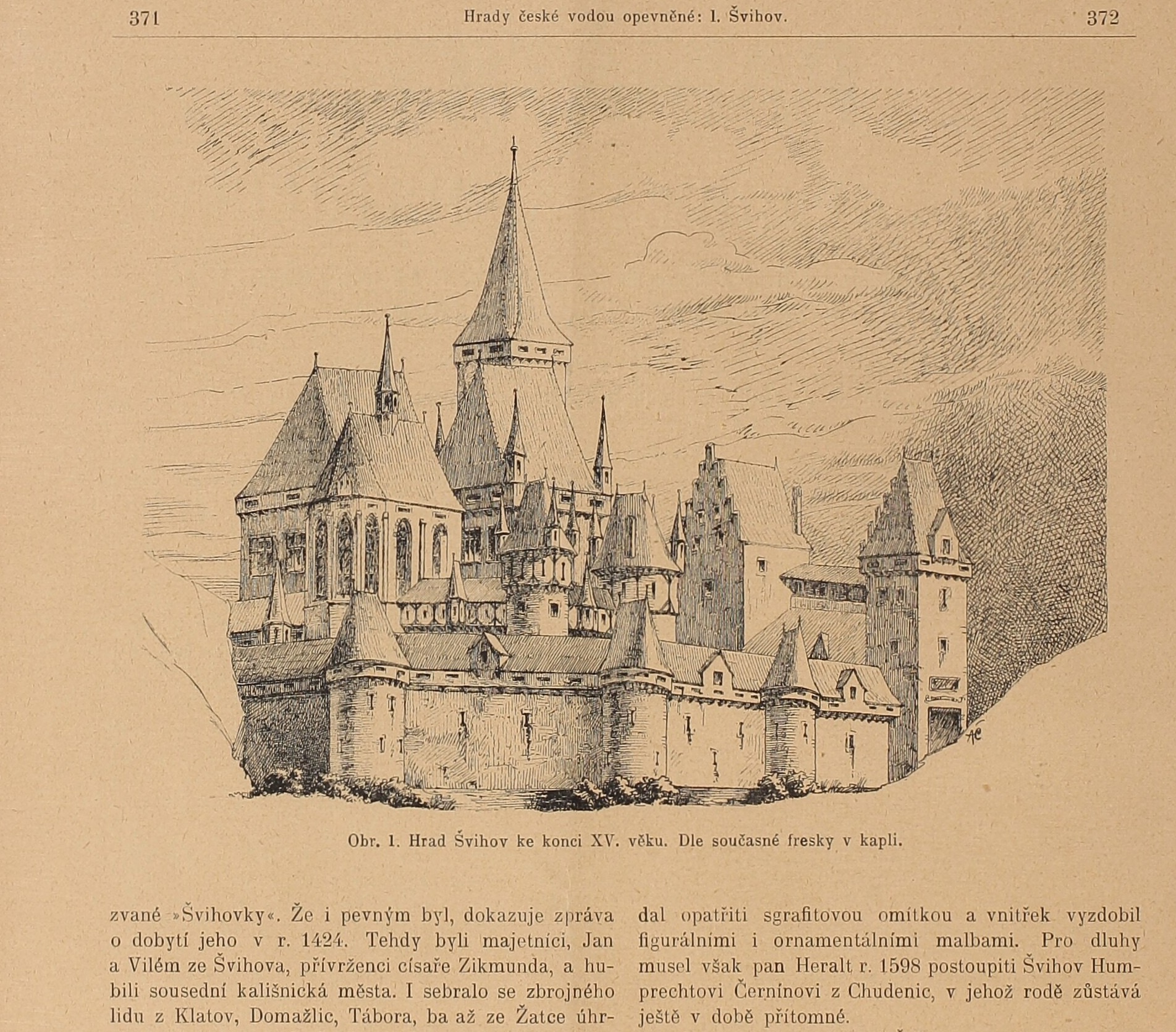
Obr. 1. Hrad Švihov ke konci XV. věku. Dle současné fresky v kapli., Švihov Castle

Obr. 1. Hrad Švihov ke konci XV. věku. Dle současné fresky v kapli.

1878 · Památky archaeologické a místopisné: organ Archaeologického sboru Musea království Českého

Public domain (Moravian Library)

Questions about Švihov Castle

What is the history of Švihov Castle?

Švihov Castle was built and rebuilt in the late Gothic period by the Rýzmberk of Skála family. It was besieged by Hussite forces during the Hussite Wars, who forced the garrison to surrender by siphoning the moats. The Kavka of Říčany family later took control, before selling it to the Czernin family after about fifty years of poor management.

What is inside Švihov Castle?

Inside Švihov Castle are the Great Hall with a wooden cassette ceiling, the Feast Hall, kitchen, armoury and bed chambers. The chapel has a vaulted nave and entrance hall, while 16th-century wall paintings survive in the Red Bastion, the chapel and other rooms. The kitchen has mainly 18th-century furnishings.

Who owns Švihov Castle now?

Švihov Castle is owned by the Czech Republic. It is also designated a national cultural monument of the Czech Republic, a status held since 2002. The castle is conserved and open to the public.

Where is Švihov Castle?

Švihov Castle is in Švihov in the Plzeň Region, within the administrative area of Švihov u Klatov. It is located in the Czech Republic. The castle stands in the town of Švihov.

When was Švihov Castle built?

Švihov Castle was first raised in 1500, placing its construction in the 16th century. Its major late Gothic rebuilding took place between 1480 and 1489, with further fortification work completed by 1520. The castle therefore developed in several stages around the turn of the 16th century.

Was Švihov Castle ever attacked or besieged?

Švihov Castle was besieged by Hussite forces during the Hussite Wars and surrendered after its water moats were siphoned. Swedish forces also unsuccessfully besieged it during the Thirty Years' War. The castle therefore fell in the Hussite siege but held against the later Swedish attack.

Which family or clan held Švihov Castle?

The Rýzmberk of Skála family built Švihov Castle and shaped its late Gothic form. The Kavka of Říčany family held it for about fifty years, and the Czernin family then bought it after the Kavkas were forced to sell. The castle remained in Czernin hands until nationalisation in 1945.

What did Švihov Castle look like in its prime?

Švihov Castle is a late Gothic water castle with long, low pale rubble-stone curtain walls and a darker battered base. Its silhouette includes a cone-roofed round corner tower, a tall five-level entrance tower and a chapel block with arched windows. Four large bastions project into the surrounding water moats and ponds, with red clay tile roofs over the palaces and service ranges.

Is Švihov Castle still standing or is it a ruin?

Švihov Castle is still standing and is in restored condition, rather than being a ruin. Part of its rampart was damaged after an order for demolition, while the palaces, chapel and bastions were later used as a granary. Reconstruction work began in 1950, with later repairs restoring parts of the fortifications and Gothic façades.

Who built Švihov Castle?

Švihov Castle was built by the Rýzmberk of Skála noble family, with major works by the architect Benedikt Rejt. Půta Švihovský of Rýzmberk ordered the late Gothic rebuilding between 1480 and 1489, and his sons continued the work after his death. Benedikt Rejt later completed the fortification works by 1520.

Can you visit Švihov Castle?

Švihov Castle is open to the public. Visitors can see the armoury, kitchen, feast hall, chapel, bed chambers and Great Hall, while the castle is also used as a local cultural centre for exhibitions, conferences, concerts and other events. It is designated a national cultural monument of the Czech Republic.
All castles of Czechia · Castles of Europe · the best castles in Europe · explore the finished reconstructions.