
Denmark · Restored
Sønderborg Castle
Sønderborg Slot
Sønderborg Castle is a historic brick castle on the island of Als in Sønderborg, Denmark. Over centuries it was enlarged from a medieval tower into a four-wing residence and today houses the Sønderborg Castle Museum and a preserved Renaissance chapel.
First raised
1158
Its prime
1726
Today
Restored
As it stood in 1726
What Sønderborg Castle looked like in its prime.
A compact, four-wing red-brown brick castle set on a former islet beside Als Fjord, with a continuous steep hipped tiled roof punctured by chimneys and a few dormers. The façades show three storeys of regularly spaced rectangular windows with broad wooden frames, a central arched entrance leading into a cobbled inner courtyard, and a low stone plinth at ground level. The castle is surrounded by earth ramparts that open into park-like gardens sloping to the waterfront; the chapel stands within the west range.
Its story
The story of Sønderborg Castle.
Valdemar's Tower and the Fight for Als, 1158–1289
Sønderborg began as a fortified tower raised by Valdemar the Great on an islet in Als Strait to guard against Wendish attack. Its building is dated 1158 in some accounts, 1169 in others, the later date placing it just after the Wends ravaged southern Als about 1168. A long struggle between the Danish king and the duke of Schleswig over the island followed. Christopher I took and partly destroyed the castle in 1253; it was probably rebuilt, the first tower replaced by a larger one and the site walled. It already served as a prison of sorts: in 1289 Duke Valdemar IV of Schleswig held his steward Peder Höfel captive here.
Atterdag's Siege and Richardis's Bargain, 1340–1375
At Whitsun 1340 the young Valdemar married Helvig, sister of Duke Valdemar of Southern Jutland, in the castle: a step towards his elevation as king, Valdemar Atterdag, later that year. From the 1350s the fortress was heavily extended, gaining the Blue Tower (Blåtårn) and massive outer walls.
In 1358 Atterdag besieged Sønderborg. Duke Valdemar had joined the king's enemies and was absent; his wife Richardis was in the castle. She pleaded with the king and won castle and town back, on an undertaking that while the war lasted the duke might stay only two or three days at a time and with no more than twenty men. Atterdag returned in 1373 to negotiate with the widowed Richardis. About 1375 a further tower went up at the south-eastern corner, and the settlement below grew into the town of Sønderborg.
Eric of Pomerania's Failed Siege and Christian II's Captivity, 1409–1549
Eric of Pomerania besieged the castle from 1409 to 1410 without taking it, and had the Swedish knight Abraham Brodersøn, Queen Margaret's favourite, to whom the siege had been entrusted, executed for tyrannical conduct. King Hans and his son Christian II extended Sønderborg into one of the realm's strongest fortresses, and for that strength it became a prison of state.
Lured into an ambush, the deposed Christian II arrived on 9 August 1532 and was held as a prisoner of state until 1549. He was lodged in the Blue Tower in a light and roomy chamber, and fief accounts show him amply supplied with food, drink and clothing. Against the legend of close confinement, he was probably free to move within the outer walls, and sometimes joined the noble hunts on Als.
Oberberg's Renaissance Castle and the Sonderburg Dukes, 1549–1667
Christian III had the fortress converted into a four-wing castle by Hercules von Oberberg between 1549 and 1557. Queen Dorothea took town and castle as part of her dower estate in 1559, and after the king's death Oberberg built her castle chapel in 1568–70; almost untouched since, it is reckoned one of Europe's oldest and best-preserved Lutheran princely chapels. Her son John II (Hans the Younger) had a burial room built in it with a portal of marble and alabaster.
Sønderborg passed to Hans the Younger on Dorothea's death in 1571 and became the seat of the small duchy of Schleswig-Holstein-Sonderburg, divided after his death on 9 October 1622. His son Alexander was buried in the castle chapel in 1627, and Alexander's son Hans Christian died in 1653 leaving the fief in hopeless debt. In 1667 the ruined duchy was attached to the Danish throne and the prefect (amtmanden) took up residence; the castle was little used thereafter.
Baroque Rebuilding, Prussian Barracks and the Castle Museum
Frederik IV had the castle rebuilt in Baroque form in 1718–1726 by his contractor general Wilhelm von Platen. The Blue Tower was demolished in 1755. The castle passed to the Dukes of Augustenborg in the 1760s but never became their residence; it was let out as a warehouse instead.
In both Slesvig wars, 1848–50 and 1864, it served as a camp hospital and quartered Danish troops. After the Danish defeat of 1864 Schleswig was incorporated into Prussia, and from 1867 the castle was a Prussian infantry barracks. During the First World War the Prussians interned those they suspected of espionage here, and war prisoners were later transferred to the castle.
The plebiscite of 1920 returned Sønderborg to Denmark; the last duke of Augustenborg, Ernst Günther, let Sønderborg County Museum into part of the castle that year, and the Danish state bought it in 1921. In 1945 and 1946 the Danish authorities ran the castle as an internment camp for people charged with offences against the state; among them Danish Nazis and men of the German minority in Southern Jutland who had volunteered for the SS. Peter Koch and Jørgen Stærmose, Royal Inspectors of Listed State Buildings, restored it to Frederik IV's Baroque form in 1964–73. It is state-owned and a protected monument on the national register, housing the Museum Sønderjylland collections, open year-round.
Step inside
8 places to explore in 1726.
The record describes 8 distinct spots at Sønderborg Castle, including 4 interiors: the great hall (riddersal), queen dorothea's chapel (dronning dorotheas kapel), chapel choir loft and organ and more. Create your own photoreal reconstruction and explore every one, more scenes means more rooms, more angles, and more of the place to stand in.
Build Your Own Castle
Recreate Sønderborg Castle with AI to explore it.
The artist rebuilds it as it stood in 1726, a photoreal reconstruction that belongs to you alone. Pay with coins, no subscription needed.
Recreate this castle →Defend this castle →Whose castle
Clans who held Sønderborg Castle.
The families that held Sønderborg Castle for a decade or more across its history, follow a name to its clan.
Schleswig-Holstein-Sonderburg
Held from 1571, when it passed to Hans the Younger, until the duchy was attached to the Danish throne in 1667.
Augustenborg
Held by the dukes of Augustenborg from 1764 until the Danish state bought the castle in 1921.
From the archive
Sønderborg Castle on paper: the measured plan and period views.
The survey plan and photographs below are the ground truth this page's reconstructions are checked against, drawn and photographed while the castle was still a working garrison. Every image is public-domain or openly licensed, with its source named.
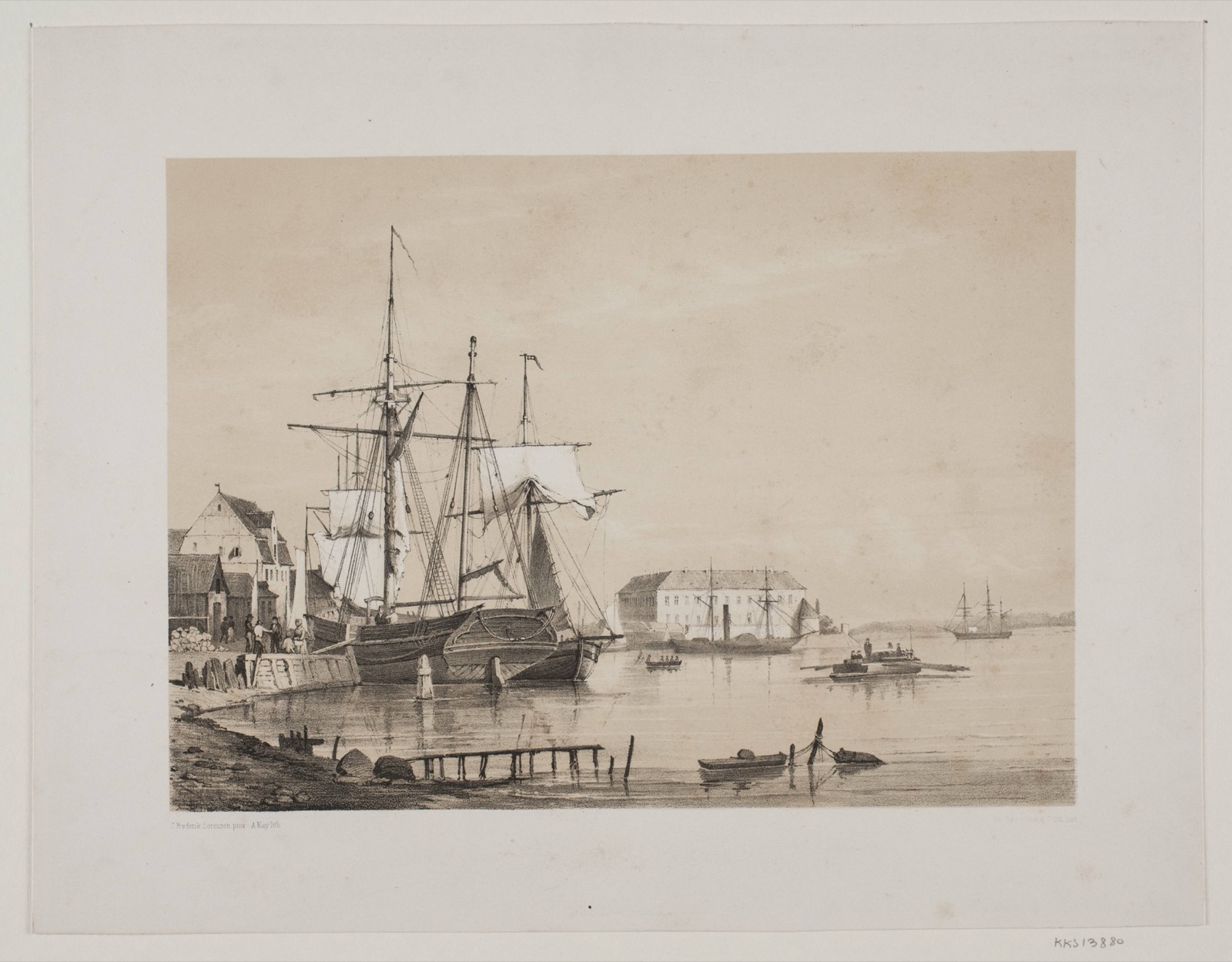
Sønderborg slot set fra havnen i Sønderborg
· National Gallery of Denmark (via Europeana)
Public domain
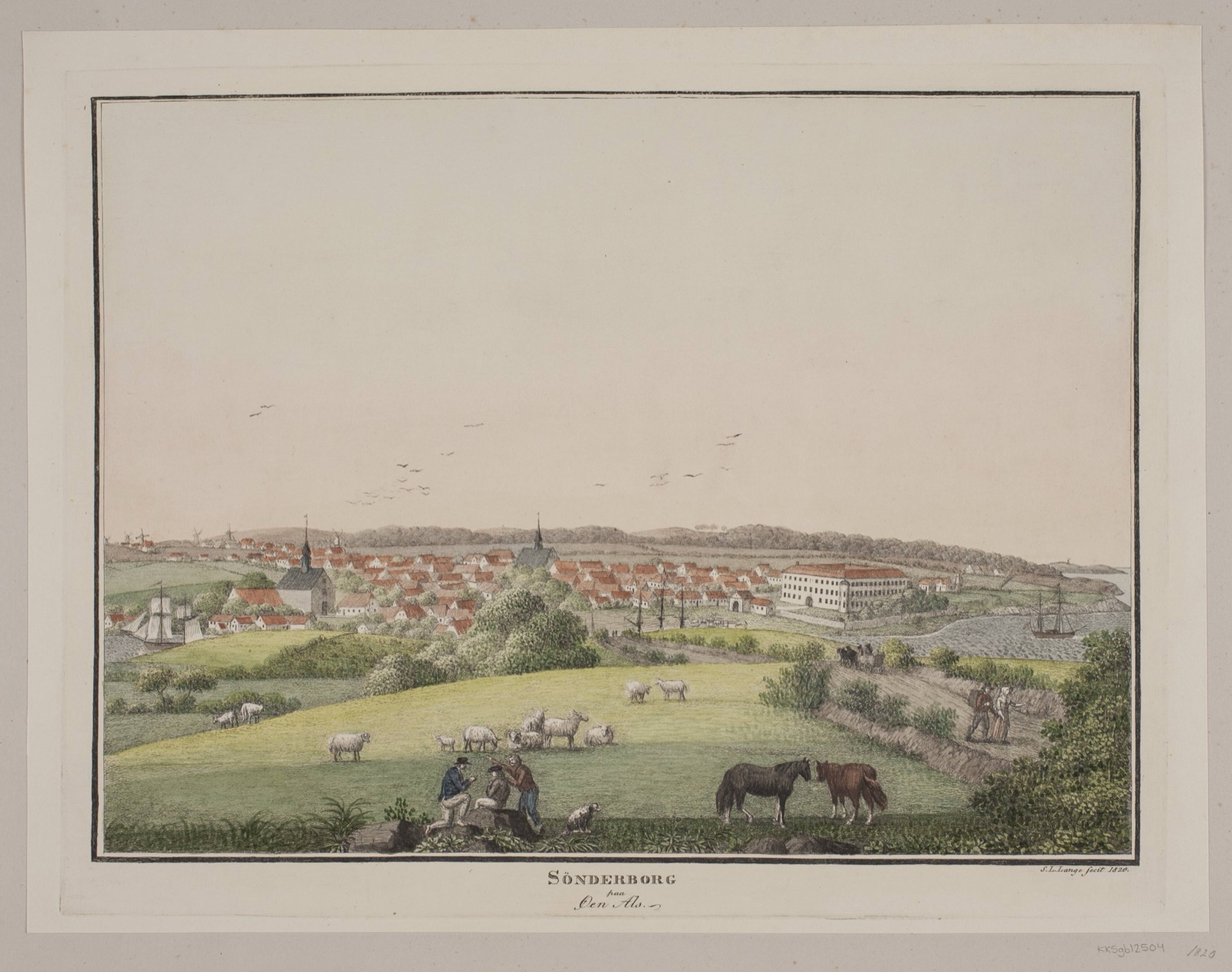
Sønderborg på øen Als
1820 · National Gallery of Denmark (via Europeana)
Public domain


