
England · Still standing
Alnwick Castle
Alnwick Castle is a large medieval-origin castle and country house in Northumberland, England, long held by the Percy family and today still inhabited by the Duke of Northumberland. The complex combines an inner shell keep set within a large outer bailey and a succession of curtain walls and towers, and is open to the public for tours and exhibitions.
First raised
1096
Its prime
1865
Today
Still standing
Ranked among Europe’s castles
As it stood in 1865
What Alnwick Castle looked like in its prime.
Broad, low-slung curtain walls and a central shell keep composed of a cluster of tightly packed towers form a two-ring plan set on a raised site with the River Aln to the north and a steep ravine to the south and east. The gate sequence includes a long barbican and a Romanesque archway flanked by two semi‑octagonal towers; crenellated parapets and a dozen main towers punctuate the outer wall. Stonework appears pale grey-brown and the roofs are low and pitched; the inner courtyard contains the Prudhoe Tower with a ground-level loggia.
Its story
The story of Alnwick Castle.
Ivo de Vesci's Guard on the Aln, c. 1096
Alnwick Castle was raised to guard a road crossing the River Aln. Ivo de Vesci, Baron of Alnwick, a nobleman from Vassy in Calvados, erected the first parts of it in about 1096, in the years after the Norman Conquest. The barony moved on by marriage: his daughter Beatrix married Eustace fitz John, Constable of Chester and Knaresborough, who gained Malton and Alnwick through her. The castle enters the record in 1136, when King David I of Scotland captured it; the chroniclers already called it very strong.
William the Lion, and King John's Order to Demolish
William the Lion, King of Scotland, besieged Alnwick in 1172 and came back to besiege it again in 1174. The second attempt ended with the Scottish king himself taken outside the walls, at the Battle of Alnwick.
In 1212 Eustace de Vesci, lord of Alnwick, was accused of plotting with Robert Fitzwalter against King John. John ordered the demolition of Alnwick and of Fitzwalter's stronghold, Baynard's Castle; at Alnwick the instruction was never carried out. Inheritance did what demolition had not. John de Vesci succeeded on his father's death in Gascony in 1253 while still underage, and Henry III handed the wardship of the estates to a foreign relative, to the great offence of the family. The property passed into the guardianship of Antony Bek, who sold it to the Percys, earls and later dukes of Northumberland, who hold it still.
Henry Percy's Fortress on the Border
The stone castle Henry Percy bought was a modest affair, and he began rebuilding immediately. He did not live to see it completed; his son, also Henry (1299–1352), continued the work, and between them the programme turned Alnwick into a major fortress along the Anglo-Scottish border. The Abbot's Tower, the Middle Gateway and the Constable's Tower survive from it. The work balanced military requirement against the family's residential needs and set the template for 14th-century castle renovation in northern England, a run of palace-fortresses - Bamburgh and Raby among them - built to be as opulent and theatrical as they were defensible. In 1345 the Percys acquired Warkworth Castle; Alnwick was reckoned the more prestigious, but Warkworth became their preferred residence.
Henry Percy, 1st Earl of Northumberland (1341–1408), rebelled against Richard II and helped to dethrone him. He and his son Harry Hotspur later rebelled again, this time against Henry IV. The king defeated Hotspur at the Battle of Shrewsbury and then pursued the earl; Alnwick surrendered in 1403 under the threat of bombardment.
Seven Changes of Hand, 1461–1464
Castles were infrequently attacked during the Wars of the Roses, the conflict being generally settled by combat in the field. Alnwick was one of three castles held by Lancastrian forces in 1461 and 1462, and the military historian D. J. Cathcart King wrote that it was there that the "only practical defence of a private castle" was made. It was held against Edward IV until its surrender in mid-September 1461, after the Battle of Towton. Sir William Tailboys recaptured it for Lancaster, then gave it up in late July 1462 to Hastings, Sir John Howard and Sir Ralph Grey of Heton. Grey was appointed captain and in the early autumn surrendered to the Lancastrians after a sharp siege.
When the Earl of Warwick arrived in November, Queen Margaret and her French adviser Pierre de Brézé were forced to sail to Scotland for help; a mainly Scots relief force under George Douglas, 4th Earl of Angus, and de Brézé set out on 22 November. Warwick's army kept news from reaching the starving garrisons, and Bamburgh and Dunstanburgh soon agreed terms, but Hungerford and Whittingham held Alnwick until Warwick withdrew as the relief arrived on 5 January 1463. The Lancastrians then missed their chance to bring Warwick to battle and retired, leaving a token garrison that surrendered the next day.
By May 1463 the castle was Lancastrian for the third time since Towton, betrayed by Grey of Heton, who tricked its commander, Sir John Astley. The cycle ended after John Neville, Lord Montagu, won at Hedgeley Moor and Hexham in 1464: Warwick came before Alnwick on 23 June and received its surrender the following day. Within the decade the 4th Earl of Northumberland had pledged fealty to Edward IV, and the castle was returned to the Percys.
Cromwell's Prisoners, and Salvin's £250,000
After the execution of Thomas Percy, 7th Earl of Northumberland, in 1572, Alnwick was increasingly uninhabited. The 9th Earl put a distant cousin, another Thomas, in charge as constable in 1594; little over a decade later that Thomas was killed fleeing the Gunpowder Plot and the earl was sent to the Tower of London. More than a century passed before a Percy lived at Alnwick again. In 1650 Oliver Cromwell used the castle to house prisoners taken after the Battle of Dunbar.
The returning Percys rebuilt in the second half of the 18th century, employing Robert Adam, James Paine, Daniel Garrett and Capability Brown. George III made Hugh Smithson and Elizabeth Seymour 1st Duke and Duchess of Northumberland in 1766, and the king's own restorations at Windsor Castle drew partly on what they had done at Alnwick. In the 19th century Algernon, 4th Duke, undid much of it, paying Anthony Salvin £250,000 between 1854 and 1865 to remove the recent additions and remodel the castle in a more convincingly medieval style.
The soldiering left its residue in the towers: the Constable's Tower holds an exhibition on the Percy Tenantry Volunteers, local men raised between 1798 and 1814 to repel Napoleon's planned invasion, and the Abbot's Tower the Regimental Museum of the Royal Northumberland Fusiliers. Listed Grade I since February 1952, the castle remains the home of Ralph Percy, 12th Duke of Northumberland.
Step inside
11 places to explore in 1865.
The record describes 11 distinct spots at Alnwick Castle, including 3 interiors: kitchen (salvin interior), principal state rooms (italianate decoration), constable's tower (military displays). Create your own photoreal reconstruction and explore every one, more scenes means more rooms, more angles, and more of the place to stand in.
Build Your Own Castle
Recreate Alnwick Castle with AI to explore it.
The artist rebuilds it as it stood in 1865, a photoreal reconstruction that belongs to you alone. Pay with coins, no subscription needed.
Recreate this castle →Defend this castle →Whose castle
Clans who held Alnwick Castle.
The families that held Alnwick Castle for a decade or more across its history, follow a name to its clan.
de Vesci
Ivo de Vesci erected the first parts of the castle in about 1096, and the de Vesci barons of Alnwick held it until the family's estates were sold to the Percys after 1212.
The Percys bought Alnwick from Antony Bek, guardian of the de Vesci estates, and have held it as earls and later dukes of Northumberland ever since; the 12th Duke lives there today.
From the archive
Alnwick Castle on paper: the measured plan and period views.
The survey plan and photographs below are the ground truth this page's reconstructions are checked against, drawn and photographed while the castle was still a working garrison. Every image is public-domain or openly licensed, with its source named.
Alnwick Castle
1897 · J. D. Mackenzie, The Castles of England, vol. 2 (1897)
Public domain
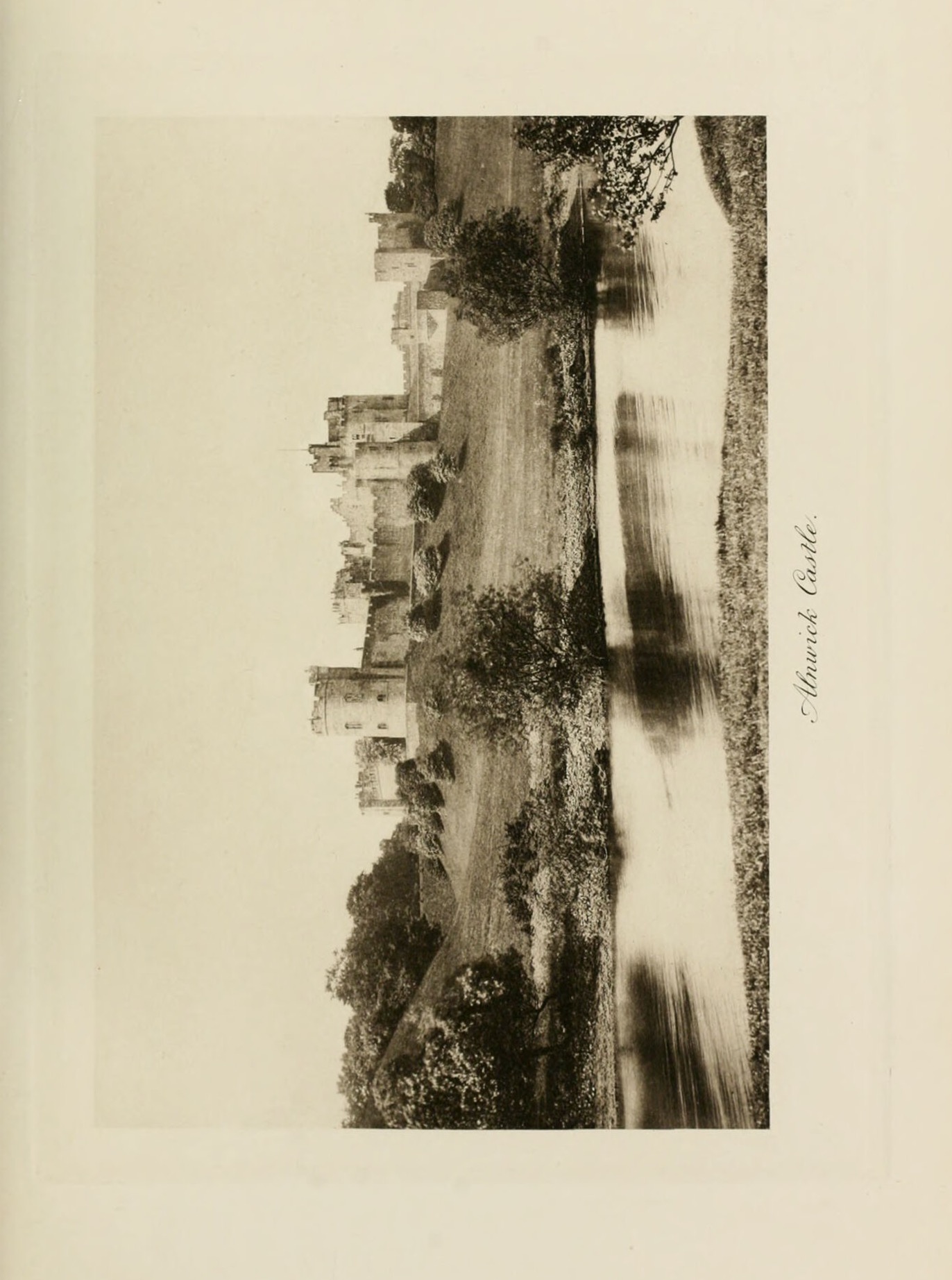
Alnwick Castle.
1897 · J. D. Mackenzie, The Castles of England, vol. 2 (1897)
Public domain


