England · Restored
Warwick Castle
Warwick Castle is a medieval fortress sited on a sandstone bluff at a bend of the River Avon in the town of Warwick. The stone castle developed from a Norman motte-and-bailey and reached its well-known 14th-century river-facing form under the Beauchamp earls, with prominent round towers, a fortified gatehouse and an ornate riverside facade.
First raised
1068
Its prime
1360
Today
Restored
Ranked among Europe’s castles
As it stood in 1360
What Warwick Castle looked like in its prime.
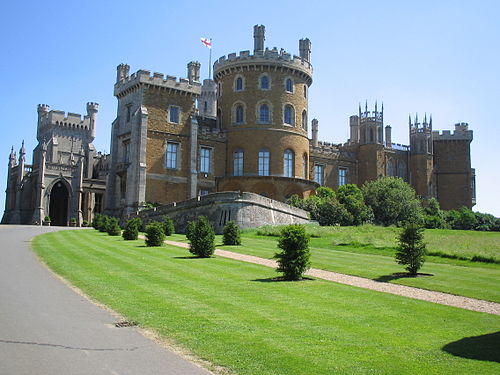
A long, river-facing curtain of warm sandstone sits atop a steep cliff overlooking a bend in the River Avon, reflected in the water below. The silhouette is defined by two large cylindrical, crenellated towers with machicolations flanking a fortified gatehouse and barbican; a Watergate opens to the river. South-side domestic ranges with regular tall narrow windows run along the curtain, and continuous battlements crown the walls, the whole presenting as a complete, occupied castle.
Its story
The story of Warwick Castle.
From Æthelflæd's Burh to Montfort's Slighting, 914–1267
A burh was established on the bluff above the Avon in 914 at the instigation of Æthelflæd, daughter of Alfred the Great, one of ten raised to defend Mercia against the invading Danes and placed to dominate the Fosse Way and the river crossing. William the Conqueror planted a motte-and-bailey here in 1068 as he advanced northwards to hold the Midlands against rebellion, tearing down four houses belonging to the Abbot of Coventry to make room. William II appointed Henry de Beaumont constable, and in 1088 made him the first Earl of Warwick.
In 1153 Roger de Beaumont's wife, Gundreda de Warenne, was tricked into believing him dead and surrendered the castle to the invading army of Henry of Anjou, later Henry II; the Gesta Regis Stephani has Roger dying on hearing that she had handed it over. Under Henry II the motte-and-bailey gave way to a stone shell keep, its buildings set against the curtain wall. A century on, William Maudit, 8th Earl, held for Henry III in the Second Barons' War, and in 1264 Simon de Montfort's forces rode out from Kenilworth and took Warwick by surprise attack; the chronicler John Rous records that the north-eastern walls were slighted so "that it should be no strength to the king", and Maudit and his countess were held at Kenilworth until a ransom was paid.
Henry de Beaumont founded the church of All Saints inside the castle walls by 1119; the Bishop of Worcester, holding a castle no fit place for a church, removed it in 1127-28. Henry II gave the castle back to the earls, who had stood by his mother the Empress Matilda through the Anarchy, and in the baronial rebellion of 1173-74 the earl kept his loyalty and the castle was used to store provisions. The Beaumont line ran to 1242, when Thomas, 6th Earl, died and the earldom went to his sister Margaret as countess in her own right; her first husband John Marshal died soon after, and Henry III held the castle until she married John du Plessis that December. William de Beauchamp, nephew of the William Maudit taken to Kenilworth, inherited in 1267.
Gaveston's Execution and the Beauchamp Towers, 1312–1360
The earldom passed to the Beauchamps in 1267, and seven generations of them made most of the additions the castle carries. In 1312 Guy de Beauchamp, 10th Earl, seized Piers Gaveston, 1st Earl of Cornwall, and imprisoned him at Warwick until his execution on 19 June, the magnates who moved against him accusing him of stealing the royal treasure.
Thomas de Beauchamp, 11th Earl, rebuilt the front facing the town between 1330 and 1360, adding a barbican, a gatehouse with murder holes, two drawbridges and portcullises, and a tower at either end of the reconstructed wall, Caesar's Tower and Guy's Tower. The Watergate Tower dates from the same campaign. Caesar's and Guy's are residential and may follow French models such as Bricquebec; both are machicolated and vaulted in stone on every storey, and Caesar's carries a double parapet found nowhere else. Caesar's held a grim basement dungeon and has been known by local legend since at least 1644 as Poitiers Tower, either because prisoners from the battle of 1356 were kept there or because the ransoms raised from that battle helped pay for the building. The gatehouse towers were machicolated in their turn. The front over the river, by contrast, was raised as a statement of Beauchamp power and would have been of minimal defensive value, part of a fourteenth-century turn towards castles built to be seen rather than held.
The Kingmaker's Royal Prisoner, 1469–1485
The Beauchamp line ended in 1449, and Richard Neville, the Kingmaker, became earl through his wife's inheritance of the title. In the summer of 1469 Neville rebelled against Edward IV and imprisoned the king in Warwick Castle, attempting to rule in his name until constant protest from the king's supporters forced him to release Edward; he was killed at the Battle of Barnet in 1471. The castle passed to his son-in-law George Plantagenet, Duke of Clarence, executed in 1478, and then into Crown custody. Clarence's son Edward, attainted by Henry VII, was held fourteen years in the Tower of London and executed in 1499, the last Earl of Warwick of the title's first creation.
Richard III, the Kingmaker's other son-in-law, had begun two gun towers in the early 1480s, Bear and Clarence, left unfinished at his death in 1485. With their own well and ovens they formed a stronghold independent of the rest of the castle, possibly against mutiny by the garrison, and the post of Keeper of the Artillery was created in 1486.
Leland's Ruin and Elizabeth's Timber Lodging, 1535–1601
By the time the antiquary John Leland came through, between 1535 and 1543, the decay was plain: the dungeon stood in ruin at the west-north-west, there was a tower with an iron postern-gate through it, and the king was spending heavily on foundations cut into the rock to hold up the south side, where great pieces had fallen away. The castle was in Crown care from 1478 until 1547, and some five hundred loads of stone went into repairs, but when John Dudley petitioned for ownership he reported that one whole side, with the dungeon tower, was "clearly ruinated and down to the ground", and then repaired nothing himself.
Elizabeth I came in 1566 on progress and again in 1572 for four nights, a timber building put up inside the castle for her stay while Ambrose Dudley, 3rd Earl, left the place to her. The earldom went extinct a second time on his death in 1590, and a survey that year found the castle still in disrepair, with lead stripped from the roofs of several buildings including the chapel.
From Fulke Greville's Ruin to the Civil War Garrison, 1604–1660
In October 1601 Sir Fulke Greville reckoned that "in very short time there will be nothing left but a name of Warwick". James I granted him the ruinous castle in 1604 and he spent over £20,000 converting it into a country house, until in 1628 his manservant Ralph Haywood, finding himself omitted from the will, stabbed him twice in Holborn.
Robert Smythson was commissioned to draw the castle as it stood before any of the work began. It was during the repairs that Warwick brushed the Gunpowder Plot: the conspirators, waiting at Dunchurch for news, learned the plot had failed and stole cavalry horses from the castle stables to get away. Greville was made Baron Brooke in 1621 and lived in a suite of rooms in the Watergate Tower; William Dugdale judged the result "a place not only of great strength but extraordinary delight, with most pleasant gardens, walks and thickets, such as this part of England can hardly parallel". Greville lived four weeks after Haywood stabbed him, and the Watergate Tower has been called the Ghost Tower ever since for the ghost said to walk it.
Robert Greville, 2nd Baron Brooke, spent January to May 1642 raising the garden walls, throwing up bulwarks of beams and soil to mount artillery, and obtaining gunpowder and wheels for two cannon. Greville was a Parliamentarian, and on 7 August a Royalist force under Spencer Compton, 2nd Earl of Northampton, laid siege while he was away; Sir Edward Peyto commanded the garrison and refused William Dugdale's summons to surrender. By Richard Bulstrode's account the besiegers had "only two small pieces of cannon", hauled to the top of the church steeple and discharged at the castle, "to which they could do no hurt, but only frightened them within the castle, who shot into the street, and killed several of our men".
Essex's forces relieved the garrison on 23 August and the Royalists retreated to Worcester. Prisoners taken at Edgehill were held in Caesar's and Guy's Towers, and prisoners from the Battle of Worcester in 1651 after them; a garrison with artillery and supplies was maintained from 1643 to 1660, numbering 302 soldiers at its strongest, until the Council of State ordered it disbanded.
From Garrison to Country Seat, 1660–1813
In 1660 the Council of State ordered the governor to hand the castle to Robert Greville, 4th Baron Brooke, who found the state apartments outmoded and in poor repair; Roger and William Hurlbutt, master carpenters of Warwick, modernised the interiors between 1669 and 1678, William being sent into Dorset to take careful notes of the new rooms at Kingston Lacy. The castle was fit enough by 4 November 1695 to receive William III. Francis Greville, 8th Baron Brooke, remade the grounds from 1749 with Lancelot Brown, who swept the narrow river terrace into a lawn falling to the Avon, and commissioned Canaletto in 1747, five paintings and three drawings survive, making Warwick the artist's most often painted building in Britain. The earldom was created a fourth time for Greville in 1759. By 1802 George Greville, 2nd Earl of the new creation, owed £115,000; the estates were signed over in 1806 and only returned to the earls in 1813.
Fire in Lady Warwick's Apartments, 1871
Fire broke out in the early hours of Sunday 3 December 1871 in Lady Warwick's apartments above the library, with Lord and Lady Warwick away. A nurse carried two of the children, Eva and Sydney Greville, through smoke and flame minutes before the main staircase collapsed; brigades from Warwick and Leamington were hampered by an inadequate water supply, and the Great Hall and private apartments were gutted, though the overall structure was unharmed. Weeks later, according to Lady Warwick, the blaze proved to have been set by the family's recently employed under-butler to conceal his robbery of the private apartments. Anthony Salvin carried out the restoration in 1872–75, subsidised by public donations of £9,651.
Evacuees, the Tussauds Sale and the Trebuchet, 1940–2023
When Coventry was being bombed the 7th Earl opened Warwick to evacuees from the city and to the Ministry of Supply; Rudolf Hess was rumoured to have been held here for a night on his way from Scotland to London. The earl transferred the castle to his heir in 1967, and in 1978 Lord Brooke sold it to the Tussauds Group for £1,300,000 after 374 years in Greville hands, a sale that set father and son against each other in public. Tussauds ran it as a tourist attraction and restored castle and grounds; the armoury on show there is reckoned second only to the Tower of London's. Blackstone bought the site in March 2007 and the Prestbury Group in July, with Merlin Entertainments operating it on a renewable 35-year lease. The castle is a scheduled monument and a Grade I listed building, together with its boundary walls, stables, conservatory, mill and lodge.
A working trebuchet was raised on the riverbank below the walls in June 2005–18 metres tall, more than 300 pieces of oak, 22 tonnes, built in Wiltshire to drawings from the Danish museum Middelaldercentret, which had recreated the first fully working trebuchet in 1989. Eight men took half an hour to load and release it, four of them running in treadwheels four metres high to raise a six-tonne counterweight. On 21 August 2006 it threw a 13-kilogram projectile 249 metres at 195 kilometres an hour, taking the record from the Danish machine. It was decommissioned in 2020 on safety grounds and replaced with a comparable engine in 2023.
Step inside
11 places to explore in 1360.
The record describes 11 distinct spots at Warwick Castle, including 3 interiors: caesar's tower, basement dungeon, guy's tower, residential chambers, great hall and chapel (south side). Create your own photoreal reconstruction and explore every one, more scenes means more rooms, more angles, and more of the place to stand in.
Build Your Own Castle
Recreate Warwick Castle with AI to explore it.
The artist rebuilds it as it stood in 1360, a photoreal reconstruction that belongs to you alone. Pay with coins, no subscription needed.
Recreate this castle →Defend this castle →Whose castle
Clans who held Warwick Castle.
The families that held Warwick Castle for a decade or more across its history, follow a name to its clan.
Beauchamp
Earls of Warwick (Beauchamp), 1268–1449.
Neville
Held by the Nevilles, Warwick 'the Kingmaker', 1449–1499.
Greville
Seat of the Greville Earls of Warwick, 1604–1978.
From the archive
Warwick Castle on paper: the measured plan and period views.
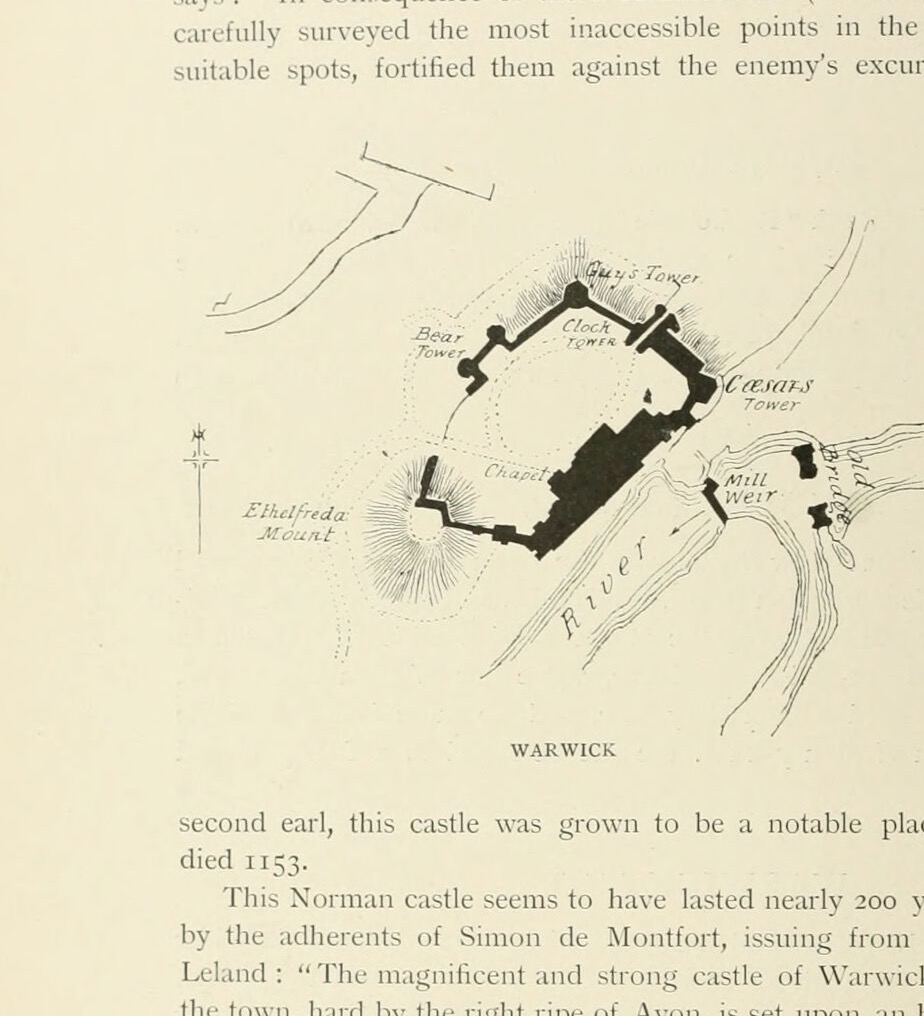
The survey plan and photographs below are the ground truth this page's reconstructions are checked against, drawn and photographed while the castle was still a working garrison. Every image is public-domain or openly licensed, with its source named.

(The castle, Warwick, England) (LOC) (16493874486)
ca. 1890-1900 · Photochrom Prints Collection (via Wikimedia Commons)
Public domain
WARWICK
1897 · J. D. Mackenzie, The Castles of England, vol. 1 (1897)
Public domain
Nearby