
England · Restored
Arundel Castle
Arundel Castle is a restored and remodelled medieval castle in Arundel, West Sussex, England, founded in the 11th century and long the seat of the Earls of Arundel and Dukes of Norfolk. The present appearance reflects extensive 18th- and 19th-century restoration and late-Victorian remodelling; it is a Grade I listed building open to the public.
First raised
1067
Its prime
1905
Today
Restored
As it stood in 1905
What Arundel Castle looked like in its prime.
A compact hilltop silhouette dominated by a large cylindrical keep with a crenellated top and corbelled machicolation-like band, several square and round towers, and long curtain walls. Facings combine pale ashlar and darker flint with ashlar dressings; the south-east range shows large pointed-arch Gothic windows. Parapets and crenellations line the roofline; narrow vertical arrow slits puncture the round tower. The castle sits above a slope of trees and overlooks the town below.
Its story
The story of Arundel Castle.
Roger de Montgomery's Fifth of Sussex, 1067
Roger de Montgomery, a cousin of William the Conqueror, had stayed behind in Normandy to keep the peace there while William was away in England. His reward was extensive land in the Welsh Marches and across the country, together with one fifth of Sussex, the Arundel Rape, granted as part of a much larger honour of hundreds of manors, and he was declared the first Earl of Arundel. He began work on the castle in around 1067. What he raised was a motte-and-bailey.
Henry I Takes the Castle from Robert of Bellême, 1101–1102
In 1102 the forces of Henry I besieged Arundel after its holder, Robert of Bellême, rebelled. The siege ended with the castle surrendering to the king. It passed afterwards to Henry's widow, Adeliza of Louvain, and her second husband William d'Aubigny. In 1139, during the early years of the Anarchy, the couple received Adeliza's stepdaughter the Empress Matilda at Arundel.
From d'Aubigny to FitzAlan to Howard
Adeliza died in 1151 and William in 1176, and the castle descended through the d'Aubigny line until the death of Hugh d'Aubigny, 5th Earl of Arundel, in 1243. John FitzAlan then inherited the castle and the honour of Arundel through his mother, and in 1433 Henry VI recognised him as having held the earldom of Arundel by right.
The FitzAlan male line ended with Henry Fitzalan, 12th Earl of Arundel, whose daughter and heiress Mary FitzAlan married Thomas Howard, 4th Duke of Norfolk, in 1555; the castle and the earldom passed to their descendants. Arundel has been the seat of the Earls of Arundel since the 11th century, and of the Dukes of Norfolk since the Howards inherited it.
Eighteen Days in 1643, and the Slighting Order of 1653
In December 1643 Sir William Waller brought a Parliamentarian army against the castle. The 800 royalists inside surrendered after eighteen days. Parliament ordered the castle slighted in 1653, though the weather probably did more damage to it than the demolition gangs.
delete - move the Charles II paragraph ahead of the slighting order so the section reads forward. On 14 October 1651, Captain Morley, who held Arundel for Parliament, was out hunting when he nearly took Charles II and Colonel Phillips. Charles was on the run after the Royalist defeat at Worcester; his party dismounted as though to make the descent of the hill easier, and let Morley's riders run past.
The 11th Duke's Repairs and Buckler's Remodelling
Arundel was not the Howards' favourite residence, and for generations the Dukes of Norfolk spent their time and money on other ducal estates, Norfolk House in London among them. Charles Howard, 11th Duke of Norfolk, began restoring and improving the castle in 1787, and had Francis Hiorne build the folly that still stands on the hill above Swanbourne Lake. William Raphael Eginton supplied the stained glass, including three full-length portraits of barons of King John's time for the baronial hall.
Henry Howard, 13th Duke, remodelled the interior in time for Queen Victoria and Prince Albert, who stayed for three days in 1846; the work added a suite of six rooms on the second floor of the south-east range, with the furniture designed by the firm of Morant. The 15th Duke then restructured the castle from 1875 to 1905 to designs by Charles Alban Buckler, the building work carried out by Rattee and Kett of Cambridge. The result is a Gothic Revival castle over an 11th-century core.
The 16th Duke intended to hand Arundel to the National Trust, but after his death in 1975 the 17th Duke cancelled that plan, setting up an independent charitable trust to guarantee the castle's future and overseeing further restoration. It was listed Grade I in 1949 and scheduled as a monument in 1976. On 21 May 2021 thieves broke in and took gold rosary beads described as irreplaceable, carried by Mary, Queen of Scots, to her execution in 1587, along with coronation cups given by monarchs to the Earl Marshal.
Step inside
8 places to explore in 1905.
The record describes 8 distinct spots at Arundel Castle, including 2 interiors: baronial hall (interior), south-east range, second-floor suite. Create your own photoreal reconstruction and explore every one, more scenes means more rooms, more angles, and more of the place to stand in.
Build Your Own Castle
Recreate Arundel Castle with AI to explore it.
The artist rebuilds it as it stood in 1905, a photoreal reconstruction that belongs to you alone. Pay with coins, no subscription needed.
Recreate this castle →Defend this castle →Whose castle
Clans who held Arundel Castle.
The families that held Arundel Castle for a decade or more across its history, follow a name to its clan.
FitzAlan
Held by the FitzAlan Earls of Arundel through the medieval centuries.
Passed to the Howards, Dukes of Norfolk, in 1555, their seat ever since.
From the archive
Arundel Castle on paper: the measured plan and period views.
The survey plan and photographs below are the ground truth this page's reconstructions are checked against, drawn and photographed while the castle was still a working garrison. Every image is public-domain or openly licensed, with its source named.
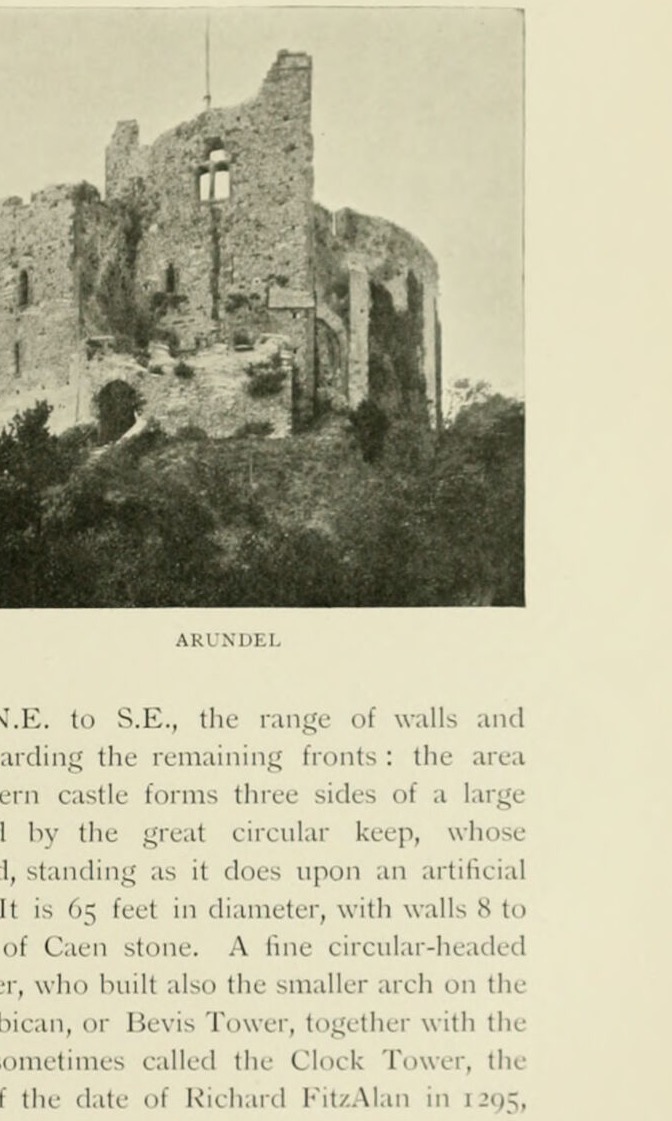
ARUNDEL
1897 · J. D. Mackenzie, The Castles of England, vol. 1 (1897)
Public domain
Nearby


