England · Ruin
Ashby de la Zouch Castle
Ashby de la Zouch Castle is a late-medieval fortified site in Ashby-de-la-Zouch, Leicestershire, converted from an earlier manor by William, Lord Hastings after 1473. The complex featured two large multi-storey towers flanking ranges of domestic buildings and a substantial surrounding park and gardens; it was slighted in the mid-17th century and today survives as a managed ruin.
Its prime
1617
Today
Ruin
As it stood in 1617
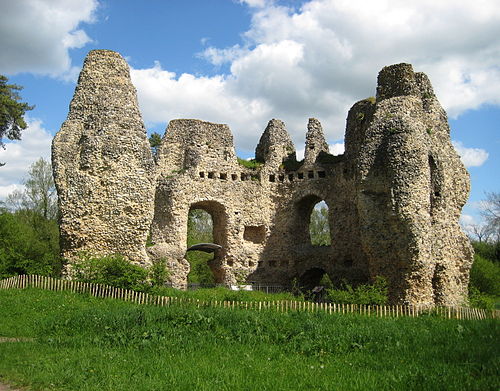
What Ashby de la Zouch Castle looked like in its prime.
Massive, multi-storey rectangular stone towers flank a low linking curtain wall with a sequence of tall arched openings and window embrasures; the towers rise with stacked vertical window holes and a crenellated parapet line at the top of the taller tower. The masonry is weathered grey-brown ashlar and rubble; most roofs are absent in the ruins but at prime the ranges and towers formed a continuous roofline around an inner court set above a broad grass forecourt and adjacent formal gardens and parkland.
Its story
The story of Ashby de la Zouch Castle.
The Manor of Ascebi, 1086-1399
A manor stood at Ashby-de-la-Zouch by 1086, when the place was recorded as Ascebi. Robert de Beaumont, Count of Meulan and later Earl of Leicester, acquired the lands in 1100 and settled the Belmeis family there as tenants; after that line died out in 1160 the earls reassigned the estate to the La Zouche family, from whom the manor took its later name. The le Zouch line failed in 1399.
Lord Hastings and the Licence to Crenellate, 1461-1483
The manor probably passed by sale and marriage to James Butler, Earl of Ormond and Wiltshire, a Lancastrian captured at Towton in 1461 by Edward IV and executed. The Crown seized his estates, and in 1462 Ashby was given to William, Lord Hastings, who had fought beside Edward at Towton and became royal chamberlain. After 1471 he made it his principal residence, in place of Kirby Muxloe.
Edward granted him the right to crenellate four of his manors in 1474, with a 3,000-acre park here. He appears to have intended a castle of four huge towers, like the royal fortresses at Tutbury and Nottingham; work seems to have begun the year before permission was formally given. Only half were finished when Richard, Duke of Gloucester, summarily executed Hastings in June 1483 for refusing to support the deposition of Edward V; the castle was restored to his widow, Katherine.
Earls of Huntingdon and Their Royal Guests, 1529-1634
Hastings' grandson George, a favourite of Henry VIII, was made Earl of Huntingdon in 1529, rebuilt parts of the castle in brick and redesigned the gardens. Henry Hastings inherited in 1560 and kept a household of 77 servants, though he spent most of his time at York, heading the Council of the North; in 1569 he imprisoned Mary, Queen of Scots there, accused of plotting against Elizabeth I. It passed to his brother George and then to a grandson, Henry, who hosted James I three times between 1612 and 1617 and Charles I in 1634; by then generations of heavy expenditure had much diminished the family estates.
Henry Hastings' Garrison and the Slighting, 1642-1648
When war came in 1642 Ferdinando Hastings, who took the earldom in 1643, stayed neutral, while his younger brother Henry became a key Royalist commander in the Midlands. The castle linked Royalist territory in the north and west and gave easy access to the Trent; Henry made it his base, with outposts near Donnington and Shardlow. Town buildings were pulled down for material to refortify castle and town, tunnels dug and an “Irish fort” built. In early 1643 the garrison was sent to relieve Newark and, in Prince Rupert's larger force, forced the Parliamentary besiegers to surrender.
By late 1644 Parliamentary forces at Coleorton had the garrison contained. Charles I passed through in May 1645 on his way to besiege Leicester, and again in retreat after Naseby. Henry returned in September, when 600 more soldiers joined him and the 60-man garrison in raids on Parliamentary convoys and Coleorton. Plague at year's end forced the besiegers back to Leicester, while the garrison left the buildings for the park; once it passed, Parliament raided the town, and Henry worked through Ferdinando to surrender on good terms in February 1646, securing the release of himself, the garrison and their weapons.
A Royalist rebellion in Kent in May 1648 revived fears that Henry might reoccupy Ashby. Lord Grey, a Hastings rival in Leicestershire, took charge in August and held Royalist prisoners there, among them the Duke of Hamilton. In November (possibly because of Henry's part in the rebellion) William Bainbrigg was ordered to put the place beyond military use, and did so at once, demolishing one side of the Great Tower and the Kitchen Tower with undermining and gunpowder.
Ashby Place, Ivanhoe and the Ministry of Works, 1653-2015
Ferdinando was imprisoned for debt in 1653 and the family moved to Donington Hall, though part of the ruins was repaired into a house, Ashby Place, home after 1746 to Selina Hastings, Countess of Huntingdon. It passed in 1789, on Francis Hastings' death, to Francis Rawdon, later Earl of Moira. Sir Walter Scott set a tournament scene at Ashby in Ivanhoe in 1819, and the novel's popularity made it famous; Rawdon's agent Edward Mammatt repaired the ruins and opened them to visitors.
The Rawdons took a government repair grant in 1912 but could not afford the upkeep, and by the early 1930s the walls had become unstable. It passed into the guardianship of the Ministry of Works in 1932, which repaired it and opened the grounds. English Heritage manages it today, with 15,164 visitors in 2015; it is protected as a Grade I listed building and a scheduled monument, for the historian John Goodall an “outstanding example of a late medieval castle”.
Step inside
5 places to explore in 1617.
The record describes 5 distinct spots at Ashby de la Zouch Castle, including 1 interior: curtain wall and inner court. Create your own photoreal reconstruction and explore every one, more scenes means more rooms, more angles, and more of the place to stand in.
Build Your Own Castle
Recreate Ashby de la Zouch Castle with AI to explore it.
The artist rebuilds it as it stood in 1617, a photoreal reconstruction that belongs to you alone. Pay with coins, no subscription needed.
Recreate this castle →Defend this castle →Whose castle
Clans who held Ashby de la Zouch Castle.
The families that held Ashby de la Zouch Castle for a decade or more across its history, follow a name to its clan.
la Zouche
Held the manor from about 1160 until the line died out in 1399; the manor took its name from the family.
Hastings
Built by William, Lord Hastings, after 1473; the family's seat for several generations.
Rawdon
Owners into the 20th century; Francis Rawdon opened the ruins to visitors, and the family maintained the castle until 1932.
Nearby