
England · Ruin
Beeston Castle
Beeston Castle is a medieval fortification perched on a sandstone crag in Cheshire, England, originally built in the 1220s and held by the crown. The site comprises an inner bailey on the rocky summit and an outer bailey on the lower slopes, with substantial curtain walls, multiple projecting D-shaped towers and gatehouses. It was slighted in the 17th century and today survives as exposed ruined walls and towers managed by English Heritage.
First raised
1220
Its prime
1300
Today
Ruin
As it stood in 1300
What Beeston Castle looked like in its prime.
Sited atop a steep New Red Sandstone crag, the castle forms a roughly rectangular summit enclosure with continuous sandstone curtain walls punctuated by projecting D-shaped towers. Bands of red and pale sandstone appear in the masonry; the outer bailey walls run down the slopes below the summit. On three sides the rock falls away sheer; on the fourth a deep rock-cut defensive ditch protects the approach. In its prime the gatehouses, towers and contiguous curtain walls formed an unbroken defensive silhouette above the Cheshire Plain.
Its story
The story of Beeston Castle.
Ranulf's Castle on the Rock, 1220s
Beeston was built in the 1220s for Ranulf de Blondeville, 6th Earl of Chester, shortly after his return from the Fifth Crusade: one of three major castles he raised in those years, alongside Bolingbroke in Lincolnshire and Chartley in Staffordshire, all sharing similar tower designs. Medieval documents call it Castellum de Rupe, the Castle on the Rock, and the name is literal: it sits on a sandstone crag 350 feet above the Cheshire Plain, its outer bailey walls sited to reuse the rampart of an Iron Age hill fort already on the crag.
Unlike most castles of its period Beeston has no keep. The natural drops, massive walls, strong gatehouses and carefully positioned towers made the baileys themselves the stronghold: a rectangular inner castle on the summit with a sheer fall on three sides and a rock-cut ditch up to 30 feet deep on the fourth, and an outer bailey on the lower slopes whose gatehouse stood behind a ditch 16 feet wide and 10 feet deep. The outer walls, six feet thick and faced in sandstone, carried open-backed D-shaped towers, an innovation in English castles at the time, letting defenders shoot along the walls while denying cover to attackers who broke in. Two wells were cut into the rock; one, at 370 feet, is among the deepest castle wells in England.
Henry III, Prince Edward and the Welsh Wars
Most of the defences were complete when Ranulf died in 1232, but no living quarters had been built, and none had been added when his successor John died without a male heir in 1237, allowing King Henry III to take over the Earldom of Cheshire. Henry enlarged Beeston during his wars with Wales and used it as a prison for Welsh captives, yet no halls or chambers were ever raised; garrisons were probably housed in wooden buildings in the outer bailey.
In 1254 Henry gave Beeston and other Cheshire lands to his son Prince Edward, together with the title Earl of Chester, conferred on the heir to the English throne ever since. During the Montfortian rebellion the castle was retaken from the rebels in 1265 by James de Audley and Urian de Saint Pierre, after Edward's escape from captivity. The Crown kept Beeston in repair through Edward's reign and the 14th century, when Cheshire men served as its constables, but by the 16th century it was judged of no further military use, and in 1602 it was sold to Sir Hugh Beeston of Beeston Hall.
Richard II's Buried Gold
Persistent rumour holds that Richard II hid part of his personal treasure at Beeston in 1399, on his way to Chester before sailing to Ireland to put down a rebellion. He was deposed on his return by Henry, Duke of Lancaster, the future Henry IV, and the hoard is said to have lain undiscovered ever since. Many searches have been made, most probing the deep well in the inner bailey, and nothing has ever been found, though the tale may not be well founded, since Henry IV is recorded as having recovered Richard's gold and jewellery from its various hiding places.
Captain Sandford's Night Raid, 1643
The Civil War pressed the neglected castle back into service. Parliamentary forces under Sir William Brereton seized Beeston on 20 February 1643, repairing the walls. Part of the royal army of Ireland having landed at Chester that year, Captain Thomas Sandford and just eight soldiers crept into the castle at night on 13 December, possibly aided by treachery, and surprised the governor, Captain Thomas Steele, who was so shaken that he surrendered on the promise of marching out with honours. Steele was tried and shot for failing to hold the castle.
The Royalist garrison then withstood a parliamentary siege from November 1644 until November 1645, when want of food forced surrender. In 1646 the castle was slighted under Cromwell's destruction order, to end its use as a stronghold.
Quarry Stone and Fete Days
In the late 17th century Sir Thomas Grosvenor had Eaton Hall built by William Samwell, arranged so that the hall's occupants looked out towards Beeston's ruins. The 18th century was less kind: the grounds were quarried, and the outer gatehouse was demolished to make a track for carting the stone away. In 1840 the castle passed to John Tollemache, then the largest landowner in Cheshire, and in the mid-19th century it hosted an annual two-day fete for local widows and orphans that drew more than 3,000 visitors a day. The ruins are now a Scheduled Ancient Monument in the care of English Heritage.
Step inside
7 places to explore in 1300.
The record describes 7 distinct spots at Beeston Castle, including 1 interior: inner bailey deep well. Create your own photoreal reconstruction and explore every one, more scenes means more rooms, more angles, and more of the place to stand in.
Build Your Own Castle
Recreate Beeston Castle with AI to explore it.
The artist rebuilds it as it stood in 1300, a photoreal reconstruction that belongs to you alone. Pay with coins, no subscription needed.
Recreate this castle →Defend this castle →Whose castle
Clans who held Beeston Castle.
The families that held Beeston Castle for a decade or more across its history, follow a name to its clan.
Beeston
Sold by the Crown to Sir Hugh Beeston in 1602, after the castle was judged of no further military use.
From the archive
Beeston Castle on paper: the measured plan and period views.
The survey plan and photographs below are the ground truth this page's reconstructions are checked against, drawn and photographed while the castle was still a working garrison. Every image is public-domain or openly licensed, with its source named.
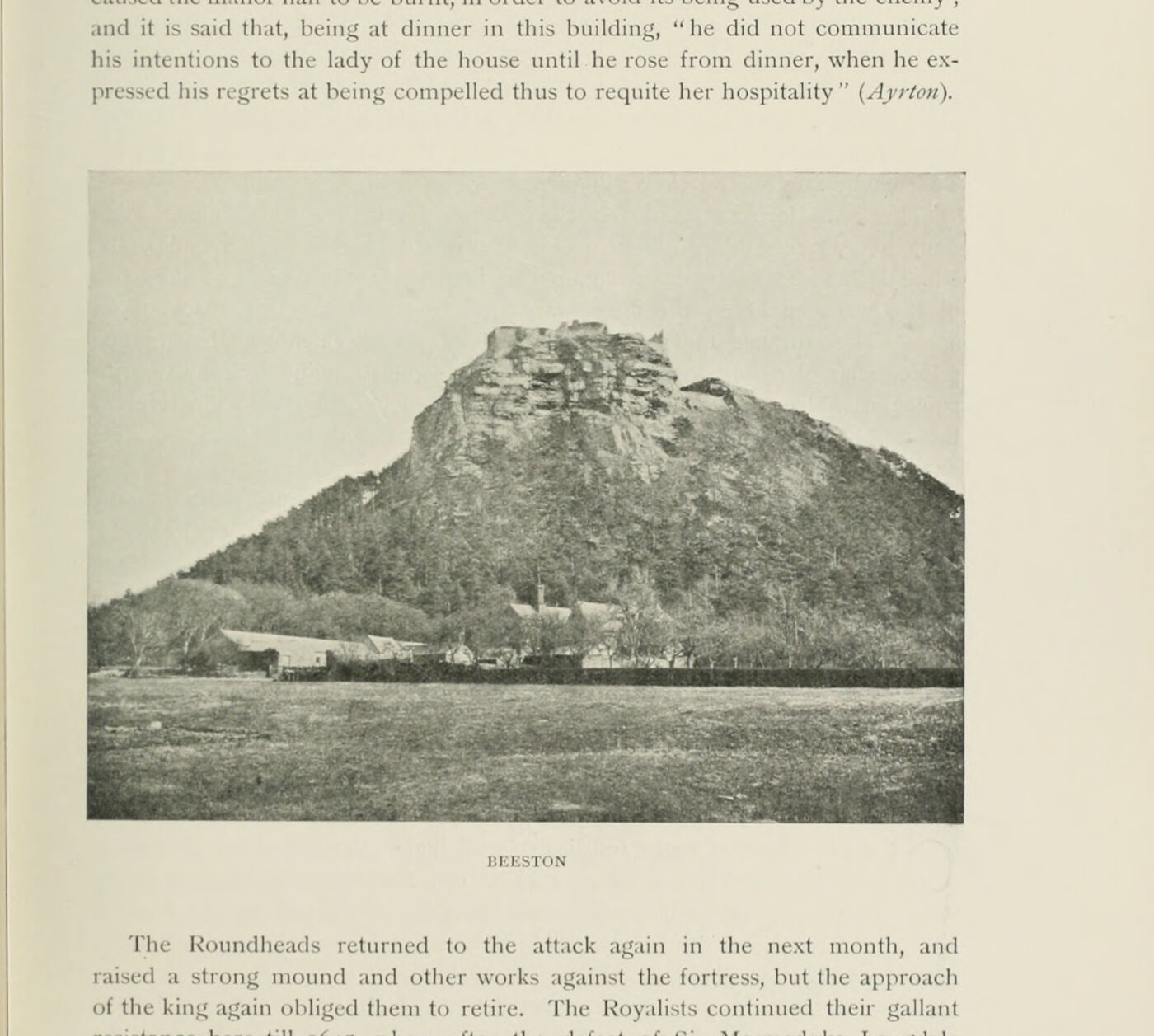
BEESTON
1897 · J. D. Mackenzie, The Castles of England, vol. 2 (1897)
Public domain
Nearby
Landmarks within reach of Beeston Castle.


Questions about Beeston Castle
What is the history of Beeston Castle?
Why was Beeston Castle built, and what was it used for?
Who owns Beeston Castle now?
Where is Beeston Castle?
When was Beeston Castle built?
Was Beeston Castle ever attacked or besieged?
Which family or clan held Beeston Castle?
What did Beeston Castle look like in its prime?
Is Beeston Castle still standing or is it a ruin?
Who built Beeston Castle?
Can you visit Beeston Castle?
More castles of England


Explore the city


