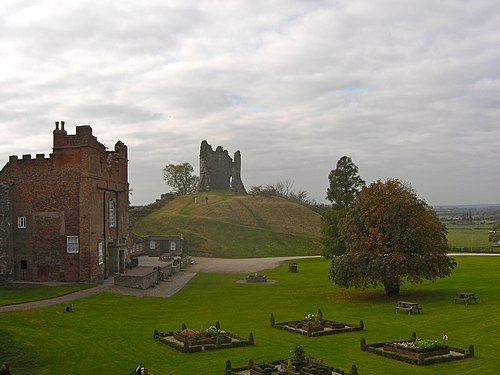
England · Partial ruin
Berry Pomeroy Castle
Berry Pomeroy Castle is a late-15th to 17th-century castle and Tudor house on a limestone outcrop above the Gatcombe Brook in South Devon. Built by the Pomeroys and remodelled and extended by the Seymours, it became a largely abandoned and partly-ruined fortified residence by the late 17th century and is now an English Heritage site. Archaeological work in the late 20th century clarified its late-medieval origins and later phases.
First raised
1496
Its prime
1688
Today
Partial ruin
As it stood in 1688
What Berry Pomeroy Castle looked like in its prime.
A grey limestone curtain wall encircles a courtyard on a limestone outcrop above a wooded valley; a prominent twin-towered gatehouse with broad central arched entrance forms the main southern approach. To the north of the courtyard a rectangular four-storey Tudor range with large mullioned windows rises above the curtain; a smaller round tower (St Margaret's Tower) projects from the curtain at one end. Roofs over ranges would be pitched and covered in slate; at the castle's prime all walls, roofs and windows were complete.
Its story
The story of Berry Pomeroy Castle.
The Pomeroys' Late-Built Castle
The de la Pomeroy family held the large feudal barony of Berry Pomeroy from shortly after the Norman Conquest, the Domesday Book of 1086 records them here, and by 1166 the barony ran to almost thirty-two knight's fees. Yet for centuries their seat was a manor house, not a fortress. Henry Pomeroy enclosed a deer park in 1207, but the first mention of a castle comes only in 1496, when Elizabeth, widow of Richard Pomeroy, was assigned a third of both the castle and the capital messuage, a document that makes clear the two stood on different sites.
The design of the gun ports in the gatehouse and St Margaret's Tower, which with the curtain wall are the oldest surviving parts, points to construction in the late 15th century, probably one of the last traditional personal castles built in England. It rose on a limestone outcrop above the deep wooded valley of the Gatcombe Brook, a favoured spot within the family's own deer park: a dry moat, gatehouse and ramparts, with buildings ranged inside the curtain wall. In 1978 a wall painting of the Adoration of the Magi, dated on style to about 1490–1500, was found hidden behind vegetation in the gatehouse's upper storey.
Sold to the Lord Protector, 1547
By 1547 the Pomeroys were in financial difficulty, and Sir Thomas Pomeroy sold the estate to Edward Seymour, 1st Duke of Somerset, Lord Protector to the boy-king Edward VI. Somerset was buying many properties at the time and may never have visited. He fell from favour and was beheaded for treason in 1552, his lands forfeit to the Crown; only in 1558, after complex property dealings, did his son Lord Edward Seymour gain title to the castle.
Lord Edward, High Sheriff of Devon in 1583, cleared away the old Pomeroy buildings between 1560 and 1580 and raised a fashionable four-storey house at the north end of the courtyard, whose shell still stands mostly to its original height. After his death in 1593 his son, another Edward, added the North Range in about 1600, completing a Tudor mansion inside the medieval walls. He died in 1613, two years after being created a baronet.
Civil War Raid and the Fifty-Room Inventory
Sir Edward Seymour, 2nd Baronet, Governor of Dartmouth, lived in style at the castle until the Civil War, when he sided with the Royalists. He was captured, and while he lay imprisoned in London the castle was raided by Parliamentarians. Cromwell sequestered his estates, though he was allowed to remain at Berry Pomeroy, where he died in 1659. His son, a Royalist colonel from 1642, was held in Exeter until 1655, then prospered after the Restoration as Deputy Lieutenant for Devon, Vice-Admiral and MP for Totnes.
At his death in 1688 an inventory recorded around fifty rooms, though the buildings were likely in poor repair after the fortune spent in the Royalist cause. His heir, the 4th Baronet (MP for Exeter and Speaker of the House of Commons from 1673) preferred Bradley House in Wiltshire, and probably stripped the castle of useful materials to fund the rebuilding of Bradley House, completed in 1710. Berry Pomeroy remained in use until his mother Lady Anne died there in 1694. By 1701 John Prince, who had known its dining room "adorn'd, besides paint, with statues and figures cut in alabaster", wrote that "'tis now demolished, and all this glory lieth in the dust".
A "Picturesque" Ruin, and What the Spades Found
Overgrown with ivy and the haunt of jackdaws, the ruin became a favourite of the "picturesque" movement from the end of the 18th century: forty-five prints of it were published between 1734 and 1861, and its reputation for being haunted only fed the crowds. Around 1830 the Duke of Somerset repaired the crumbling walls, one of the first examples of conservation work on a ruined building, probably prompted by concern for visitors' safety.
Excavations between 1980 and 1996 rewrote the castle's story. No trace of any building earlier than the late 15th century was found, overturning the old belief that the walls were the work of the first Norman Pomeroys; nothing at all supported the cherished tales of Civil War cannon fire from the opposite hillside or a catastrophic lightning strike. The buildings had simply been stripped, systematically, of everything reusable. A Grade I listed building still owned by the Duke of Somerset, the castle is today administered by English Heritage.
Step inside
10 places to explore in 1688.
The record describes 10 distinct spots at Berry Pomeroy Castle, including 3 interiors: gatehouse upper chamber (wall painting), north range dining room, dungeons and lower chambers. Create your own photoreal reconstruction and explore every one, more scenes means more rooms, more angles, and more of the place to stand in.
Build Your Own Castle
Recreate Berry Pomeroy Castle with AI to explore it.
The artist rebuilds it as it stood in 1688, a photoreal reconstruction that belongs to you alone. Pay with coins, no subscription needed.
Recreate this castle →Defend this castle →Whose castle
Clans who held Berry Pomeroy Castle.
The families that held Berry Pomeroy Castle for a decade or more across its history, follow a name to its clan.
Pomeroy
The de la Pomeroys held the barony from shortly after the Norman Conquest and built the castle in the late 15th century; sold in 1547.
Seymour
Bought by Edward Seymour, 1st Duke of Somerset, in 1547; with the Seymour family ever since.
From the archive
Berry Pomeroy Castle on paper: the measured plan and period views.
The survey plan and photographs below are the ground truth this page's reconstructions are checked against, drawn and photographed while the castle was still a working garrison. Every image is public-domain or openly licensed, with its source named.

Berry Pomeroy Castle, Dartmouth, England-LCCN2002696645
ca. 1890-1900 · Photochrom Prints Collection (via Wikimedia Commons)
Public domain
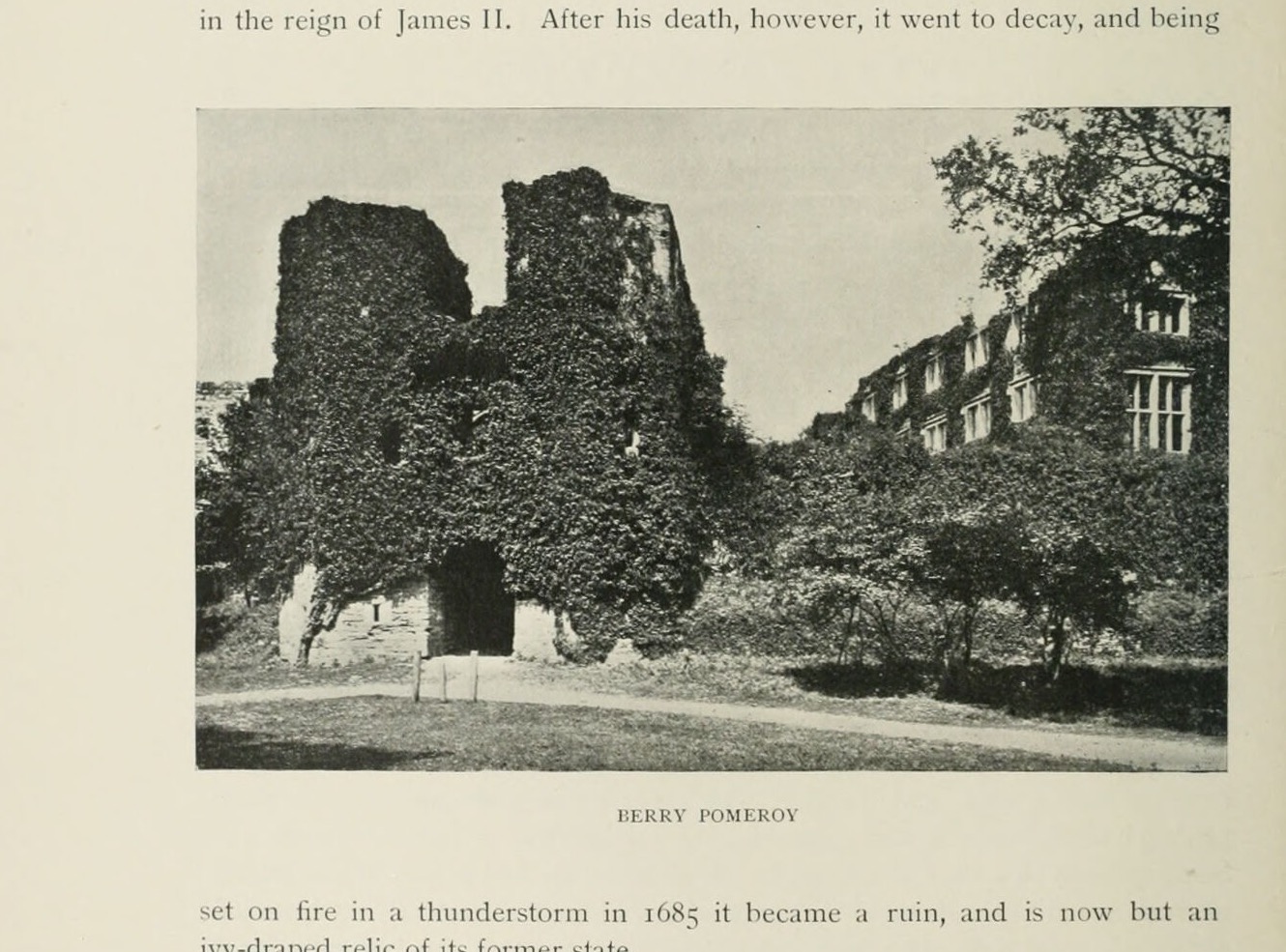
BERRY POMEROY
1897 · J. D. Mackenzie, The Castles of England, vol. 2 (1897)
Public domain
Nearby