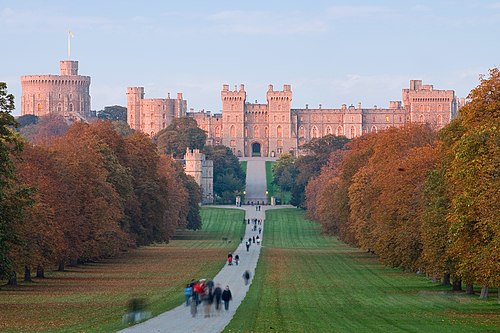
Bletchingley Castle
Bletchingley Castle is a Norman-period ringwork and bailey castle on a prominent part of the Greensand Ridge in Surrey. The site preserves earthwork banks and ditches, the foundations and partial masonry of a c.12th-century great-house and the footprint of a rectangular tower demolished in the 1260s. The monument today is an overgrown ruin with later 19th-century buildings set into the mound.
Its prime
1170
Today
Ruin
As it stood in 1170
What Bletchingley Castle looked like in its prime.
A near-circular Norman ringwork sitting on a narrow Greensand Ridge, defined to the north and east by a deep ditch up to 6m and an earthen rampart 1.4–2.4m high; a 3m-wide causeway on the north‑east marks the original entrance. Within the ringwork the main stone great-house measures about 24m square with surviving undercroft to roughly 2.5m and stair locations at the NW and SE corners. An outer bank and ditch enclose a bailey to the north and east, and a small north‑west mound may mark a barbican site.
Its story
The story of Bletchingley Castle.
Late in the twelfth century a rectangular tower was built on an earlier earthwork enclosure at Bletchingley by Richard Fitz Gilbert, founder of the de Clare family. The Surrey branch of the de Clares lived in the village and sided with the barons in their disputes with the Crown in the thirteenth century.
The wars of 1263–64 brought the castle its only recorded military action. Simon de Montfort, accompanied by Gilbert de Clare, 7th Earl of Gloucester, marched past on his way to attack the king's army on the coast; Royalists who had seized the de Clares' Tonbridge Castle pounced on his retreating London force and are said to have taken and dismantled Bletchingley, an operation that might have proved disastrous for the barons had they been beaten at Lewes.
The castle land later separated from the manor, held in the sixteenth century by a Cholmeley, afterwards by the Drake family (who took the name Brockman), and sold in 1793 to John Kenrick. Nineteenth-century building for the Castle Hill house cut into the mound, but the ringwork and bailey survive well, with large areas within the ringwork apparently undisturbed.
Step inside
9 places to explore in 1170.
The record describes 9 distinct spots at Bletchingley Castle, including 2 interiors: great-house undercroft, first-floor living quarters / hall. Create your own photoreal reconstruction and explore every one, more scenes means more rooms, more angles, and more of the place to stand in.
Build Your Own Castle
Recreate Bletchingley Castle with AI to explore it.
The artist rebuilds it as it stood in 1170, a photoreal reconstruction that belongs to you alone. Pay with coins, no subscription needed.
Recreate this castle →Defend this castle →Whose castle
Clans who held Bletchingley Castle.
The families that held Bletchingley Castle for a decade or more across its history, follow a name to its clan.
de Clare
Built c.1170 by Richard Fitz Gilbert, founder of the de Clare family; taken and dismantled by Royalist forces in 1264.
Nearby