England · Partial ruin
Bolton Castle
Bolton Castle is a 14th-century quadrangular castle in Wensleydale, North Yorkshire, built for Richard, 1st Baron Scrope of Bolton. The castle comprises high, continuous curtain walls with large square corner towers and was partly damaged in the 17th century; parts have been restored while other sections remain ruined. It is a Grade I listed building and remains in the ownership of the Scrope/Powlett descendants and is open to visitors.
First raised
1379
Its prime
1399
Today
Partial ruin
As it stood in 1399
What Bolton Castle looked like in its prime.
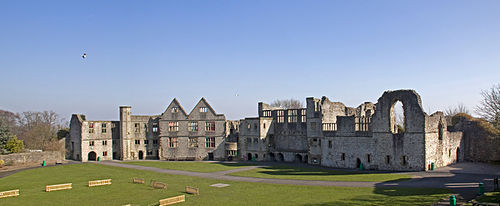
A large quadrangular plan of grey coursed limestone with four tall, mostly square corner towers and continuous high curtain walls; narrow vertical arrow-slit openings and larger rectangular and pointed-arched windows puncture the façades. Rooflines are dominated by battlemented parapets; some tower tops are broken away in places. The castle sits in a grassy valley setting with a low dry-stone boundary and farmed fields approaching the outer yard. At its prime the walls and towers would have been continuous and intact.
Its story
The story of Bolton Castle.
Richard Scrope's Licence and John Lewyn's Contract, 1378–1399
Bolton Castle was built between 1378 and 1399 by Richard, 1st Baron Scrope of Bolton; the contract with the mason John Lewyn was made in September 1378 and the licence to build granted in July 1379, at a reputed cost of 18,000 marks. A quadrangular castle in Wensleydale, it gave the nearby village of Castle Bolton its name. The 16th-century writer John Leland described an astronomical clock in the courtyard and tunnels that carried smoke away from the hearth in the hall, and Sir Francis Knollys judged it to have the highest walls of any house he had seen.
The Pilgrimage of Grace and the King's Torch, 1536
In 1536 John, 8th Baron Scrope backed the Pilgrimage of Grace, the rebellion against Henry VIII's religious reforms, and gave sanctuary in the castle to Adam Sedbar, Abbot of Jervaulx. Scrope had to flee to Skipton pursued by the king's men; Sedbar was caught and executed, and in retribution the king ordered Bolton Castle torched, causing extensive damage. Within a few years some of the damage had been repaired and Scrope had regained his seat in Parliament.
Six Months of Mary, Queen of Scots, 1568–1569
After her defeat at the Battle of Langside in 1568, Mary, Queen of Scots fled to England, where her presence threatened the Protestant Elizabeth I. First held at Carlisle Castle under the watch of Henry, 9th Baron Scrope, she was moved to Bolton in July 1568 when Carlisle proved unsuitable. Her principal keeper there, Sir Francis Knollys, appraised the castle as 'very strong, very fayre, and very stately after the olde manner of building... the highest walled house I have seen, and has but one entrance thereinto.'
Mary was given Scrope's own apartments in the south-west tower, but of her retinue of 51 only 30 of her men and six ladies-in-waiting could stay in the castle, the rest lodging nearby. The house was not fitted for a queen: tapestries, rugs and furniture were borrowed from local houses and from Barnard Castle, and Elizabeth herself loaned pewter vessels and a copper kettle. Mary hung an old cloth of estate from Scotland above her chair in the great chamber, making it like a throne room. Her keepers let her wander the surrounding lands and hunt; she passed her days having her hair dressed by her friend Mary Seton, while Knollys, whom she nicknamed 'Schoolmaster', taught her English, a language she had never used before. She even met with local Catholics, for which Knollys and Scrope were severely reprimanded. Local tradition holds she once escaped towards Leyburn, losing her shawl on the way, the story behind the name of The Shawl, the cliff edge running west out of the town. In January 1569 she was taken from Bolton to Tutbury in Staffordshire, where she would spend much of the eighteen years before her execution in 1587.
Slighted but Never Sold
The castle was damaged in the English Civil War and slighted afterwards, though much of it survived. When Emanuel Scrope, 1st Earl of Sunderland, died in 1630 without legitimate children, Bolton passed to Mary, the eldest of his three illegitimate daughters, who married Charles Powlett, 6th Marquess of Winchester and 1st Duke of Bolton. The castle has never been sold: their descendant Thomas Peter Algar Orde-Powlett, 9th Baron Bolton, inherited it on his father's death in June 2023. Part ruin, part restored, it is protected as a Grade I listed building and a Scheduled Ancient Monument.
Step inside
7 places to explore in 1399.
The record describes 7 distinct spots at Bolton Castle, including 3 interiors: great chamber (throne-like seat), hall with hearth and smoke tunnels, south-west tower apartments (private chambers). Create your own photoreal reconstruction and explore every one, more scenes means more rooms, more angles, and more of the place to stand in.
Build Your Own Castle
Recreate Bolton Castle with AI to explore it.
The artist rebuilds it as it stood in 1399, a photoreal reconstruction that belongs to you alone. Pay with coins, no subscription needed.
Recreate this castle →Defend this castle →Whose castle
Clans who held Bolton Castle.
The families that held Bolton Castle for a decade or more across its history, follow a name to its clan.
Scrope
Built 1378–99 by Richard, 1st Baron Scrope of Bolton; held by the Scropes until 1630 and never sold out of the family's descent.
Orde-Powlett
Inherited through Mary Scrope's marriage to Charles Powlett, 1st Duke of Bolton; held today by the 9th Baron Bolton.
Nearby