England · Ruin
Bridgnorth Castle
Bridgnorth Castle is a medieval castle in the town of Bridgnorth, Shropshire. Founded in 1101, its principal square great tower and extended curtain walls were constructed and enlarged in the 12th century. The site was largely demolished after a Civil War siege in the 17th century and today survives as fragmented masonry on Castle Hill.
Its prime
1174
Today
Ruin
As it stood in 1174
What Bridgnorth Castle looked like in its prime.
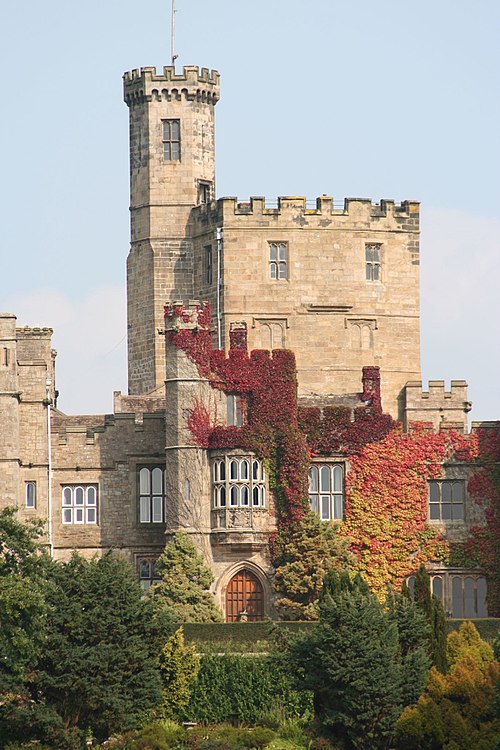
A compact, hillside medieval fortress dominated by a tall, square great tower set within continuous curtain walls and a projecting mural turret; the massing reads as a thick stone rectangle rising from a raised mound. Walls are built of coursed red-brown sandstone with dressed faces and rubble infill, punctured by narrow vertical openings and concealed wall-bays. At the summit the tower and adjacent ranges form a continuous roofline; the surrounding slope has scattered trees and enclosure fencing at the base.
Its story
The story of Bridgnorth Castle.
Robert de Belleme's Castle and Henry I's Seizure, 1101–1120
Robert de Belleme, son of the French earl Roger de Montgomery and his successor as Earl of Shrewsbury, founded the castle in 1101, possibly on the site of a Saxon burh raised by Æthelflæd in 912. King Henry I took it from him the following year and built a temporary castle of his own on Panpudding Hill. Most of the surviving outer walls date from a building campaign of about 1105 to 1113, and around 1120 Henry I had the walls replastered and refaced in better stone.
Henry II's Great Tower and the Barbican, 1160–1281
The castle's principal feature, a square great tower, was raised under Henry II in 1160, and the castle was extended between 1166 and 1174. A mural tower already standing in 1160 was enlarged in 1226, and a barbican with a drawbridge, built by 1212, was first recorded in 1221. In 1242 the outer bailey, since vanished, was formally absorbed into the town, and in 1261 the sheriff of Bridgnorth was ordered to roof and repair the houses within it. By 1267 the castle was losing its strategic significance, and it was recorded in disrepair by 1281.
The Despenser War and a Forgotten Castle, 1321–1540
In 1321 the barons who rebelled against Edward II during the Despenser War seized the castle, but by the mid-14th century, in the wake of the Black Death, it had once again lost most of its strategic importance, and by the 15th century it was largely forgotten. It was noted in disrepair at the start of Henry VIII's reign and only partly repaired around 1530. When the antiquary John Leland visited in 1540 he described walls "of great height" going "totally to ruine," reckoning "the castle to be more in compasse than a third part of the town," its bailey by then filled with timber-framed houses.
Cromwell's Three-Week Siege, 1642–1647
Charles I is said to have called Bridgnorth and its castle "the finest in my domain" in 1642, and the town became one of the Midlands' main Royalist strongholds, heavily garrisoned that year. The castle was partly slighted in 1645, and in 1646 Cromwell's forces arrived to take it from the Royalist garrison under Sir Robert Howard. During the three-week siege that opened on 31 March 1646, the engineer Colonel Lavington drove a 21-metre tunnel into Castle Hill intending to blow up gunpowder stored in the Church of St Mary Magdalene; the Royalists surrendered before the mine was fired, and the tunnel (Lavington's Hole) survives among the sealed-off Hermitage Caves. Cromwell ordered the castle demolished, and by 1647 little of the structure remained; its stone was carried off to repair the town's damaged buildings.
From Royal Residence to Ruin, 1650s–2001
Despite the demolition, the King's House, the castle's royal apartments, continued to be maintained as a royal residence into the later 17th century. In 1821 the demolition of the Hole in the Wall public house, built against the ruins, uncovered the castle's postern gate; plans to preserve it were abandoned when the gate was blown up with gunpowder later that year because it obstructed traffic. Civil War damage left the surviving fragment of the great tower leaning at 15 degrees, four times the tilt of the Leaning Tower of Pisa.
By 1900 the ruins were overgrown with moss and falling into further disrepair. The ruined barbican was uncovered in 1945; in 1956 the site was given to the town council, which cleared the growth from the remains, and excavation by the television programme Time Team over three days in 2001 clarified the castle's layout and building history. Castle Hill, now home to the town's First World War memorial, is a scheduled monument first listed in 1928 and a Grade II listed building since 1949.
Step inside
7 places to explore in 1174.
The record describes 7 distinct spots at Bridgnorth Castle, including 2 interiors: king's house (royal palace) courtyard, hermitage caves entrance on castle hill. Create your own photoreal reconstruction and explore every one, more scenes means more rooms, more angles, and more of the place to stand in.
Build Your Own Castle
Recreate Bridgnorth Castle with AI to explore it.
The artist rebuilds it as it stood in 1174, a photoreal reconstruction that belongs to you alone. Pay with coins, no subscription needed.
Recreate this castle →Defend this castle →Whose castle
Clans who held Bridgnorth Castle.
The families that held Bridgnorth Castle for a decade or more across its history, follow a name to its clan.
Montgomery
Founded in 1101 by Robert de Belleme, son of Roger de Montgomery, who succeeded his father as Earl of Shrewsbury.
Nearby