England · Ruin
Brough Castle
Brough Castle is a medieval castle built within the Roman fort of Verterae near the village of Brough in Cumbria. It was developed from an 11th-century motte-and-bailey into a stone castle, enlarged by the Cliffords and later restored by Lady Anne Clifford before falling into ruin and passing to English Heritage.
First raised
1092
Its prime
1390
Today
Ruin
As it stood in 1390
What Brough Castle looked like in its prime.
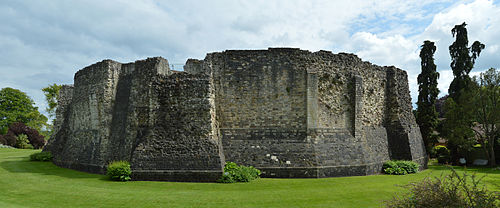
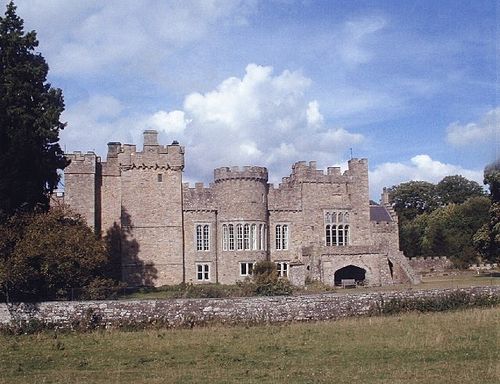
Perched on the raised earthworks of a former Roman fort, the castle reads as a long curtain wall of warm red-brown sandstone with a prominent round tower (Clifford's Tower) at one corner and several stepped bases and rectangular window openings. The curtain has tall arched windows and compact, angular towers and buttresses; it sits on a grassy mound overlooking the Eden valley, with a cobbled bailey behind the outer wall and complete battlements at its prime.
Its story
The story of Brough Castle.
William Rufus Builds in the Roman Fort, 1091-1092
Brough stands inside Verterae, a 3-acre Roman fort guarding the Stainmore Pass from the River Eden across the Pennines and the Roman road to Carlisle. The north-west was contested border country between the Normans and the Scots. William Rufus invaded in 1091 and built the castle around 1092 in the north part of the old fort, reusing its earthworks: a motte and bailey with a timber keep on stone foundations, the rest of the enclosure made a palisaded bailey. The planned village of Church Brough was laid out beside it.
William the Lion Takes the Keep, 1173-1202
In 1173 William the Lion of Scotland invaded as part of the Great Revolt against Henry II. His army failed at Wark and Carlisle, took Appleby and turned on Brough. Six knights guarded it and resisted, but William took the outer defences and besieged the keep, threatening to execute the garrison if it was not surrendered. The keep was set on fire and the garrison surrendered; one knight, in Jordan Fantosme's chronicle, fought on with spears and then wooden stakes until he was overwhelmed. William had Flemish mercenaries destroy what defences remained; Brough was recovered after Henry II's forces defeated him at Alnwick.
Henry II had a square stone keep built in the 1180s, first by Theobald de Valoignes and then by Hugh de Morville, who rebuilt the rest of the castle; it was set into the bailey wall so that it directly supported the outer defences. Thomas de Wyrkington worked on for King John from 1199 to 1202, converting the castle entirely into stone.
The Vieuxponts and the Coming of the Cliffords, 1203-1333
King John granted the lordship of Westmoreland, including Brough, to Robert de Vieuxpont in 1203, and he enlarged the castle to exert his authority. He died in 1228 owing the Crown £2,000, leaving the castle to his young son John; his guardian, Hubert de Burgh, put the Prior of Carlisle in to run the estate, and the castle fell into ruin.
John died supporting the rebels in the Second Barons' War of 1264-67, and his lands were split between his daughters Isabel and Idonea. Isabel took Brough; Henry III gave Roger de Clifford guardianship of some of these lands, and Roger married her, beginning a long Clifford tenure. By 1333 the Cliffords had recombined the Vieuxpont estates and controlled the Eden valley from Appleby, Brougham, Pendragon and Brough.
Clifford's Tower, Bannockburn and the Wars of the Roses, 1308-1485
Robert Clifford held Brough by about 1308 and improved the defences, rebuilding the east wall and raising a new hall beside his apartments in a new circular tower, Clifford's Tower. He died fighting the Scots at Bannockburn, and the country around was attacked in 1314 and 1319, damaging Church Brough.
In the 1380s Roger, the fifth baron, rebuilt the south wall and replaced the hall with a more fashionable first-floor hall and chamber block. Around 1450 the gatehouse was reinforced with buttresses and a further courtyard built within the bailey, possibly by Thomas Clifford. The family took the Lancastrian side in the Wars of the Roses: Thomas died in 1455 and John in 1461, and the Yorkists held Brough until John's son Henry was restored by Henry VII in 1485.
The Christmas Fire and Anne Clifford's Rebuilding, 1521-2010
Henry Clifford used the castle until 1521, when fire broke out after a lavish Christmas feast and destroyed the habitable parts. He died shortly afterwards, and Brough stayed ruined for many years.
Lady Anne Clifford, a major Clifford landowner, retired north during the Commonwealth; a royalist, she was protected by powerful friends in the Parliamentary faction. She worked at Brough between 1659 and 1661, more than anywhere else on her estates, aiming to restore its pre-1521 condition and to recreate 12th-century features in the keep, which she renamed “the Roman Tower” in the belief the Romans had built it. It had 24 fireplaces by 1665, the year she first spent Christmas there. In 1666 another fire left it uninhabitable; the remaining bailey buildings became a law court, and Anne died in 1676 with the castle unrestored.
Anne's daughter Margaret had married John Tufton, Earl of Thanet, and John's son Thomas stripped the castle around 1695 to supply rebuilding Appleby. The furnishings were sold in 1714, and in 1763 much of Clifford's Tower's stone was plundered for Brough Mill; the castle was then abandoned. The south-west corner of the keep partly collapsed around 1800, and in 1920 more came down; the owner, Lord Hothfield, gave the property to the Office of Works; the ruins were stabilised. A listed building and scheduled monument, it is run by English Heritage as a tourist attraction; in 2010 English Heritage judged its condition to be declining.
Step inside
10 places to explore in 1390.
The record describes 10 distinct spots at Brough Castle, including 4 interiors: first-floor hall and chamber block, apartments in clifford's tower (bedchambers), solar and private chambers and more. Create your own photoreal reconstruction and explore every one, more scenes means more rooms, more angles, and more of the place to stand in.
Build Your Own Castle
Recreate Brough Castle with AI to explore it.
The artist rebuilds it as it stood in 1390, a photoreal reconstruction that belongs to you alone. Pay with coins, no subscription needed.
Recreate this castle →Defend this castle →Whose castle
Clans who held Brough Castle.
The families that held Brough Castle for a decade or more across its history, follow a name to its clan.
Vieuxpont
Granted the lordship of Westmoreland, including Brough, by King John in 1203; Robert de Vieuxpont enlarged the castle.
Clifford
In possession from the 1260s after the Second Barons' War; Lady Anne Clifford restored the castle in 1659–61.
From the archive
Brough Castle on paper: the measured plan and period views.
The survey plan and photographs below are the ground truth this page's reconstructions are checked against, drawn and photographed while the castle was still a working garrison. Every image is public-domain or openly licensed, with its source named.
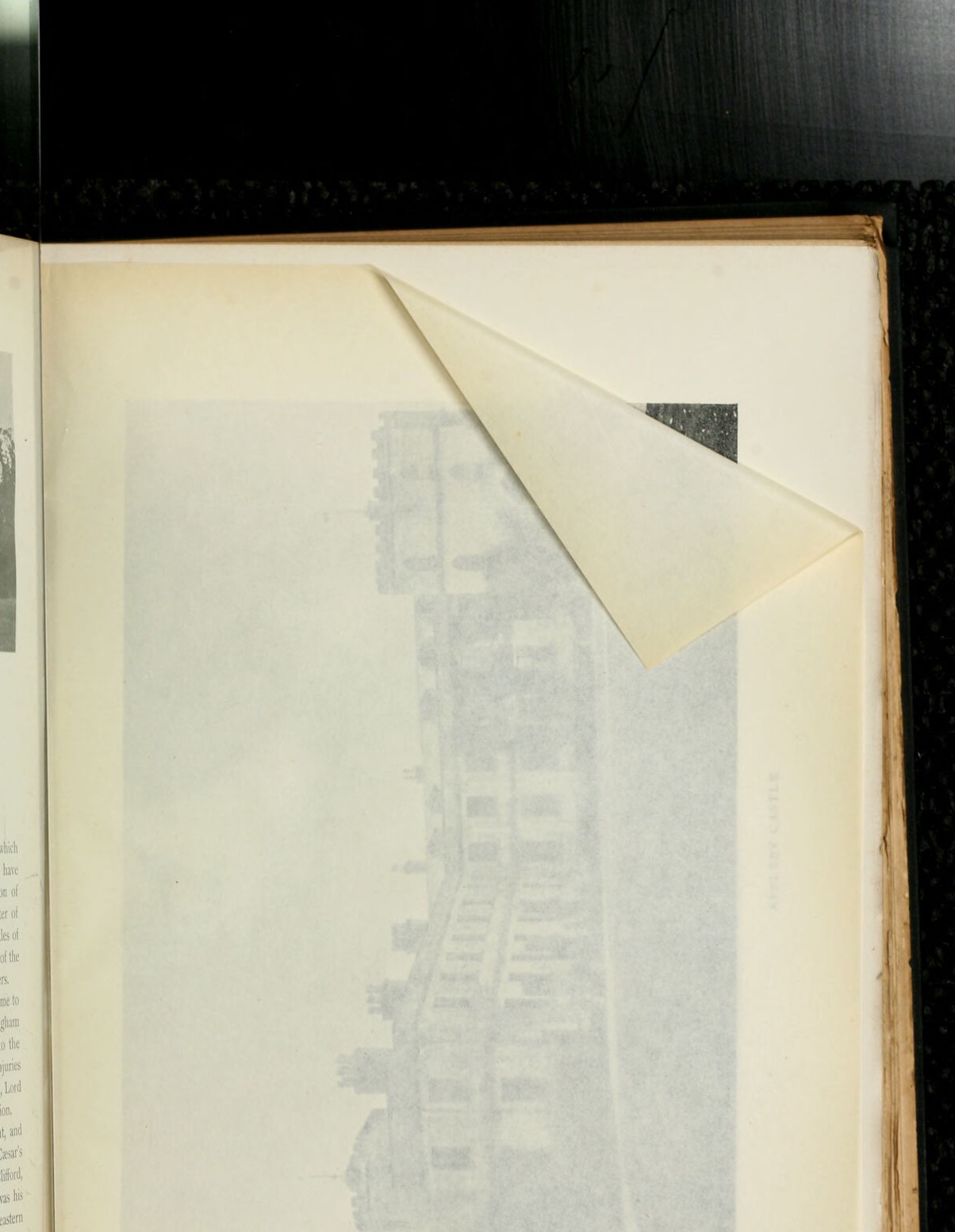
Brough Castle
1897 · J. D. Mackenzie, The Castles of England, vol. 2 (1897)
Public domain